NASA spots a ‘break’ in one of the Milky Way’s spiral arms

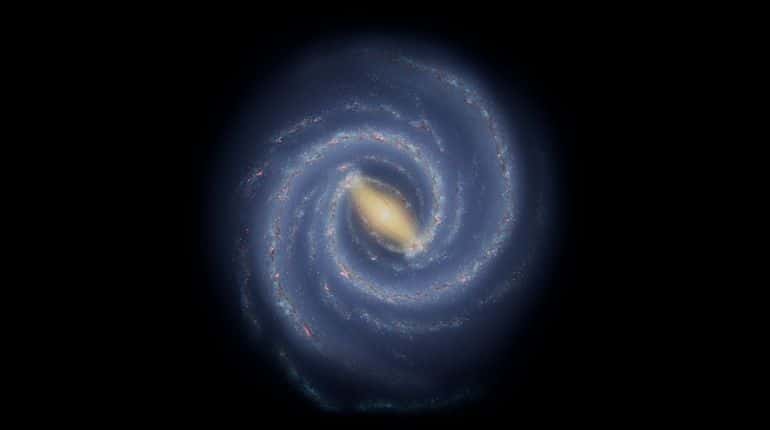
Large-scale structure of the Milky Way
The National Aeronautics and Space Administration (NASA) has spotted acontingent of young stars and star-forming cloudsjutting out from the Milky Way's Sagittarius Arm.
Stretching some 3,000 light-years, this is the first major structure identified with an orientation so dramatically different than the arm.
Until now, the understanding of the galaxy’s shape had been based upon indirect measurements of celestial landmarks within the Milky Way and inferences from structures observed in other galaxies populating the universe.
The Milky Way began to form relatively soon after the Big Bang explosion that marked the beginning of the universe some 13.8 billion years ago.
Astronomers have a rough idea of the size and shape of the Milky Way’s arms, but much remains unknown: They cannotsee the full structure of our home galaxy because Earth is inside it.
NASA used its Spitzer Space telescope to detect infrared light that can penetrate those clouds, while visible light (the kind human eyes can see) is blocked.
Young stars and nebulae are thought to align closely with the shape of the arms they reside in. To get a three-dimensionalview of the arm segment, the scientists used the latest data release from the ESA (European Space Agency) Gaia mission to measure the precise distances to the stars.
The combined data revealed that the long, thin structure associated with the Sagittarius Arm is made of young stars moving at nearly the same velocity and in the same direction through space.
Michael Kuhn, an astrophysicist at Caltech and lead author of the new paper, said ''A key property of spiral arms is how tightly they wind around a galaxy.''
This characteristic is measured by the arm’s pitch angle. A circle has a pitch angle of 0 degrees, and as the spiral becomes more open, the pitch angle increases.
''Most models of the Milky Way suggest that the Sagittarius Arm forms a spiral that has a pitch angle of about 12 degrees, but the structure we examined really stands out at an angle of nearly 60 degrees.''
Similar structures,sometimes called spurs or feathers,are commonly found jutting off the arms of other spiral galaxies. For decades scientists have wondered whether our Milky Way’s spiral arms are also dotted with these structures or if they are relatively smooth.
The Milky Way, spiral-shaped with a central bar-like structure composed of stars, includes 100 to 400 billion stars, including the sun.
(With inputs from agencies)