

&imwidth=800&imheight=600&format=webp&quality=medium "NASA's asteroid-bound spacecraft sends its last laser message from deep space. Here's why that matters")
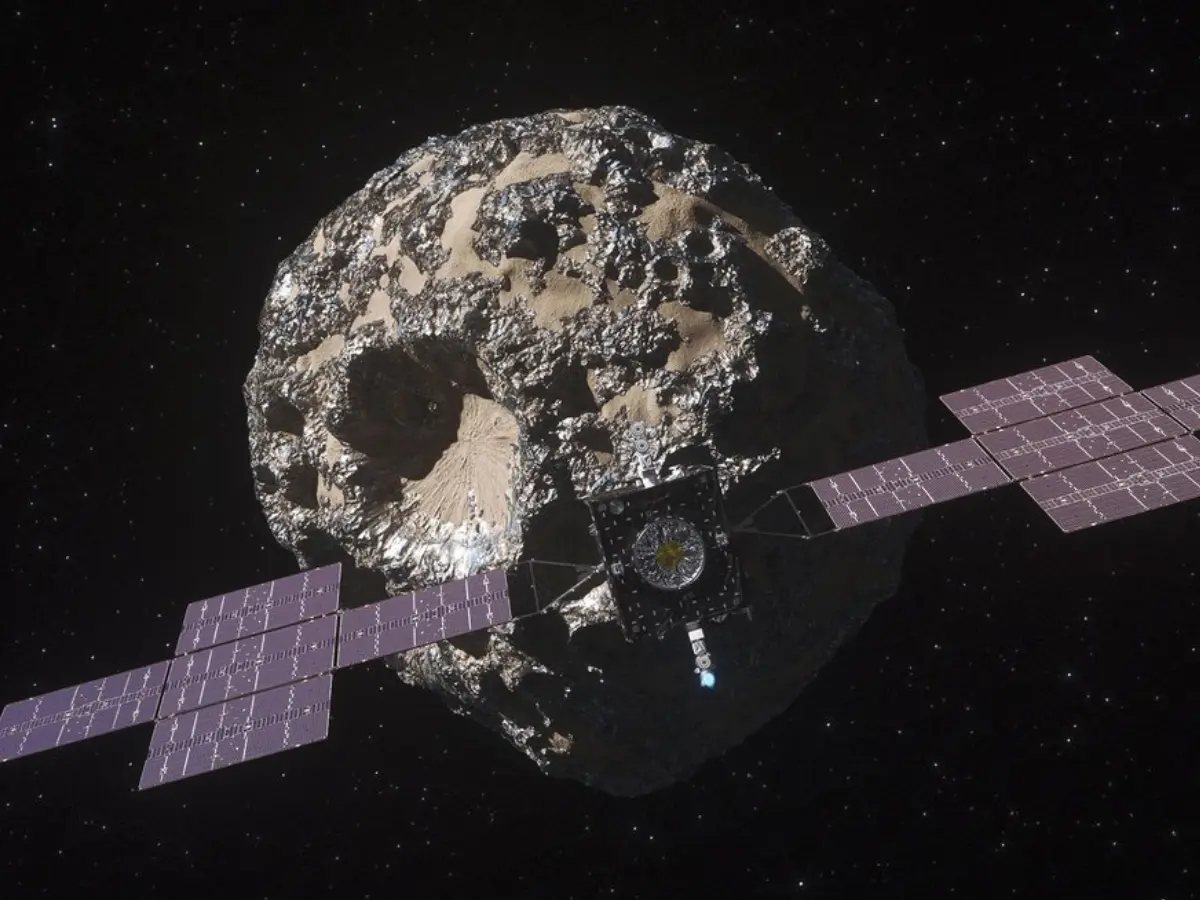
NASA's Psyche spacecraft has sent its final laser downlink signal from a distance of 350 million kilometres in space. This is a new milestone in the field of space communications. The infrared laser message was beamed in December 2024 from a distance of 494 million kilometres, a point which is more than twice the average distance between Earth and Mars. That's more than 1,285 times the distance between Earth and the Moon. Psyche is going to the asteroid belt to study one particular space rock. It has been tasked with exploring the metal-rich asteroid 16 Psyche, a remnant of planetary formation, which can offer insights into the building blocks of terrestrial planet cores. The 65th message sent by Psyche was its last laser message before it started working on its mission. It is a big achievement for NASA's Deep Space Optical Communications (DSOC) technology test.
From here on, Psyche will use more standard radio communications to downlink data back to Earth. Acting NASA Administrator Sean Duffy said, "NASA is setting America on the path to Mars, and advancing laser communications technologies brings us one step closer to streaming high-definition video and delivering valuable data from the Martian surface faster than ever before." The difference between the date the message was sent and when it was received comes down to Psyche's place in solar orbit. It is on a path which sometimes brings it closer to Earth and sometimes farther. Also Read: Threat to Earth, speed, age and more: All your questions about interstellar comet 3I/Atlas answered
NASA and future missions
Laser signals and radio transmissions are very different, and NASA has been working on effective communication techniques to further its plans in space and reach beyond the Moon and Mars. While radio communications are reliable, they are relatively slow. DSOC has successfully transferred 13.6 terabytes of data to Earth's ground terminals to date. It even beamed an ultra-high-definition video at 267 megabits per second from a distance of 30.5 million kilometres, a first for NASA.
Experts at the space agency say that the DSOC technology works and can send large amounts of data from the deepest points in space. NASA is hoping to use it in its future Mars mission.

