

&imwidth=800&imheight=600&format=webp&quality=medium "Monster 'cosmic hamburger' shows signs of major activity that points to something huge")
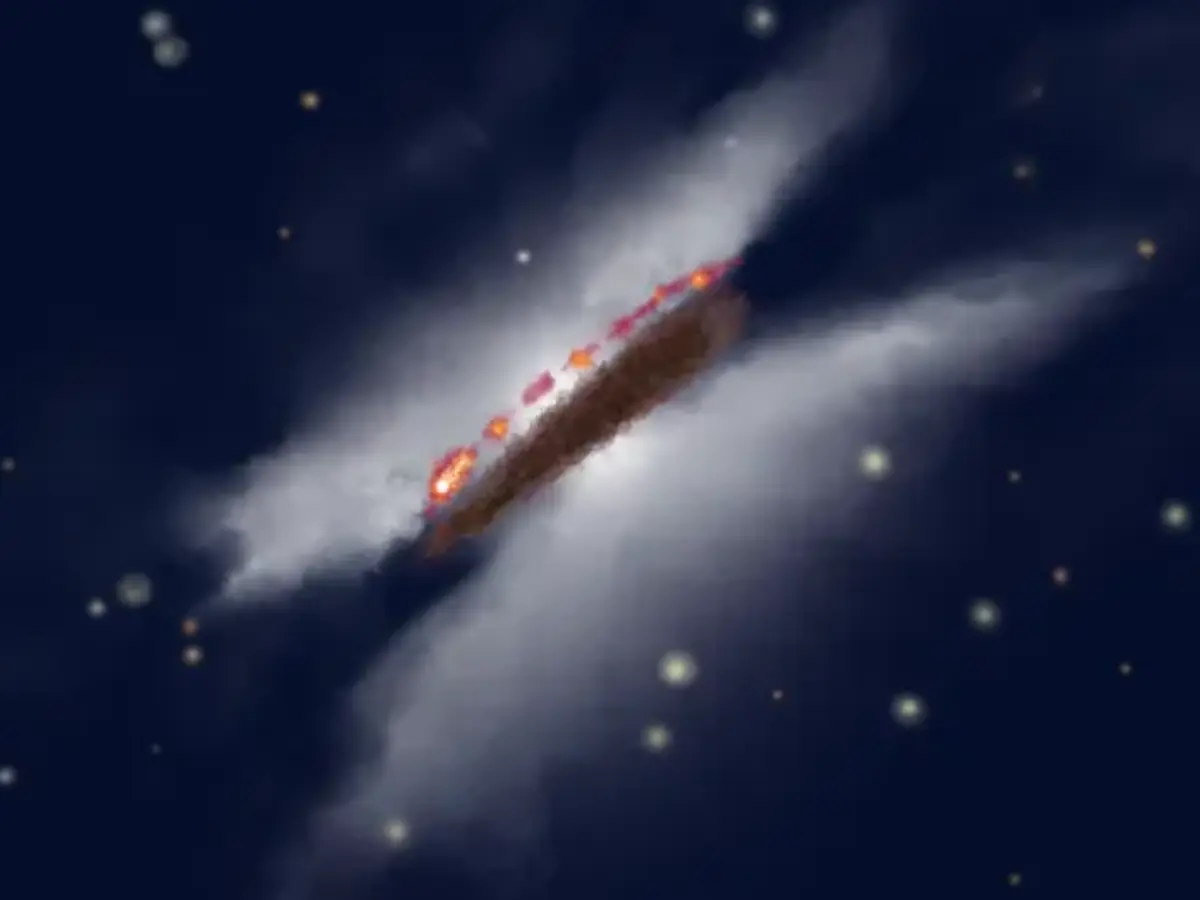
A "cosmic hamburger", one of the biggest planet-forming disks of gas and dust, or protoplanetary disks, has revealed a surprise. Scientists have detected the first signs of planet formation in this system. Known as Gomez's Hamburger (GoHam), its dense gas layers have been spotted with hints that planets might soon be born in this system. GoHam appears like a burger from Earth because it is seen edge-on with stacked layers of gas that look like "buns" rotating around a young star that makes up the "burger" in this case. The dust and other particles sit in the middle, while the gas takes up an enormous amount of space, spreading to a width of 2,000 times the distance between the sun and the Earth. Its height was a mind-boggling several 100 times this area. This makes it the biggest protoplanetary disk ever seen in the universe. The team observed the disk through the Atacama Large Millimeter/submillimeter Array (ALMA), a powerful array of 66 radio antennas located in northern Chile. "GoHam gives us a rare and clear view of the vertical and radial structure of a very large, nearly edge‑on disk," lead researcher Charles Law of the University of Virginia said in a statement.
He added that GoHam is a "benchmark system for testing detailed models of how disks evolve and form planets." He added that it is the "perfect laboratory for understanding how giant planets can form far from their star" because of "the combination of extreme disk size, strong asymmetries, winds, and potential planet formation." They can also understand how the birth of planets "reshapes the surrounding gas and dust."
Also Read: Hive mind meets deep space: Honeybees did MATHS, revealing what an alien’s first words could be
Dust grains, gases and signs of planet formation
Through ALMA, the team was able to map the locations of dust grains and gas molecules in the system. They noted that these elements had placed themselves in distinct layers, and the gases included two forms of carbon monoxide and several sulfur-based molecules. The lightest gas resided above the midplane of GoHam, while the heaviest ones were near the midplane. The enormous amount of dust present in this disk is a sign that it could be home to several planets in the future. This cosmic burger is lopsided, has an extended and brighter dust emission on one side, and traces of a "photoevaporative wind" on the northern side. The former is what will give birth to planets someday. An arc of sulfur monoxide beyond the dust of the disk and only on one side aligns with a dense clump of material labelled "GoHam b". Astronomers believe this is matter collapsing under its own gravity, and possibly the earliest stage of planet formation in the outer disk.

