'Devil comet' throws another surprise as astronomers notice a weird green glow

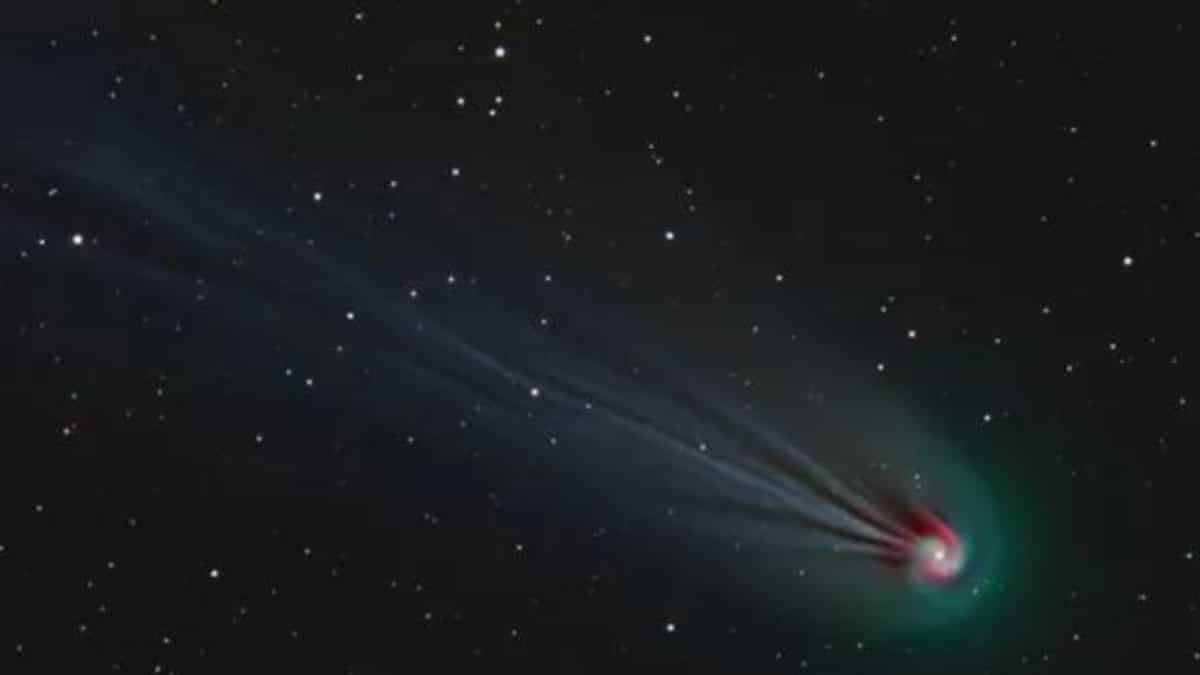
Photograph Clicked By Jan Erik Vallestad
New images show that the massive "devil comet" that will soon pass by Earth has a hidden spiral of light surrounding its large icy core. The glowing green swirl was detected with the help of photo editing techniques and would have likely gone unnoticed otherwise.
The comet 12P/Pons-Brooks circles the sun every 71 years in a highly elliptical orbit and is made of ice and rock. It is currently approaching the sun, according to Spaceweather.com.
12P is a comet that, like most others, has a core that contains ice, gas, and dust. This core is surrounded by a frozen shell or nucleus. The nucleus is also enveloped by an icy dust cloud called a coma. This coma slowly leaks out of the comet's interior. However, 12P is a cryovolcanic comet. It frequently erupts when solar radiation causes large fissures to open in its nucleus. When this happens, the comet sprays its highly pressurized icy insides, called cryomagma, into space. As a result, its coma expands significantly, making the comet appear much brighter than usual for a short period.
In July of last year, 12P became a topic of interest among astronomers when they observed it erupt for the first time in almost seven decades. Since then, the comet has continued to erupt at a fairly frequent rate. During its initial eruptions, the comet's expanded coma had an irregular shape caused by a notch in the nucleus that blocked cryomagma outflow. This gave the comet the appearance of having demonic horns, which led to its sinister nickname. However, during more recent eruptions, these horns seem to have disappeared.
As the comet 12P approaches closer to the sun, its coma has become much more visible. This coma has a green hue due to the presence of high levels of dicarbon, which is a molecule consisting of two carbon atoms stuck together. Additionally, a sizable tail made up of dust and ice has also grown, which is blown away from the coma by the solar wind. As a result, astrophotographers are now able to capture much more striking and visually appealing shots of the comet.
Astrophotographer Jan Erik Vallestad took some remarkable images of 12P and its long tail on March 9 from Norway. He used specialised software to emphasise the changing intensity of the coma's light and discovered a previously unknown spiral within its coma. The images are highly detailed and provide an excellent view of the comet.
The spiral structure is also visible in images taken by Juris Seņņikovs, an astrophotographer based in Latvia. He used the imaging technique used by Vallestad to capture the structure.
The spiral shape is likely caused by small geysers on 12P's surface, which are pumping out streams of cryomagma. As the comet spins, these icy jets are being twisted into the swirls that are visible in the new photos.
(With inputs from agencies)