Longest-ever cosmic radio signal lasting nearly an hour likely coming from...

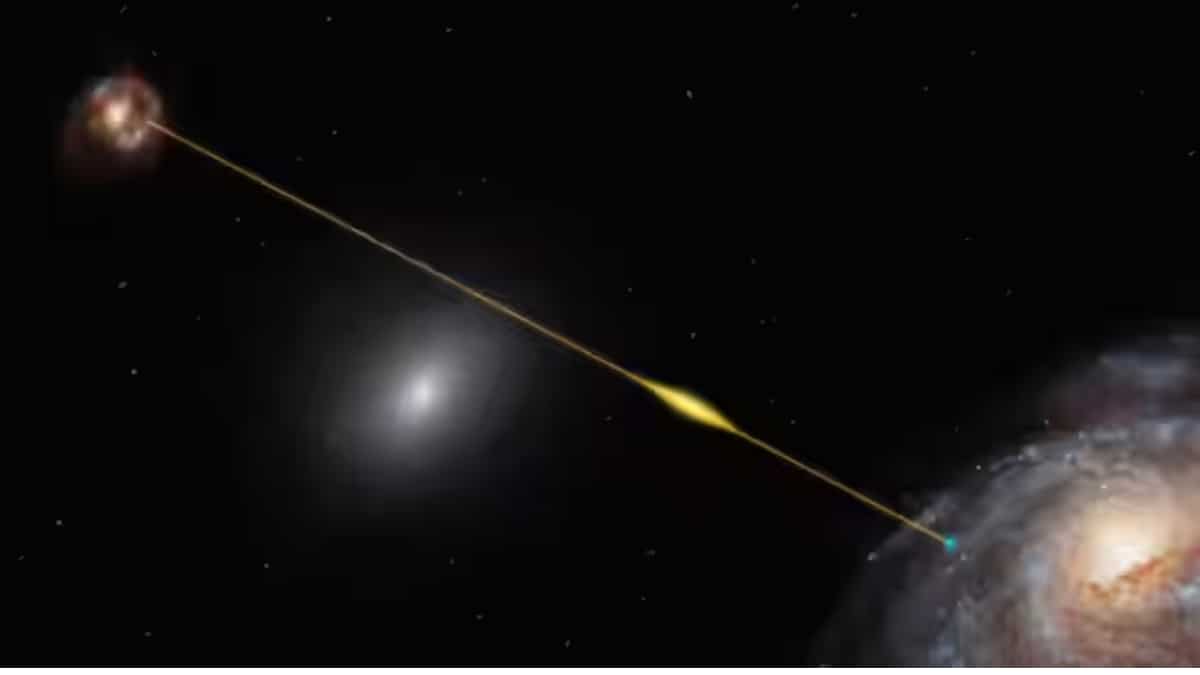
Radio signal representative image
Astronomers recently discovered the longest radio signal in space that is either coming from a neutron star or a unique white dwarf. It has a cycle of nearly an hour which has stumped scientists.
Rotating neutron stars, known as pulsars, are believed to be the reason for most of these radio signals. They are like cosmic lighthouses, rotating at extreme speeds.
It is common for radio telescopes to capture brief bursts of radio waves from distant parts of the universe. All of these “radio transients" exhibit different patterns. While some only shoot a signal once and never return, others blink regularly.
However, the latest radio signal recorded has a cycle that is nearly an hour long. Named ASKAP J1935+2148, it is the longest cosmic signal ever recorded.
Astronomers observed it for a long time and noticed that sometimes it produced long, bright flashes, and also weak, rapid pulses. They even found it to be not emitting any signal at all on some occasions.
The findings have been published in Nature Astronomy.
The researchers are still trying to figure out the source of this radio signal which they believe is likely coming from a highly unusual neutron star.
The highly unusual radio pulse was discovered using CSIRO’s ASKAP radio telescope in Wajarri Yamaji Country in Western Australia. They spotted the signal slowly flashing while monitoring a source of gamma rays and searching for pulses from a fast radio burst.
More observations were carried out over several months, adding the more sensitive MeerKAT radio telescope in South Africa to the equation.
Three distinct modes of radio signals
The study notes that the radio signal belongs to the new class of long-period radio transients and only two such others have ever been found. It has been observed in three distinct modes. Bright, linearly polarised pulses last from 10 to 50 seconds in the first stage, and become much weaker and circularly polarised lasting only about 370 milliseconds in the second state. The third state had no pulses at all.
The astronomers suspect that an interplay of complex magnetic fields and plasma flows from the source with strong magnetic fields in the surrounding space is resulting in three modes.
Either a slow-spinning neutron star is sending out this signal, which is a bigger possibility, or a white dwarf which has slow rotation periods. However, the former seems to be a ripe candidate here since there are no other highly magnetic white dwarfs nearby.

