

&imwidth=800&imheight=600&format=webp&quality=medium "NASA's Artemis II Launch Day Updates LIVE: Crew 'safe, secure and in great spirits'")
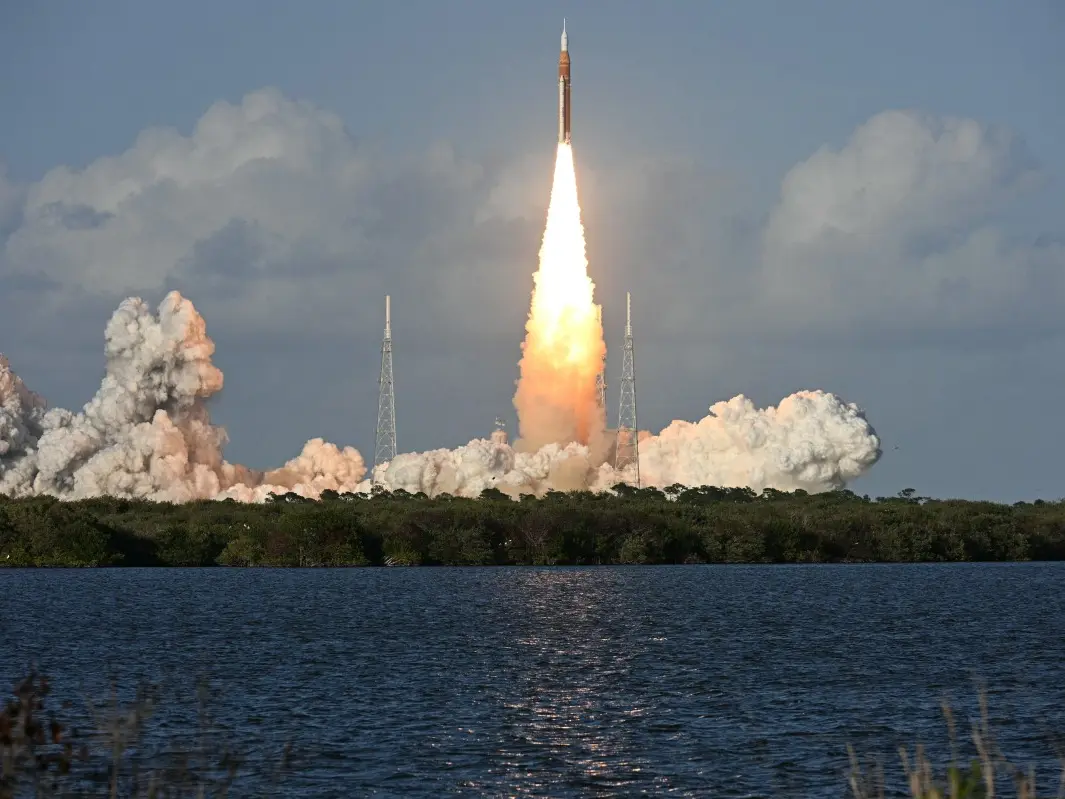
Artemis II Launch Day Updates LIVE: NASA is preparing for a historic mission to the Moon. April 1 will enter history books as the day man started his journey to the Moon once again after 54 years. This is the first time humans are going to deep space since the Apollo 17 mission, which last landed humans on the Moon. The launch will happen from NASA’s Kennedy Space Centre in Florida at 6:24 pm ET on April 1. The launch countdown started Monday at 4:44 pm ET. Live views and audio commentary of tanking operations started at 7:45 a.m. on NASA’s YouTube channel as teams load propellant into the SLS rocket. Orion, named Integrity by the Artemis crew, is the spacecraft that will fly the astronauts to the Moon.
At a press conference hours after the launch, NASA said that the crew is “safe, secure and in great spirits”. Meanwhile, astronaut Reid Wiseman said they had a “great view” shortly after take-off, and "got a great Moonrise".
Artemis II crew—Reid Wiseman, Victor Glover, Christina Koch, and Jeremy Hansen—is currently performing system checkouts and “proximity operations”. They are currently putting the capsule through its first proper manoeuvre in space. Only after these functions are successfully done will the engines be fired for the Trans-Lunar Injection, finally setting Orion on a trajectory to the Moon.
NASA launched the historic mission that will take humans to the moon after over 50 years. The rocket lifted off at 6:35 pm.
A precise series of automated commands to prepare the SLS (Space Launch System) rocket and Orion spacecraft for liftoff at a T-0 time of 6:35 pm EDT is being carried out. This ensures that all systems, starting with propulsion to avionics, transition into flight mode.
The spacecraft is now fully configured ahead of the historic launch. NASA’s Artemis II closeout crew completed its final work and has left Launch Complex 39B at NASA’s Kennedy Space Center in Florida. The team spent hours helping astronauts with suiting up, hatch closure, and performing critical spacecraft checks. Orion spacecraft sealed and ready for flight.
People in Florida and some parts of Georgia will be able to see the rocket from their homes as it takes off for the Moon. NASA shared details of how and when to watch. Full story here
Engineers have fixed the problem identified with communication to the flight termination system. They performed a confidence test to ensure the hardware is functioning before the launch. This system allows sending a signal from the ground to destruct the rocket if it were to veer off course during ascent, so it does not pose a danger to the public.
NASA technicians have completed the launch abort system hatch closure, a step that ensures the Orion spacecraft is fully sealed and ready for flight. The hatch acts as an additional protective barrier for the crew module as the capsule flies towards its target. It also allows for a rapid escape in case of an emergency.
Even as the countdown to the launch continues, a problem that has been identified can make it a no-go. The Eastern Range is trying to fix an issue related to their communication with the flight termination system. This system allows engineers on the ground to send a signal to destroy the rocket if it changes course during ascent. This is crucial to ensure public safety, and if it doesn't work, the launch might become a no-go, NASA said. However, the engineers are testing a solution.
The four astronauts have begun heading to the launch pad ahead of the launch window, which is scheduled to open shortly after 23:20 BST (18:20 local time). The Artemis II astronauts stepped outside the Neil A. Armstrong Operations and Checkout Building at NASA’s Kennedy Space Center at 1:50 p.m. ET. The crew members were greeted by a cheering crowd of NASA staff, as well as members of the media and their families.
NASA announced at 12:23 p.m. ET that it had completed the fast fill of liquid oxygen into the Space Launch System rocket's upper stage — a milestone in its tanking operations.
Astronauts in space carry a soft toy that acts as a zero-gravity indicator to give them a clear visual signal that the vehicle has reached weightlessness (microgravity). It is a small, lightweight object, mostly a plush toy. Artemis II astronauts are taking a small round face plushie wearing a cap. It has a micro SD card with the names of 5.6 million people.
Rise, zero-gravity indicator for Artemis II

The fast fill of liquid oxygen (LOX) into the interim cryogenic propulsion stage is currently going on as part of NASA's Artemis II countdown. During this stage, the oxidiser is rapidly loaded after chilldown is complete. This sets up the SLS (Space Launch System) rocket upper stage to send the Orion spacecraft into a high Earth orbit.
Artemis II will carry the names of 5.6 million people to the Moon when Orion is launched on the evening of April 1. A micro SD card with the names was placed inside Rise, their zero-gravity indicator.
Artemis II is currently in its final countdown for launch today, April 1, 2026. The process of chilldown happened in the morning after the tanking sequence started. It is a critical process of thermally conditioning the rocket's hardware to handle super-cold cryogenic propellants. The Space Launch System (SLS) uses liquid hydrogen and liquid oxygen, but the pipes in the rocket are warm. If these liquids are put into "warm" pipes at ambient temperature, a catastrophic thermal shock could occur, potentially warping or cracking the metal.
Tanking operations started at 7:45 am and can be seen live on NASA’s YouTube channel. During this time, reams will load propellant into the SLS rocket. Full coverage for the mission launch will start on NASA+ at 12:50 pm.
Fuelling is preceded by replacing the oxygen-rich atmospheric air inside the rocket's internal cavities with gaseous nitrogen. This process serves two primary functions. First, it prevents fire. By displacing oxygen, nitrogen creates a non-combustible environment, neutralising the risk of accidental ignition. It also serves the purpose of contamination control. Removing moisture and impurities protects sensitive internal systems from corrosion or freezing during the next phase of operations.
On Wednesday morning at NASA’s Kennedy Space Center in Florida, engineers completed the air-to-gaseous nitrogen changeover and cavity inerting. This critical procedure ensures both crew safety and the structural integrity of the launch vehicle.
7:45 am: Live coverage of tanking operations to load propellant into the SLS rocket begins.
12:50 pm: NASA+ coverage of launch begins.
6:24 pm: Launch from Kennedy Space Center in Florida at EDT on Wednesday, April 1.
Artemis Launch Director Charlie Blackwell-Thompson gave the official “go” for tanking at 7:33 am ET. Teams started loading propellants into the SLS (Space Launch System) rocket. This step begins with the chilldown of the core stage liquid oxygen and liquid hydrogen transfer lines.

