

&imwidth=800&imheight=600&format=webp&quality=medium "3I/ATLAS Live Tracker: When will interstellar comet emerge from Sun's glare?")
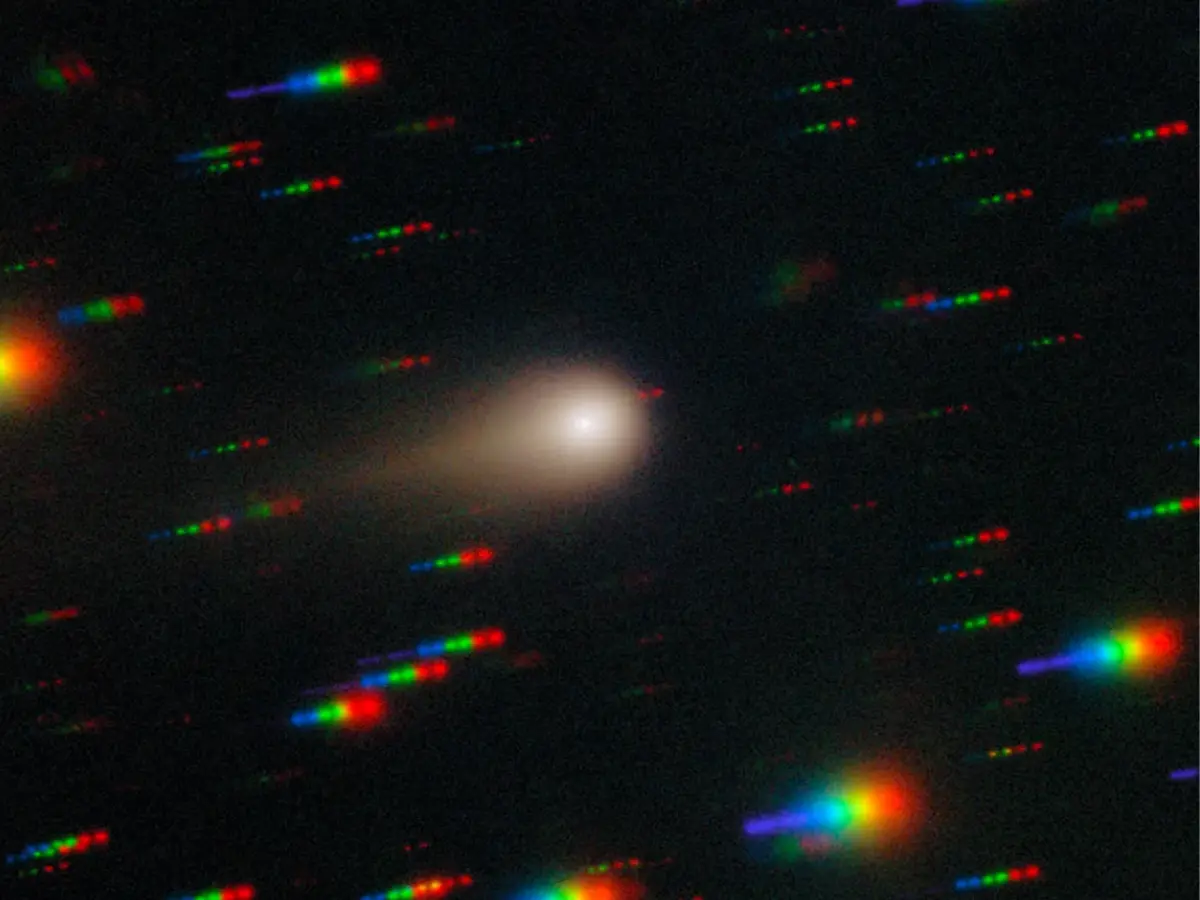
A photo of 3I/ATLAS taken by the Lowell Discovery Telescope on October 31, 2025, shows the interstellar comet after it emerged from the Sun's glare. The comet's encounter with the Sun offered multiple fresh insights into this alien visitor. It sudden increase in brightness, change in colour and non-gravitational acceleration have added to the mysteries around it as scientists try to explain the reason for the several anomalies. Harvard scientists Avi Loeb says the Sun should have changed 3I/ATLAS in several ways, and if they do not see what they think it should exhibit, then the interstellar comet might have a tenth anomaly.
The interstellar comet will most likely become visible again by mid-November. However, prior to this, there will be certain telescopes and spacecraft that will be monitoring it and might get a peek at the comet.
The European Space Agency’s Jupiter Icy Moons Explorer (JUICE) is gearing up to study 3I/ATLAS in November. In fact, the window runs from November 2 - 25. At its closest point, the spacecraft will be 64 million kilometres from the interstellar comet. There will be two observations, with the first one happening on November 4. Notably, JUICE is visiting Jovian moons Ganymede, Callisto, and Europa and will reach them in early 2030s.
Scientists think that interstellar travel could have changed 3I/ATLAS. There are likely “oddities in its nucleus properties like composition, shape, or structure”, which could have affected how it behaved near the Sun, and even at a far-off distance. Notably, the comet brightened unexpectedly near the Sun. It was also observed releasing water at a distance from the Sun, where comets typically do not become very active. Qicheng Zhang of Lowell Observatory and Karl Battams, an astrophysicist at the Naval Research Laboratory (NRL), say interstellar travel could have changed 3I/ATLAS. However, this could also be because of the design of its original planetary system.
Harvard scientist Avi Loeb recently added a ninth anomaly to 3I/ATLAS. Now, he says it could soon have a tenth oddity. He wrote in a blog post that the interstellar object should have a massive debris cloud measuring about 5 billion tons when it is again observed from Earth. This is because the non-gravitational acceleration could have resulted in it losing 15% of its mass.But if a huge plume of gas is missing around 3I/ATLAS, then non-gravitational acceleration would become a tenth anomaly.
Zhang and Battams say that the “oddities in nucleus properties like composition, shape, or structure” of 3I/ATLAS were likely the reason for its sudden brightening near the Sun. They say the comet might have acquired these properties from its host system or over its long interstellar journey. "Without an established physical explanation, the outlook for 3I's postperihelion behaviour remains uncertain, and a plateau in brightness — or even a brief continuation of its preperihelion brightening — appears as plausible as rapid fading past perihelion."
We all know that 3I/ATLAS is an interstellar object, meaning it is travelling from outside our solar system. So it is normal for it to exhibit different properties as compared to the comets that move around in our star system. Qicheng Zhang of Lowell Observatory and Karl Battams, an astrophysicist at the Naval Research Laboratory (NRL) in Washington DC, say that if the internal composition of 3I/ATLAS is different from that of the nuclei of Oort cloud comets, it could throw light on the planetary system it is coming from.
Qicheng Zhang of Lowell Observatory and Karl Battams, an astrophysicist at the Naval Research Laboratory (NRL) in Washington DC, wrote in a paper, that the reason for "3I’s rapid brightening, which far exceeds the brightening rate of most Oort cloud comets at similar r [radial distance], remains unclear." They say that this could have happened because of the speed of the comet.
The Lowell Discovery Telescope captured a photo of 3I/ATLAS after it emerged from the Sun. It took the picture on October 31. Meanwhile, the PUNCH mission, a group of small satellites studying the Sun, also took some images of the comet.

