Largest-ever X-ray map of the universe shows over 900,000 cosmic sources of high energy

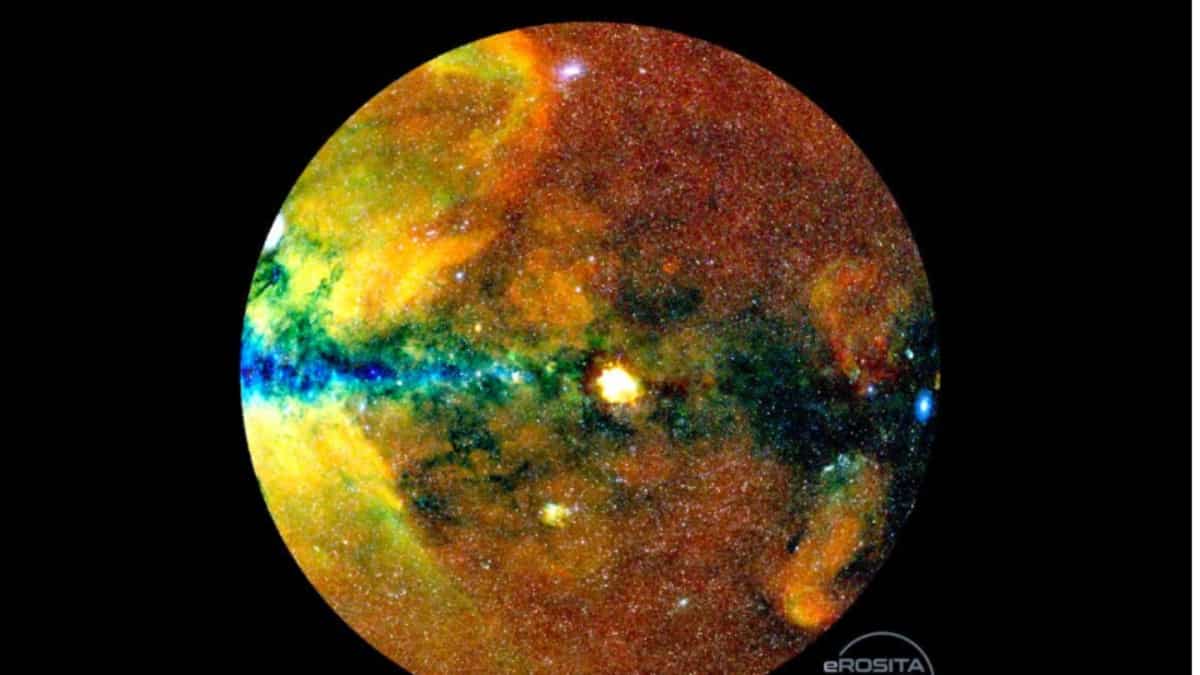
The word 'X-ray' for commoners has (literal) skeletal connotations. Say the word X-ray and we imagine gawking at our bones on black film. But for astronomers, X-ray represent a treasure trove of cosmic information. An object not visible in 'normal' wavelengths of light may emit X-ray and reveal its own secrets.
X-ray astronomy is a full-fledged branch to which peopledevote their entire career. Now a largest-ever X-ray map of the universe has been released. The map has more than 900,000 cosmic sources of high energy andmore than 700,000 supermassive black holes.
The data was published by a German consortium named "eROSITA". The X-ray map, released on January 31, has data collected by eROSITA X-ray telescope which is fitted on Spektrum-RG, a Russian-German satellite.
The Max Planck Society in Germany, which helped the mission, said from its official X handle that the eROSITA All-Sky Survey Catalogue (eRASS1) is the largest collection of X-ray sources ever published till now.
"An X-ray image of half the #universe: the first publication of the eROSITA sky-survey data release makes public the largest ever catalogue of high-energy cosmic sources," said The Max Planck Society in its post.
"In the first six months of observation, eROSITA has already discovered more X-ray sources than have been known in the 60-year history of X-ray astronomy," it added.
Th eROSITA telescope carried out its observations between December 12, 2019, and June 11, 2020.
Other than the 710,000 supermassive black holes. The high-energy cosmic sources (more than 900,000) also comprised 180,000 stars that emitted X-rays. These star are in our Milky Way.
In addition to this the map contains 12,000 clusters of galaxies and a number of X-ray emitting celestial objects from other exotic classes.
"These are mind-blowing numbers for X-ray astronomy," said Andrea Merloni, eROSITA principal investigator,as quoted by The Max Planck Society.
"We've detected more sources in 6 months than the big flagship missions XMM-Newton and Chandra have done in nearly 25 years of operation," she added.
(With inputs from agencies)