Lava spewing from volcano on Galápagos Islands destroying habitat of rare land iguanas

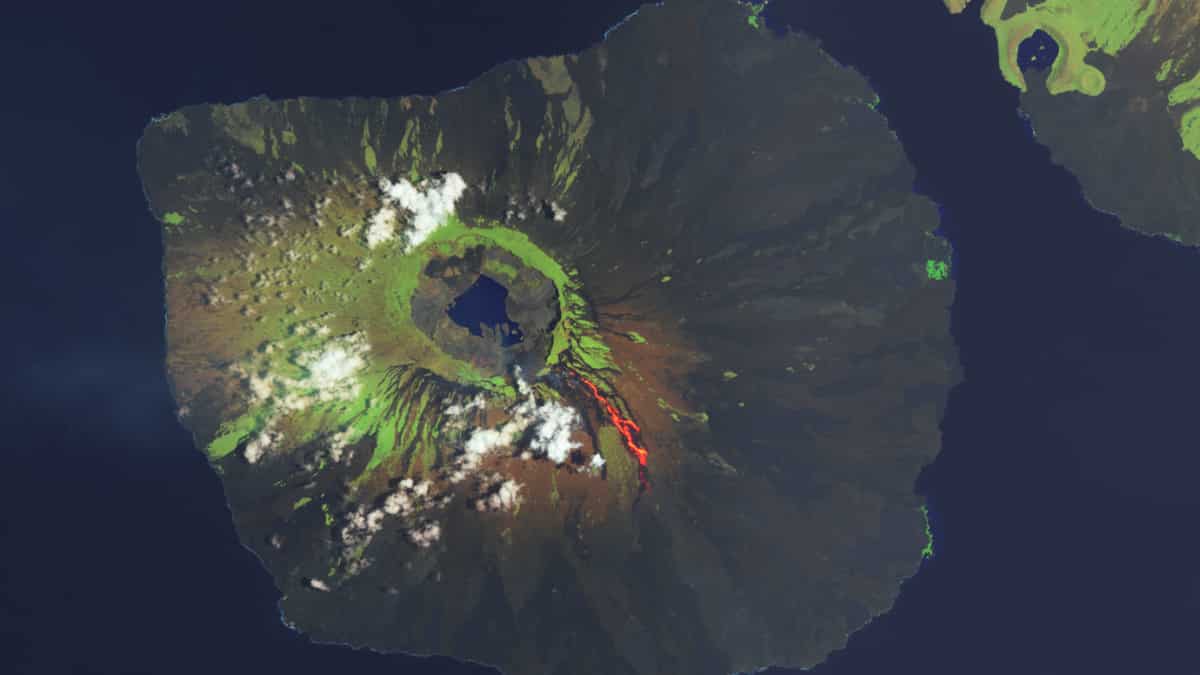
La Cumbre volcano
A striking image of the La Cumbre volcano located on Fernandina Island – the third largest island in the Galápagos Islands – garnered a lot of attention when it first erupted last month. But as of late April, the lava is still flowing and making its way down the iguana-covered mountain which is affecting their habitat.
About the volcano and its eruption
The La Cumbre volcano is located around 1,125 kilometres off mainland Ecuador and erupted for the first time since 2020, on March 2, according to Live Science.
The images taken by NASA’s Earth Observatorylast month, showed the lava slowly making its way out of a fissure near the summit of the volcano and into the mountain’s tree-covered slopes.
As of early April, a report by the Galápagos Conservancy, a United States-based nonprofit dedicated to the protection and restoration of the islands, said that the lava had made its way to the ocean.
Notably, after more than a month of continuous activity the lava reached the sea after covering a distance of nearly 10 kilometres, said the organisation.
An image posted by the Galápagos Conservancy shows plumes of white smoke risingfrom the water as the lava falls into the ocean.
Impact on Galápagos land iguanas
Since Fernandina – the most volcanically active island among the Galápagos Islands – is uninhabited, there is no risk to people or infrastructure, but the lava flow reportedly has proven to be a spectacle for people on passing ships.
The island is also home to a large population of rare land iguanas which nest and lay eggs on the rim of the volcano’s large crater or caldera and deep within it.
According to NASA, these yellow reptiles, which can grow to over one metre (3 feet) in length and weigh over 14 kilograms, mostly eat the fruit and leaves of the prickly pear cactus.
Since the eruption, the Galápagos National Park rangers and Geophysical Institute (IG) have been in touch to monitor this spectacle closely, reported the Galápagos Conservancy.
Researchers who are monitoring this volcanic eruption, according to the US-based organisation, said that the lava flow has damaged the island’s endemic vegetation, including the habitat of the land iguanas.
They also reportedly warned that as the lava flows into the ocean, it could potentially damage marine life.
A report by Live Science citing data from the Smithsonian Institute’s Global Volcanism Program said that as of April 25, the lava is still flowing with no end in sight.
“Our mission at Galápagos Conservancy is to safeguard the distinctive wildlife of the Galápagos archipelago,” said Dr. Jorge Carrión, Director of Galápagos Conservancy, in a statement.
He added, “We are watchful and prepared to offer assistance if required, but we also comprehend that this is a natural occurrence, and our primary responsibility is to observe the alterations.”
(With inputs from agencies)