Jupiter is currently emitting more light than our brightest star Sirius!

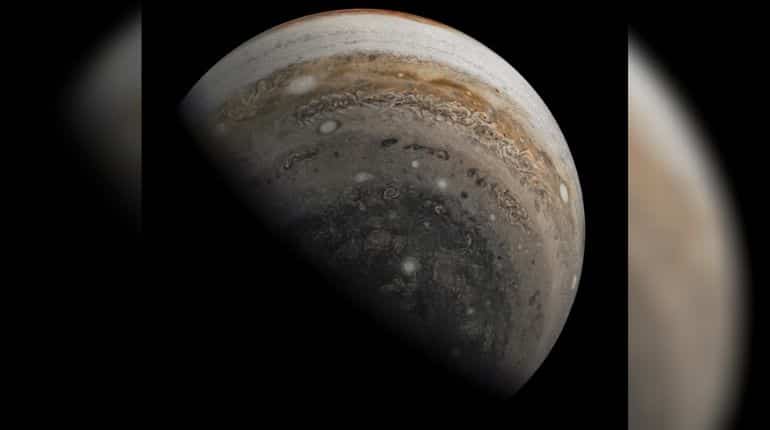
This NASA image released on December 3, 2019 shows just after its close flyby of Jupiter on November 3, 2019, what NASA's Juno spacecraft caught in this view of Jupiter's southern hemisphere as the spacecraft sped away from the giant planet.
Throughout this week, Jupiter will be at its brightest in the sky. The planet will reach “opposition” last night (July 14), which implies that the planet will now be directly opposite the sun in the sky, and the nearest to Earth.
Due to this, the planet will be visible with the naked eye in the constellation Sagittarius for the whole month. People in North America will be able to see the constellation. One can follow the Summer Triangle asterism to find the constellation if you’re unable to find it. This can be achieved by imagining a line from the Deneb star, and then through the Altari star, through which one could locate the constellation.
Leave the city!
To get the best view of the planet, one should get out of the city lights, and buildings around the city. Also, once you are able to reach a pitch dark location, give your eyes 15 minutes to acclimatise to the red filters.

The planet will be visible in the sky immediately after sunset, and will be at a magnitude of -2.7, which denotes the brightness of the planet. The more negative this is, the more bright the planet is. Today, Jupiter will be brighter than the star which emits the most light in the Earth sky - Sirius, a Northern Hemisphere star.
Last night, the planet reached its highest points in the sky around midnight, giving a glimpse of the star.
If you wish to witness the planet’s movement - a pair of binoculars will come in handy! A telescope is also a good accessory to witness the planet’s movement.
However, incase the sky is hazed with clouds and you are unable to witness it, don’t fret. The planet will be visible for the upcoming weeks.
According to a skywatching website - In The Sky, the planet will reach its highest point in the sky every night, but with a haste of 4 minutes over the preceding night. Additionally, it may be witnessed in the evening sky for a few months.