James Webb telescope's stunning click shows spiral-shaped 'FEAST for the eyes'

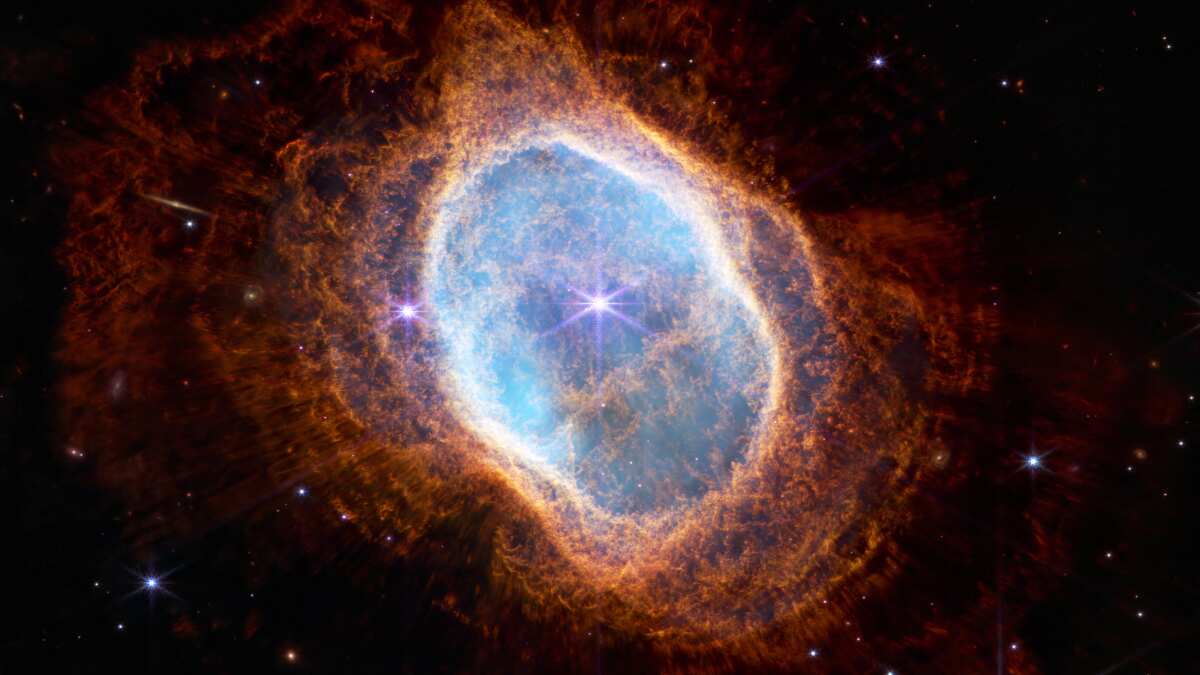
An observation of a planetary nebula from the NIRCam instrument
James Webb Space Telescope clicked an image of a beautiful spiral through its Mid-Infrared Instrument (MIRI). The image shows the galaxy M83.
What is M83 galaxy?
M83 is also known as NGC 5236, and is a type of galaxy with a spiral shape and a bar-like structure in the centre. It's located about 15 million light-years away from Earth.
The galaxy has grabbed the interest of scientists as it potentially offers an insight into how the stars are born.
How MIRI clicks such photographs?
The James Webb Space Telescope's MIRI can see things in a part of light called "infrared," which is different from what our eyes can see. In this image, the bright blue areas in the center show places with lots of stars in M83.
Spiral galaxy M51 via esawebb.org
The bright yellow streaks show where new stars are forming, kind of like star nurseries. The orange-red splashes show places with special carbon-based molecules that MIRI is good at detecting.
FEAST program has been designed to understand galactic phenomena
Scientists use MIRI to look at M83 as part of a program called FEAST, which stands for Feedback in Emerging Extragalactic Star Clusters.
Also watch |James Webb space telescope: Why NASA is being pressured to change its name
The programme aids the understandingto configure how stars are born in the galaxies and how they affect their surroundings.
Stars give out matter and energy as they form, and this is what they call "stellar feedback."
"Stellar feedback is the term used to describe the outpouring of energy from stars into the environments which form them, and is a crucial process in determining the rates at which stars form. Understanding stellar feedback is vital to building accurate universal models of star formation," European Space Agency's official readout states.
By studying this relationship, scientists can improve their models and better understand how stars are born and grow.
The FEAST programme is looking at six different galaxies, and they previously used the JWST to study another galaxy called M51.