James Webb reveals carbon oxides on Uranus' moon Ariel. What does this mean?

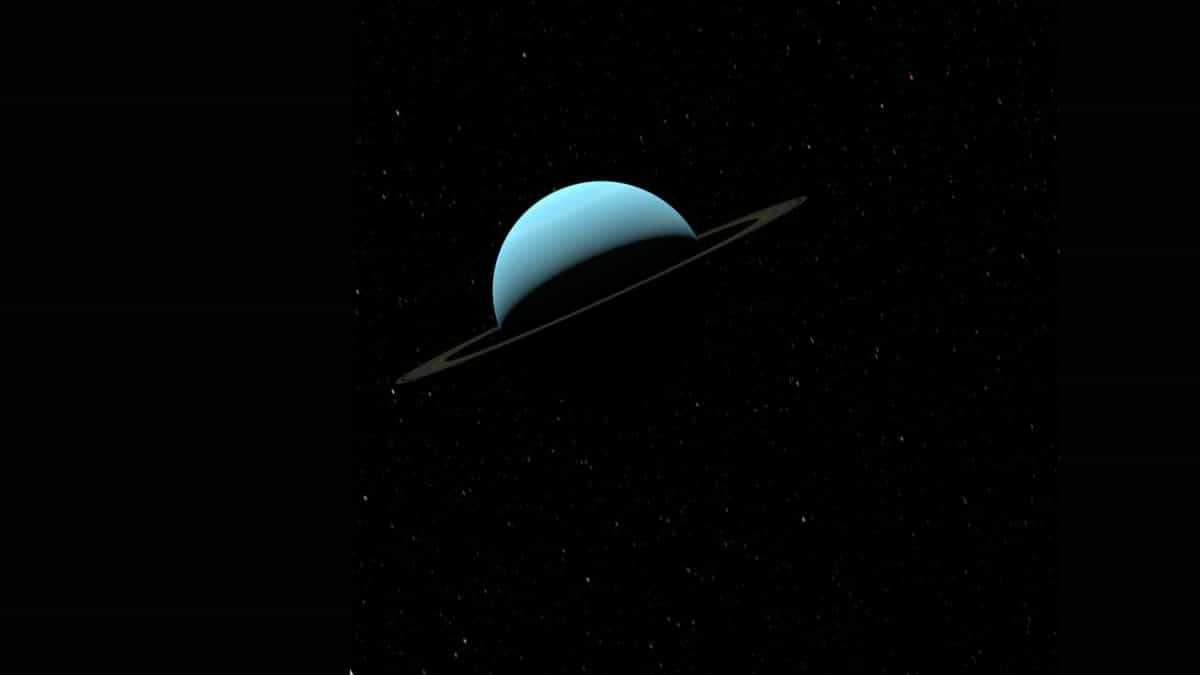
Uranus
James Webb Space Telescope (JWST) found that the surface of Uranus' moon Ariel, which is a candidate ocean world, is coated with a significant amount of carbon dioxide ice. It was discovered on the 'trailing hemisphere'that always faces away from the moon's direction of orbital motion.
The findings of the new study, published on Wednesday (Jul 24) in The Astrophysical Journal Letters, are quite surprising because of the fact that even the far away frigid places in space when carbon dioxide readily turns to gas and is lost to space. The reaches of the Uranian system are 20 times farther from the sun than Earth.
The study mentioned that the "Uranian moon Ariel exhibits a diversity of geologically young landforms, with a surface composition rich in CO2 ice", however, the origin of CO2 and other species remains uncertain.
The study mentioned that thick CO2 ice deposits and the possible presence of carbonates on both hemispheres suggest that some carbon oxides could be sourced from Ariel's interior.
As quoted by phys.org, a research team led by Richard Cartwright from the Johns Hopkins Applied Physics Laboratory (APL) in Laurel, Maryland, said: "It just shouldn't be there. You've got to get down to 30 Kelvin [minus 405 degrees Fahrenheit] before carbon monoxide's stable."
According to Cartwright, the moon has some of the most carbon dioxide-rich deposits in the solar system.
Another surprising discovery among those sediments was the first detectable signs of carbon monoxide. "The carbon monoxide would have to be actively replenished, no question," Cartwright said.
The recent observations suggest that Ariel's surface might potentially contain carbonate minerals, which are salts that are only formed when liquid water reacts with rocks.
As quoted, Cartwright said: "If our interpretation of that carbonate feature is correct, then that is a pretty big result because it means it had to form in the interior. That's something we absolutely need to confirm, either through future observations, modeling or some combination of techniques."
(With inputs from agencies)