ISRO's GSLV to launch next-gen navigation satellite NVS-01 on May 29

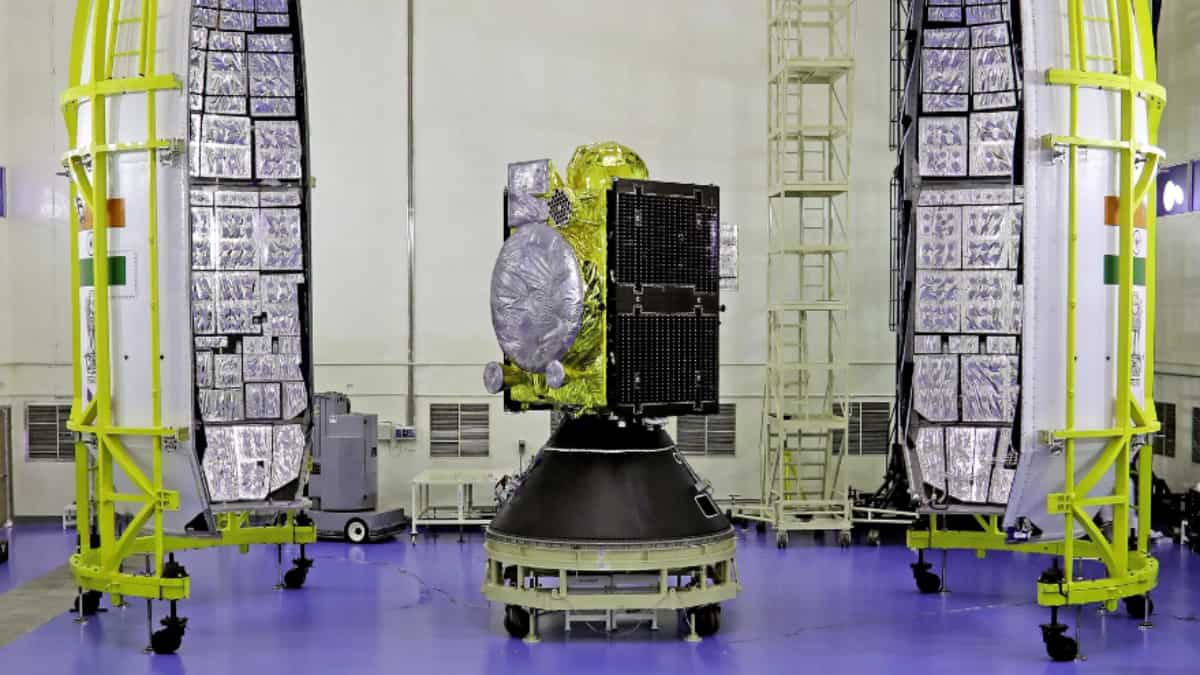
The Indian space agency ISRO will be carrying out its fourth launch mission of calendar year 2023, at 10:42am (local time) on Monday, May 29. In this launch mission, ISRO's medium-lift launcher, the Geosynchronous Satellite Launch Vehicle (GSLV) will be placing a 2,332kg navigation satellite into a Geosynchronous Transfer Orbit(GTO).
The GTO is a temporary parking orbit, into which the satellite will be hurled by the rocket. There on, the satellite will independently use its onboard propulsion systems to perform orbit-raising manoeuvres and reach its intended orbit.
NVS-01 is the first in the series of second-generation navigation satellites built by ISRO's UR Rao Satellite Centre in Bengaluru. At present, India uses its Navigation with Indian Constellation (NavIC) series of satellites for civilian and defence navigation, positioning, and timing services in the Indian mainland and even 1500 kms beyond India's borders.
"NVS series of satellites will sustain and augment the NavIC with enhanced features. This series incorporates L1 band signals additionally to widen the services. For the first time, an indigenous atomic clock will be flown in NVS-01," ISRO said.
Atomic clocks are highly precise timekeeping instruments that are placed within satellites. They offer measurements of time that are precise down to a billionth of a second (nanosecond). Such precision is crucial because they help in offering accurate positioning services. While using satellite-based positioning and navigation services, our position(of the GPS receiver) is determined with respect to its distance from multiple satellites.
When such a calculation happens, the distance is derived by multiplying the time (taken for signal to travel) and the speed of the signal (almost similar to speed of light). In such cases, (when large values are being multiplied) even a variation of a billionth of a second can lead to an inaccurate distance value (by a few meters or tens of meters). Hence it is necessary to have atomic clocks that can work for several years without even nanosecond-level errors in timekeeping.
Earlier, the NavIC series of satellites were known as IRNSS (Indian Regional Navigation Satellite System). It provides two types of services- Standard Positioning Service (SPS) which is provided to all the users and Restricted Service (RS), which is an encrypted service provided only to the authorised users.
According to ISRO, some of the applications of IRNSS/NavIC system are Terrestrial, Aerial and Marine Navigation, Disaster Management, Vehicle tracking and fleet management, Precise Timing etc. According to ISRO, NavIC SPS signals are interoperable with other global navigation satellite system (GNSS) signals such as - GPS, Glonass, Galileo, and BeiDou.
ISRO's current series of eight NavIC satellites were placed in orbit in a phased manner between the years 2013 and 2018 using PSLV rockets. All satellites in the first-generation NavIC series weighed 1,425kg and carried foreign-origin atomic clocks. All IRNSS/NavIC series satellites carried two types of payloads – navigation payload and ranging payload. The navigation payload of transmits signals for the determination of position, velocity and time. Rubidium atomic clocks are part of the navigation payload of the satellite. The ranging payload of these satellites consists of a C-band transponder which facilitates accurate determination of the range of the satellite.
WATCH WION LIVE HERE
You can now write for wionews.com and be a part of the community. Share your stories and opinions with us here.
