‘Invincible’ dinosaur preyed on by mammal: Rare fossil discovery stuns scientists

Dinosaur
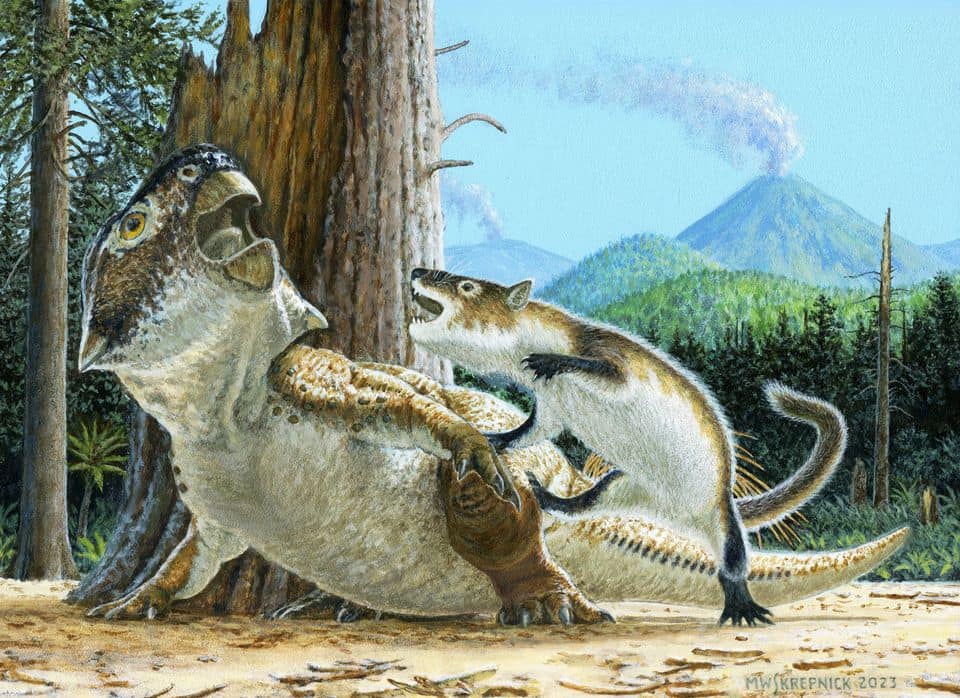
A rare fossil found in China has shed light on the possibility of mammals preying on plant-eating dinosaurs during the Mesozoic Era millions of years ago. The fossil discovered in northeastern China is rare because it shows two animals in an engaging state. Both animals were involved in mortal combat before suddenly being engulfed in a volcanic eruption and getting buried alive.
The four-legged mammal Repenomamus robustus - the size of a domestic cat - was foundferociously entangled with the beaked two-legged dinosaur Psittacosaurus lujiatunensis - as big as a medium-sized dog, Reuters explained.
Dinosaurs- Not always kings
The 125mn-year-old dramatic fossil implies that the food web during the Mesozoic era was much more complex than earlier thought. As per conventional belief, bigger dinosaurs would always prey on smaller mammals. That theory stands challenged today.
Watch:A dinosaur that lived 125 million years ago
"Here, we have good evidence for a smaller mammal preying on a larger dinosaur, which is not something we would have guessed without this fossil," said paleobiologist Jordan Mallon of the Canadian Museum of Nature in Ottawa.
"I think what's key here is that Mesozoic food webs were more complex than we had imagined," Mallon added.
‘Never seen before’
Stressing the significance of the finding, experts noted that this was for the first time that a fossil has shown a mammal preying on a dinosaur.
"There have been specimens of carnivorous dinosaurs preying on plant-eating dinosaurs before, but there has never been an example of a mammal preying on a dinosaur," said Canadian Museum of Nature palaeontologist and study co-author Xiao-chun Wu.
Psittacosaurus (dinosaur) vs Repenomamus (mammals)
Psittacosaurus, an early relative of the horned dinosaur lineage, lacked facial horns and a head crest. Instead, it featured a parrot-like beak, which it used for feeding on plant material.
Repenomamus, one of the largest mammals during the dinosaur age, boasted short and sprawling limbs, along with a long tail, sinuous body, robust skull, and shearing teeth. Paleontologist Mallon compared its appearance to that of a Chinese ferret-badger.
Previous evidence pointed to Repenomamus being a carnivorous predator. In one fossil discovery from the same region, the stomach contents of a Repenomamus specimen revealed the presence of baby Psittacosaurus bones, indicating its dino-eating habits.
WATCH WION LIVE HERE