Look Up! An 'interstellar comet' is nearing Earth and will never be seen again

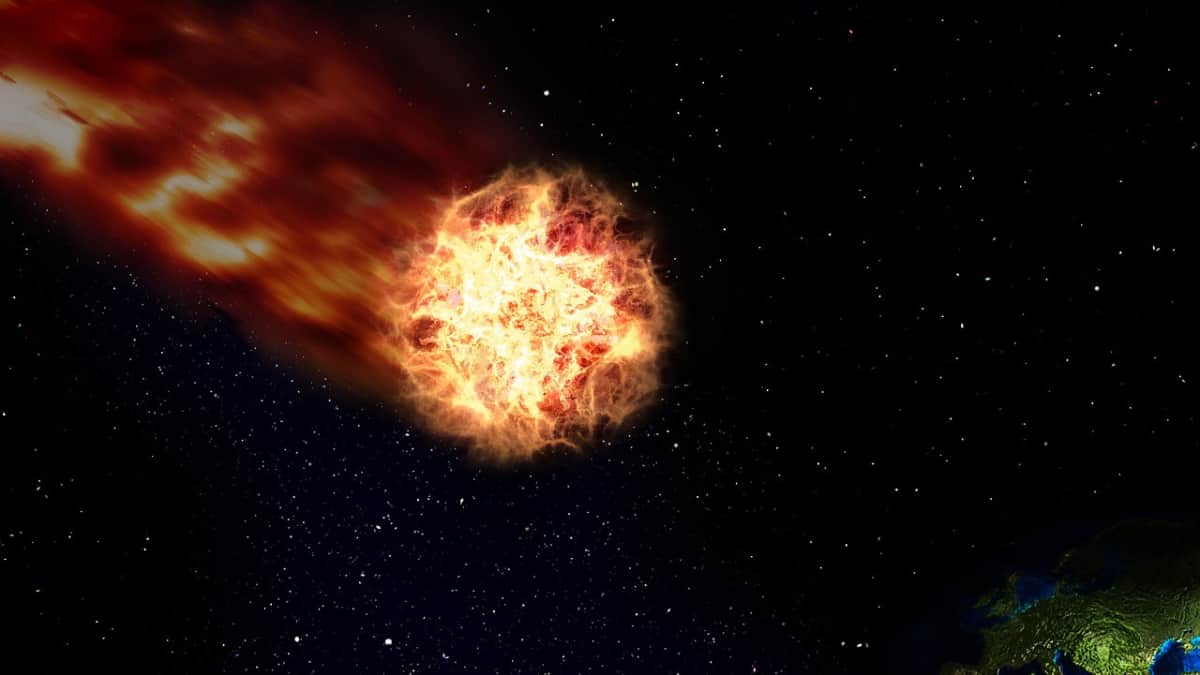
Representational image of a comet.
A comet, which has been recently discovered and is moving towards Earth, is likely to have originated from outside our solar system and is expected to get catapulted back into interstellar space after it performs an intense gravitational slingshot around the sun.
However, before the comet's forever departure from our cosmic space, the icy object is likely to turn 100 times brighter which means it is likely to shine like a star in the night sky.
The comet, which has been designated C/2023 P1, was discovered by amateur Japanese astronomer Hideo Nishimura on August 12 while falling towards the heart of the solar system. As per the follow-up observations, the object which has been nicknamed Comet Nishimura has a hyperbolic orbit, as stated by Spaceweather.com.
A hyperbolic orbit is when a cosmic object slingshots around a bigger body. like the sun, providing enough energy to smaller objects to escape the gravitational pull of the larger ones.
The orbit of Comet Nishimura means that this is most probably going to be the comet's first and final trip through the inner solar system.
Comet Nishimura to make its closest approach to Earth on Sept 13
The origin of the comet likely took place outside our start system, which makes it the third known interstellar object ever detected, after 'Oumuamua' - which was speculatively suggested by some astronomers as an alien spacecraft — and Comet 2I/Borisov.
There is also a possibility that the origin of the comet is in the outer reaches of the Oort Cloud, which is a reservoir of comets and other icy objects beyond Neptune's orbit - and has been floating on the solar system's edge for millennia before it got caught in the gravitational pull of the sun.
WATCH |NASA loses contact with Voyager-2, spacecraft is travelling in interstellar space | WION
On September 13, Comet Nishimura will make its closest approach to Earth and will be at its closest proximity to the sun on September 18.
When it will come closer to the sun, the comet will get brighter, with an apparent magnitude ranging between 5 and 3 in the night sky, which will be as bright as a typical star, as per Spaceweather.com.
(With inputs from agencies)
You can now write for wionews.com and be a part of the community. Share your stories and opinions with us here.
WATCH WION LIVE HERE