International Space Station evaded three collision risks in 2022

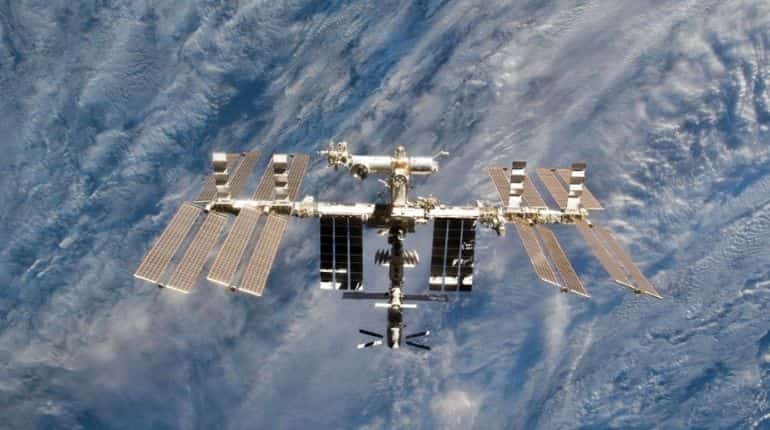
International Space Station
The International Space Station (ISS) had to perform three collision avoidance manoeuvres (CAM) in the year 2022 alone, in contrast with the total of 33 manoeuvres it has had to do since 1999.
The orbiting lab that houses a handful of astronauts and circles the earth at speeds of over 28,000kmph, at an altitude of 425kms, faces the constant risk of large and small objects that constitute space debris, said a top NASA scientist.
During a collision avoidance manoeuvre, the orbiting spacecraft fires its engines in order to move away and stay clear of an incoming object.
Speaking at an event in India, organised by the Indian Space Research Organization (ISRO) and Astronautical Society of India (ASI), Dr Jer Chyi Liou, NASA Chief Scientist for Orbital Debris stated that the American space agency had executed or assisted 18 collision avoidance manoeuvres by robotic spacecraft in the year 2022.
He mentioned that there are more than 47,000 pieces (each larger than 10cm) of space debris that are being tracked by the US Space Force and that their orbital paths were being monitored for possible collision risks. However, there were also millions of smaller pieces of debris that could not be tracked, but posed threats to assets in space.
Referring to the ISS, he revealed that the orbital lab is protected by 500 different shields, broadly known as Micrometeroids and Orbital debris (MMOD) impact protection shields.
"The American segments of the ISS are protected against orbital debris 1cm and smaller. The biggest threat to the ISS comes from debris too small to be tracked, but large enough to penetrate the protection shields (debris between 1cm to 10cm for US modules)," he said.
However, it was emphasised that installing impact shields came with a cost and increased the mass and volume of the spacecraft or space station. While the US module has impact shields to protect against debris 1cm and smaller, the other modules on ISS are not as protected and are even vulnerable to millimeter-sized debris. The orbiting lab is a joint effort between the US, Russia, Europe, Japan and Canada.
Explaining why the space debris of varying sizes is a constant cause of concern, Dr Liou mentioned that the average impact speed between two orbiting objects in Low Earth orbit (up to 2000kms above earth's surface) is 10km/second. For context, that is ten times the speed of a bullet and any collision at such high impact speeds could prove catastrophic.
WATCH WION LIVE HERE
You can now write for wionews.com and be a part of the community. Share your stories and opinions with us here.
