Humans planted pikes and did not throw spears to kill mammoths in Ice Age: Study

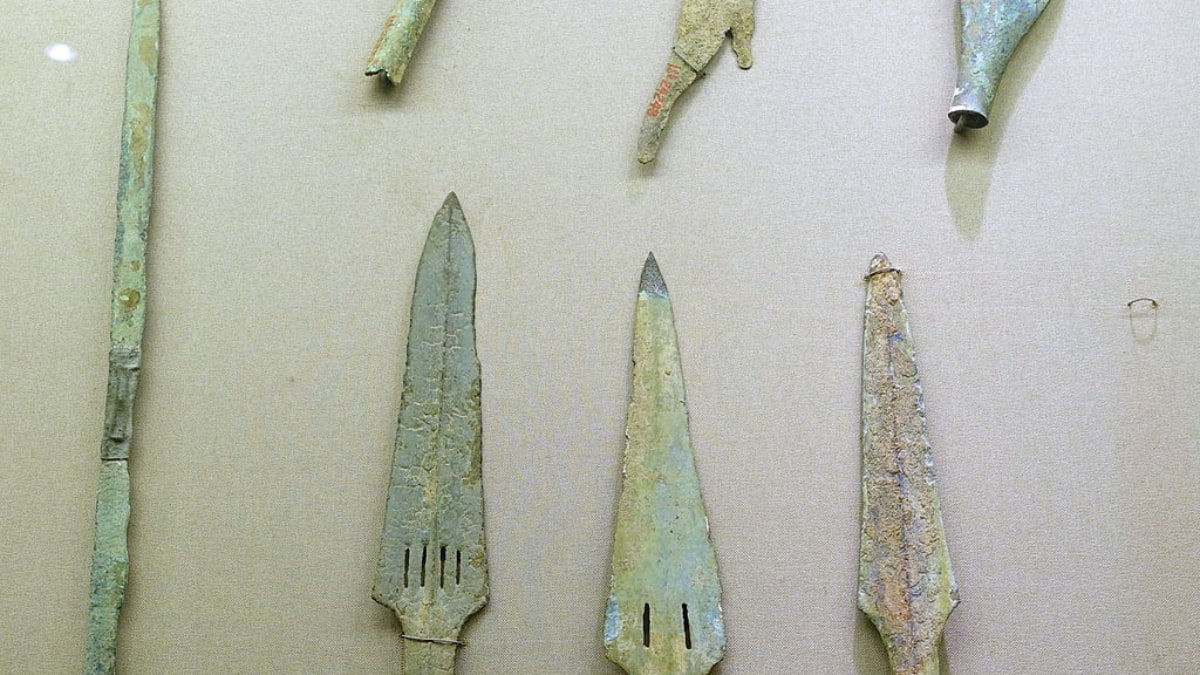
Image of the ancient spears.
The way in which humans hunted big animals in the Ice Age has always been a topic of debate and interest.
It was believed till now that carefully sharpened spears were thrown at animals by humans to hunt them down and feast on them.
However, archaeologists at UC Berkeley have now suggested that perhaps the pointed spears were planted in the ground with the sharp point of the weapon angled upwards in a way that a charging animal's body would be impaled by it.
This way the spear would have gone deeper into the body of the predator and caused more damage.
A team of Berkeley archaeologists looked into various sources of writings and artwork and even reviewed historical evidence related to people hunting with planted spears.
The scientists also carried out the first experimental study of stone weapons which emphasised pike-hunting techniques while revealing how spears react to the simulated force of an animal.
Also Read:Scientists find rare rock art in caves of Amazon telling different tale of humans and animals
As per the researchers, once the sharpened rock pierced into the flesh and started its engineered mounting system, the spear tip worked like a modern-day hollow-point bullet and caused serious wounds to the animals.
"This ancient Native American design was an amazing innovation in hunting strategies," said Scott Byram, who is the first author ofa paperon the topic published in the journalPLOS ONE.
"This distinctive Indigenous technology is providing a window into hunting and survival techniques used for millennia throughout much of the world," he added.
"You have to look beyond the simple artefact. One of the things that's key here is that we're looking at this as an engineered system that requires multiple kinds of sub-specialities within our field and other fields," Byram stated.
How did scientists measure the force of the spear system?
To understand the pike hypothesis, the team of researchers formed a test platform to measure how much force a spear system can withstand before the point gets snapped and the shaft is expanded.
Watch:Study finds Chimpanzees maybe able to speak like humans
A replica of the Clovis point spear was used in their low-tech version of an animal attack to test how various spears reached breaking points and how the expansion system reacted.
"The sophisticated Clovis technology that developed independently in North America is testimony to the ingenuity and skills that early Indigenous people employed in their cohabitation of the ancient landscape with now-extinct megafauna," said the study's co-author Kent Lightfoot.
(With inputs from agencies)