How and why ISRO is disposing off a defunct Indo-French satellite

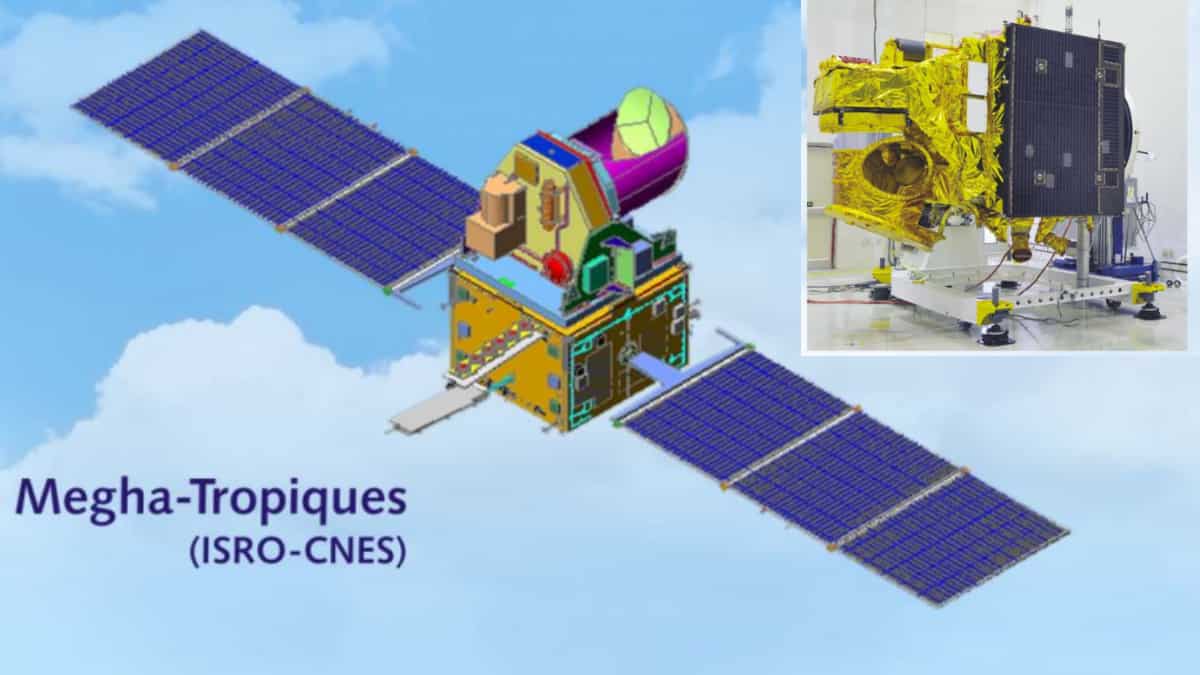
The Indian Space Agency ISRO is carrying out a controlled re-entry of a defunct Indo-French satellite and attempting to land it in an uninhabited zone in the Pacific Ocean. Launched in 2011, the 1000-kg Megha-Tropiques-1(MT1) was a satellite jointly developed by India's ISRO and France's CNES for studying tropical weather and climate. Despite it being designed for an operational life of three years, the satellite performed for more than a decade (until 2021). ISRO has predicted that the re-entry and final splashdown of the satellite would take place between 4:30 pm and 7:30 pm Indian Standard Time, on Tuesday, March 7th, 2023.
What are De-orbiting and Controlled re-entry?
With low earth orbits(orbits 400-2000kms above the earth's surface) getting increasingly overpopulated with satellites and space debris, there are several risks posed to operational space assets. The debris ranges from centimetre-sized objects to meters-wide used rocket stages and defunct satellites. All objects in Low Earth orbit travel at a speed of nearly 28,000kmph and a collision between two objects at such high speeds would create endless debris and threaten several space assets including satellites and space stations.
Alsoread |Exclusive | Gaganyaan: ISRO's crew module to undergo in-flight abort tests on mini-rocket 'TV'
To avoid such hazards, space agencies make attempts to de-orbit defunct satellites by gradually manoeuvring them closer to earth and eventually ensure that they burn up while re-entering the upper atmosphere and splashing down in uninhabited land or oceans. Another option is to bring the satellite into an orbit around the earth, where it would spend a lesser number of years circling the earth, than in its original orbit.
What is ISRO attempting with Megha-Tropiques?
In its original orbit, at an altitude of 867 km and an inclination of 20 degrees, the defunct Megha-Tropiques satellite would have circled the earth in an uncontrolled manner for more than 100 years and would have remained as space debris. Though MT1 is not designed for performing a de-orbiting and controlled re-entry, the Indian Space agency is attempting to do so, by precisely manoeuvring the satellite using its leftover onboard fuel.
According to ISRO, "about 125 kg on-board fuel remained unutilised at its end-of-mission that could pose risks for accidental break-up(in space). This left-over fuel was estimated to be sufficient to achieve a fully controlled atmospheric re-entry to impact an uninhabited location in the Pacific Ocean". Given that MT1 is more than a decade old and not all of its systems would function exactly as expected, ISRO carried out further planning by involving its experts from across domains -mission, operations, flight dynamics, aerodynamics, propulsion, controls, navigation, thermal, and other sub-system design teams.
Based on their calculations, ISRO zeroed into anuninhabited area in the Pacific Ocean between 5°S to 14°S latitude and 119°W to 100°W longitude, as the targeted re-entry zone for MT1. Since August 2022, 18 orbit manoeuvres were performed to progressively lower the satellite's orbit and bring it closer to earth."The final two de-boost burns and the ground impact are expected to take place between 16:30 IST to 19:30 IST on March 7, 2023," ISRO said. The Indian space agency also added that no large fragments of the satellite are likely to survive the aerothermal heating during re-entry. Re-entry temperatures(when an object from space re-enters earth's atmosphere) could be as much as 2500 degrees Centigrade, thus burning up most objects.
Why is ISRO performing this re-entry mission?
International guidelines for spacefaring nations stipulate certain space debris mitigation guidelines for the safe disposal and sustainable management of defunct space assets. Though this satellite is not designed to perform such controlled de-orbit and re-entry, ISRO is undertaking the challenging experiment as there are conducive parameters to carry it out. "This satellite with sufficient left-over fuel presented a unique opportunityto test the relevant methodologies and understand the associated operational nuances of post mission disposal by direct re-entry into the Earth’s atmosphere," ISRO said.
WATCH WION LIVE HERE
