Historic first! India's Chandrayaan-3 records more than 50 moonquakes. Here's what it means

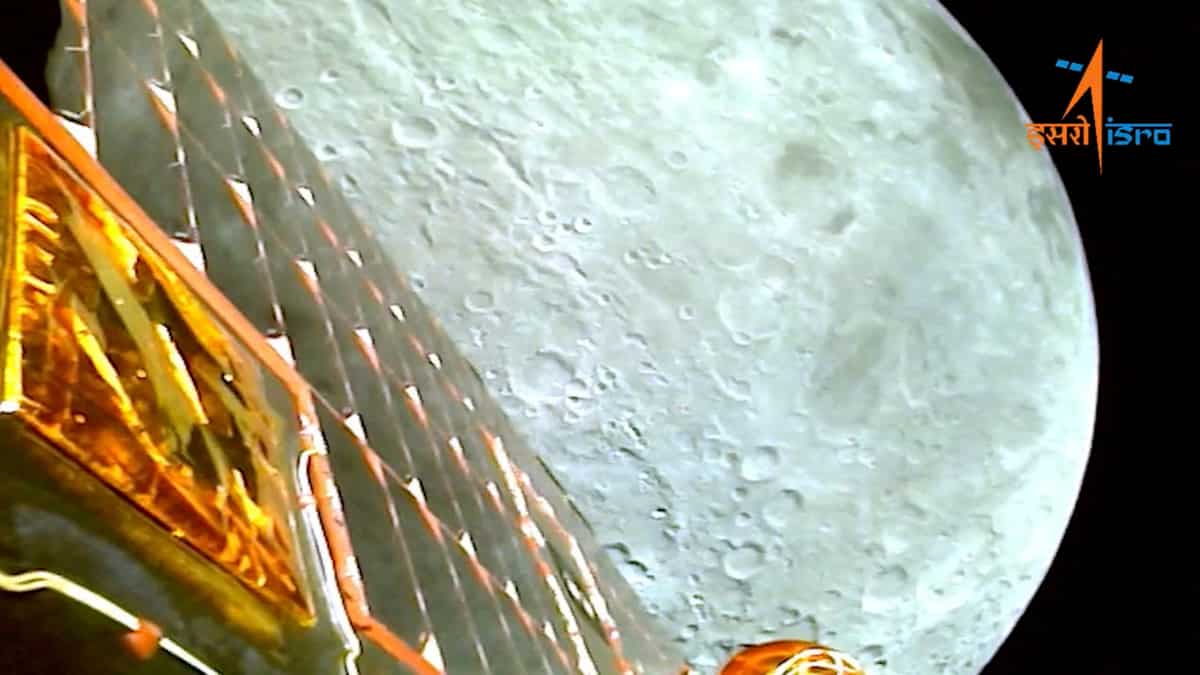
Image of Chandrayaan-3 from the Moon.
In a historic achievement, Chandrayaan-3 became the first lunar mission to have detected more than 250 seismic signatures from the south pole of the Moon, since the Apollo missions.
These 250 seismic signals included 50 unique signals that are likely to have links with moonquakes, which refer to the earthquake on the lunar soil.
This is the first time seismic data has been collected from the South Pole of the lunar surface and also the first time such an activity has been recorded since the Apollo missions.
According to the media reports, 250 seismic signatures have been detected by the Instrument for Lunar Seismic Activity (ILSA) aboard the Vikram Lander during its operational period from August 24 toSeptember 4, 2023, between the coordinates of 69.37degrees south and 32.32degrees east.
In 2023, the India Space Research Organisation (ISRO) said that the ILSA payload on Chandrayaan 3 Landerhas been able to record the movements of Rover and other payloads.
The ILSA payload is the first Micro Electro Mechanical Systems (MEMS) technology-based instrument on the moon thatutilises sensors manufactured with cutting-edge silicon micromachining technology.
All about 250 seismic signals detected by Chandrayaan-3
Among the 250 seismic signals, nearly 200 of them were said to have been produced by different mission activities like the Pragyan rover's movements or the operation of scientific instruments like the ChaSTE thermal probe or Alpha Particle X-ray Spectrometer (APXS).
However, the remaining 50 signals were classified as "uncorrelated" and the scientists were not able to draw a connection between them and any mission-related activities. This raised the possibility of these signals being produced from real moonquakes.
These findings related to the moonquakes were mentioned in a recent paper published inICARUS, which is a famous scientific journal.
Watch:Blue supermoon rises above South Korean capital Seoul
Commenting on the findings, LEOS Director Sriram said, “Out of the 250 seismic events, about 200 correlate with Pragyan’s movements or other instrument operations. The remaining 50 signals do not align with any known activities, warranting further investigation to understand their origins."
The study emphasised that the longest continuous seismic signal recorded had lasted 14 minutes.
(With inputs from agencies)