Flying saucer or cloud? Strange 'pet' feature reappears on same spot in New Zealand

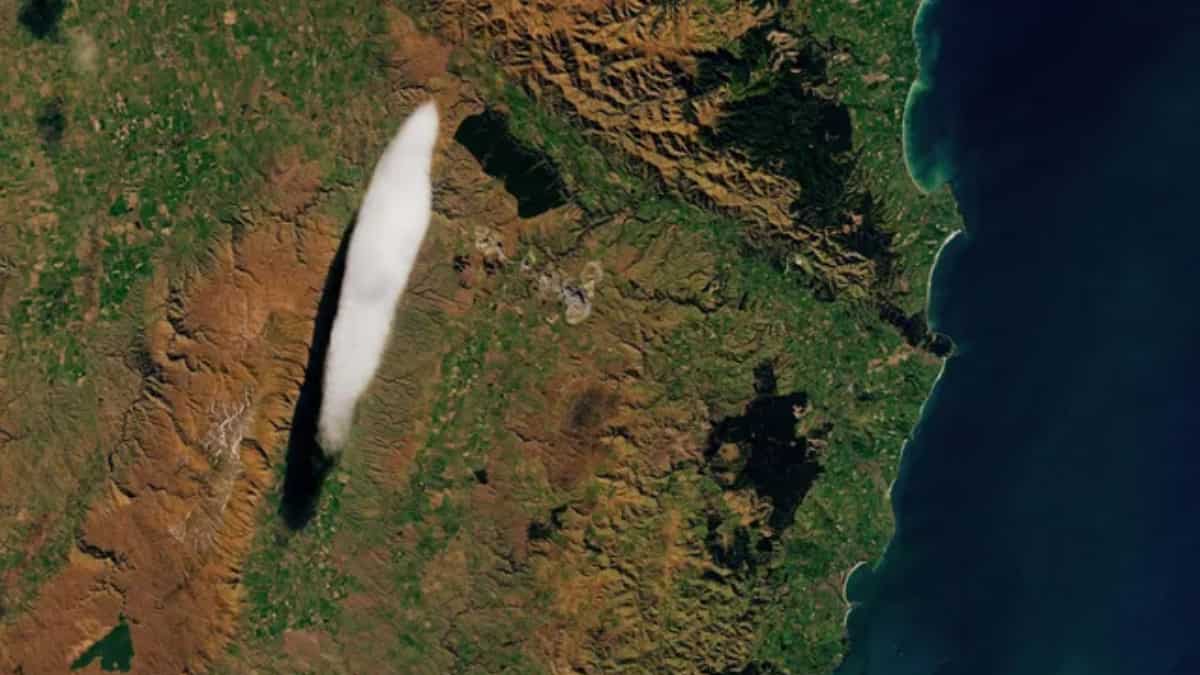
UFO like cloud
A recent satellite photo of New Zealand has revealed a strange cloud in the exact same place it was earlier seen. The "pet cloud" is known to return to the same place often, thanks to a nearby mountain range, Live Science reported. In the past, people have believed it to be a UFO because of its peculiar appearance.
The oblong cloud is called "Taieri Pet" by the locals. It is an elongated altocumulus standing lenticular cloud (ASLC), and frequently appears between the towns Middlemarch and Hyde in the Otago region of New Zealand's South Island.
Its size can vary slightly every time, but its shape and location are almost always the same. The latest cloud is 11.5 kilometres long.
When waves of air pass over a barrier, like a mountain range, water vapour is forced to condense into vertical layers. This is what led to the formation of ASLCs, as per the National Weather Service.
NASA's Earth Observatory says that the Taieri Pet forms when moist air passes over the Rock and Pillar Range, seen parallel to the left of the cloud in the photo. It is stopped in one place with perpendicular winds blowing from the north further shaping it.
Also Read:Giant rotating arm will fling satellites into space, company plans to send first batch by...
"As the cloud forms on the crest of this wave, it remains almost stationary in the sky and is shaped by the strong winds blowing through it," John Law, a meteorologist with New Zealand's MetService, told Earth Observatory.
Lenticular clouds look like UFO
Such clouds are often shaped like flying saucers which often makes one believe that they are seeing a UFO. According to the UK Met Office, lenticular clouds are "believed to be one of the most common explanations for UFO sightings across the world."
The Taieri Pet can be several hundred feet tall, based on what previous photos show. With well-defined layers on top of one another, it looks like a "huge stack of pancakes" or a "pile of plates," Earth Observatory representatives wrote.
Lenticular clouds can pose serious risks to aircraft because of the vertical currents that run up and down through it. Flights can experience severe turbulence travelling while through them and gain a coat of ice because of the low temperatures, the UK Met Office says.

