Explained | What is Anthropocene? The new epoch marked by damaging human impact

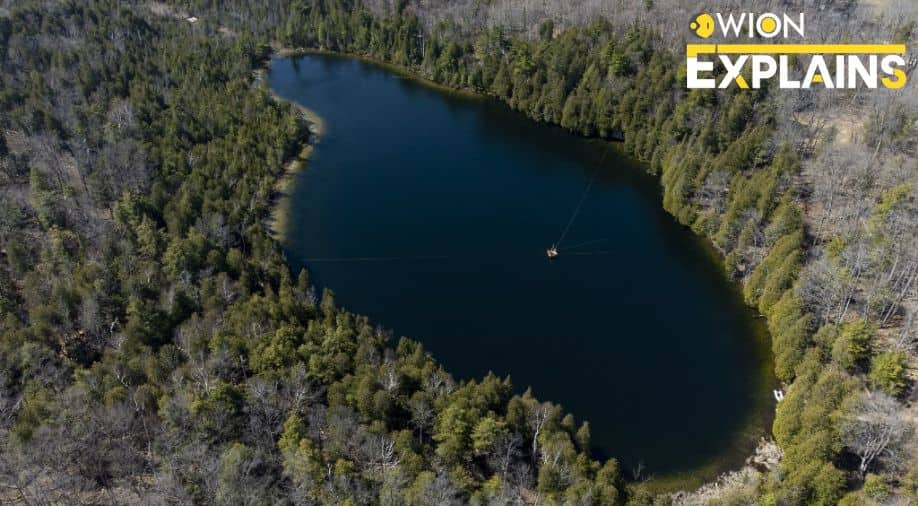
Lake Crawford
The pale blue dot in the vast darkness of universe, also referred to as Earth or our home planet has been around for billions of years. Alone in its orbital stillness, the planet has undergone a multitude of changes. Its layers carry evidence of ice age, dinosaurs roaming around, asteroid hits, mass extinctions, continental ruptures and whatnot.
Humans, who have been around a tiny fraction of that time on the cosmic scale, have also made a significant impact on the planet. Now, a special team of scientists has pointed out the timeframe when the new geologic epoch began, influenced by us - the Homo sapiens.
What isAnthropocene?
Members of the Anthropocene Working Group on Tuesday designated a small body of water near Toronto, Canada as ground zero for the Anthropocene. The word derived from Greek terms for "human" and "new" refers to the current geological age of the planet when human activity has been the dominant influence.
The data states that Earth moved into its new age about 73 years ago (1950). The layered sediments deposited at the bottom of Crawford Lake — laced with microplastics, fly-ash spread by burning oil and coal, and the detritus of nuclear bomb explosions, is being regarded as the global example of the beginning of the Anthropocene.
“The data show a clear shift from the mid-20th century, taking Earth’s system beyond the normal bounds of the Holocene," said working group member Andy Cundy, a professor at the University of Southampton, referring to the epoch that began 11,700 years ago after the end of ice age.
“The sediment found at the bottom of the Crawford Lake provides an exquisite record of recent environmental change over the last millennia,” said Simon Turner, chairman of the working group.
How did scientists find out the baseline?
Scientists are linking the new epoch to what is known as the Great Acceleration. It is the period after World War II when human activity went into overdrive. The population surged, industries expanded, more fossil fuels started to burn, nitrogen-based fertilisers became the norm and weapons ofmass destruction i.e.nuclear bombs were tested.
The scientists arrived at the conclusion that plutonium cast off by hydrogen bomb tests provided that global fingerprint.
“The clearest marker for a single year – which gives an abrupt and effectively instantaneous snapshot – is plutonium, because there’s so little of it naturally present," saidCundy,referring to the year 1952 when the US first detonated a huge hydrogen bomb in the Marshall Islands which could become the new epoch's boundary year.
Crawford Lake's competition
Crawford Lake was up against 11 other environmental spaces, spanning five continents, including Antarctica, to be regarded as the ground zero of human footprint. The scientists involved in the study said they were surprised that each of the 12 sites consistently showed the global marks of human activity. Combing them, it paints a clear picture that humans have caused a rapid change to the environment in a very short period of time.
If the scientists are able to have their way, they may proclaim that the planet has entered the Crawfordian age (named after the lake of course, following the protocol). However, the recommendations must be approved by a supermajority vote of two separate committees before final validation by the International Union of Geological Sciences (IUGS).
Point of no return?
Succinctly put, the Crawfordian age represents the point of no return in geological terms. The planet endured a long period of climate stability where human civilisation was able to grow but the future might not hold similar conditions for the generations to come.
Such has been the devastating impact of humans on Earth that last month, a new study published in Geophysical Research Letters, a journal by the American Geophysical Union stated that the planet had tilted as much as 80 centimetres (31.5 inches) between 1993 and 2010. The reason was attributed to humans pumping out indiscriminate amounts of groundwater and moving it elsewhere.
Climate change has become a routine phenomenon during this epoch. Currently, USA's southwestern states are sweltering under extreme heat with temperatures touching three figures. Meanwhile, in India, China, Japan and other Asian countries, floods have devastated human lives.
The power of humans is being classed in the same category as the meteorite that crashed into Earth 66 million years ago and wiped out dinosaurs, starting the Cenozoic Era.
For the first time in Earth's history, a single species has not only radically changed the planet's morphology, chemistry and biology, but is aware of having done so. And yet, little to nothing is being done to reverse the damage. The scientists may or may not be able to convince their peers towards the Anthropocene, mostly on technical grounds but one thing is clear, the Earth has changed, and not for good reasons.
WATCH WION LIVE HERE: