Exclusive: Indian astronauts' US training to go on for three months

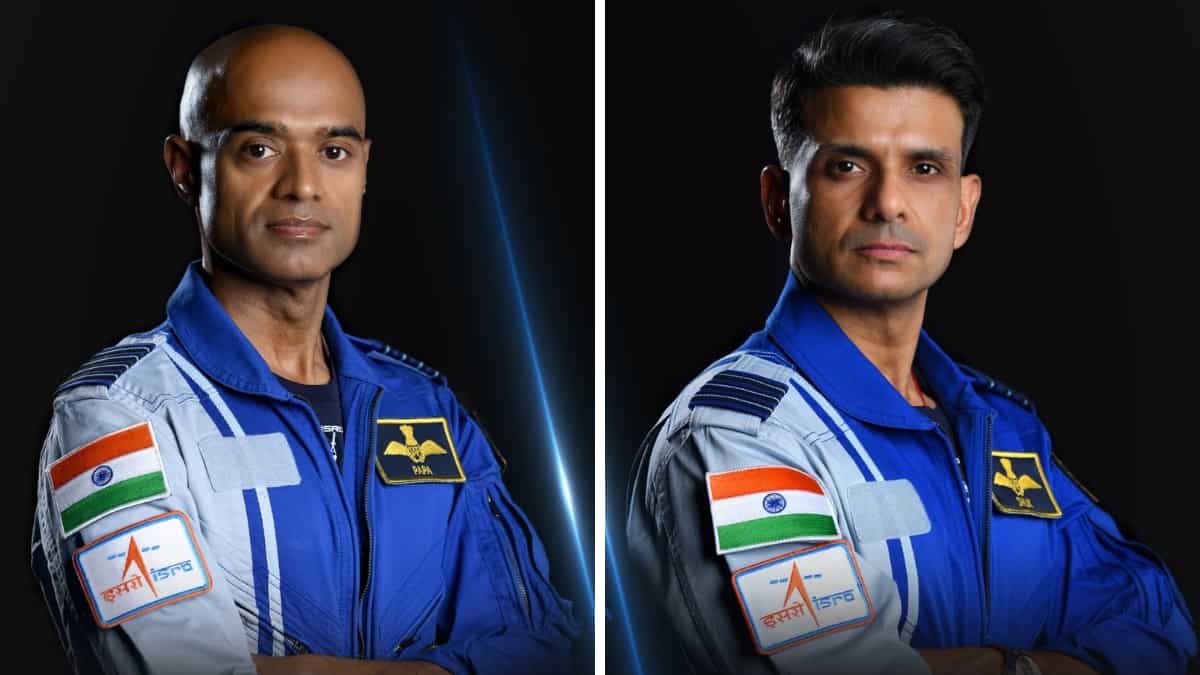
ISRO astronaut candidates Group Captains PB Nair (L) and Shubhanshu Shukla (R)
Indian astronaut candidates and Air Force Test pilots, Group Captains Shubhanshu Shukla and Prashant Balakrishnan Nair— who have now spent more than a week at NASA's Johnson Center, Houston, Texas— will be training at the American astronaut training facility for three months or longer, ISRO Chief Dr S. Somanath exclusively told WION.
In July, WION had exclusively reported that Indian astronaut candidates would commence their US-based training in early August. The duo have been in the US since 5thAugust.
For more than half a century, NASA’s Lyndon B. Johnson Space Center in Houston has played a lead role in human exploration, discovery and achievement. Since the 1960s Apollo-era to the contemporary Artemis crewed Lunar exploration efforts, and everything in between, Johnson Center has been the hub of human-led space exploration in the US.
The Indian duo are training to take part in a US-led mission to the International Space Station, an orbiting lab that circles 425kms above the earth. Recently, India's Human Spaceflight Centre (HSFC) had entered into a spaceflight agreement (SFA) with Axiom Space Inc, an American firm that has been identified by NASA.
Axiom is a private firm that facilitates a ride to space for paying customers. In this case, Axiom will facilitate the spaceflight of a chosen Indianastronaut, aboard the SpaceX Falcon 9 rocket.
Falcon 9 is the only contemporary American rocket with a proven track record of performing multipleastronaut-ferrying missions.
According to ISRO, India's primary Gaganyatri (space traveller) for this mission will be Group Captain Shubhanshu Shukla and the backup candidate will be Group Captain Prashant Balakrishnan Nair. One among them will be later approved to fly to the International Space Station (ISS) by the Multilateral Crew Operations Panel (MCOP) which is responsible for choosing the Indian candidate who will fly to the ISS.
During his stay in space, as part of the Axiom-4 mission, the chosen Indianastronautwill be undertaking scientific research and technology demonstration experiments aboard the ISS.
What is Gaganyaan? What is India prepping itsastronautcandidates for?
India has revealed the names of fourastronautcandidates who are to fly on the country's homegrown 'Gaganyaan' programme that aims to fly anastronaut-carrying capsule to earth orbit (400kms above the planet's surface) and bring them back safely for an oceanic splashdown landing. Gaganyaan was announced by Prime Minister Narendra Modi in 2018, as India's maiden mission to fly humans (trainedastronauts) to space.
Gaganyaan would be carried out by the Indian Space Agency ISRO, with test pilots of the Indian Air Force, serving as the crew members. The four candidates (Group Captains Prashant Balakrishnan Nair, Shubhanshu Shukla, Ajit Krishnan, and Angad Pratap) have already completed their training at the Yuri Gagarin Cosmonaut Training Center, Moscow.
In recent years, they have also been undergoing training at ISRO and Indian Air Force facilities, while also assisting ISRO teams in designing and developing some systems required for Gaganyaan.
Gaganyaan is the first step in a series of sustained human spaceflight missions that India wants to carry out in a phased manner. By the end of this decade, India hopes to put an uncrewed space station in Earth orbit. By 2035, it would be used as a crewed Indian outpost that's circling the earth.
India also plans to land itsastronauts on the moon by 2040, a feat that only America has accomplished in 1969, and China hopes to do so by the end of this decade.
Soviets flew 1st Indian to space in 1984; US to fly 2nd Indian to space in 2025
40 years ago, in 1984, Indian Air Force Pilot Wing Commander Rakesh Sharma flew to space as part of the Soviet Interkosmos programme. He is the only Indian to have flown to space. He did so on the Soviet Soyuz T-11 mission to the Salyut-7 space station, a lab that circles above the Earth.

Indian Air Force's Wing Commander Rakesh Sharma (centre), flight engineer Gennady Strekalov (L) and commander Yury Malyshev (R) alongside the screengrabs of the-then Indian Prime Minister Indira Gandhi's interaction with Rakesh Sharma |spacefacts.de/YouTube via Indian National Congress
In 2023, during Indian Prime Minister Narendra Modi's State visit to the US, President Joe Biden had announced that 'NASA would provide advanced training to Indianastronauts at the Johnson Space Center in Houston, Texas, with a goal of mounting a joint effort to the International Space Station (ISS) in 2024'.
Given that India's only experience of human spaceflight comes from Wing Commander Rakesh Sharma who flew fourty years ago, the 2024 mission to the ISS is expected to offer significant insights and experiences related to contemporary spaceflight and relevant technologies. This would offer crucial lessons to ISRO and its chosen candidate, as it prepares for the homegrown Gaganyaan mission.
At present, India is in the process of gradually testing various systems and technologies required to execute an uncrewed Gaganyaan mission, slated for later this year or in early 2025. After a couple of flawless uncrewed missions, India will embark on theastronaut-carrying mission, perhaps, by 2026.
Maiden Gaganyaan flight trial in Dec 2024
Following the successful launch of the SSLV-D3/EOS-08 mission, ISRO Chief Dr S.Somanath said that the agency is looking to launch the maiden uncrewed trial of the Human-rated Gaganyaan rocket and its crew module. ISRO has dubbed this mission 'G1'.
ISRO has readied much of the hardware required for this high-profile mission, including the S200 solid motors, the core L110 stage and the cryogenic C32 stage, which respectively serve as the first, second and third stages of the Human-rated LVM3 rocket.
"The Gaganyaan rocket’s three stages have come to Satish Dhawan Space Centre, Sriharikota. The integration of the crew module is happening at VSSC (Vikram Sarabhai Space Centre, Thiruvananthapuram)."
ISRO expects that all systems for the 'G1' flight will reach the Indian spaceport by November, for a planned launch in December.
