Europe's Ariane-5 rocket blasts off into space one last time

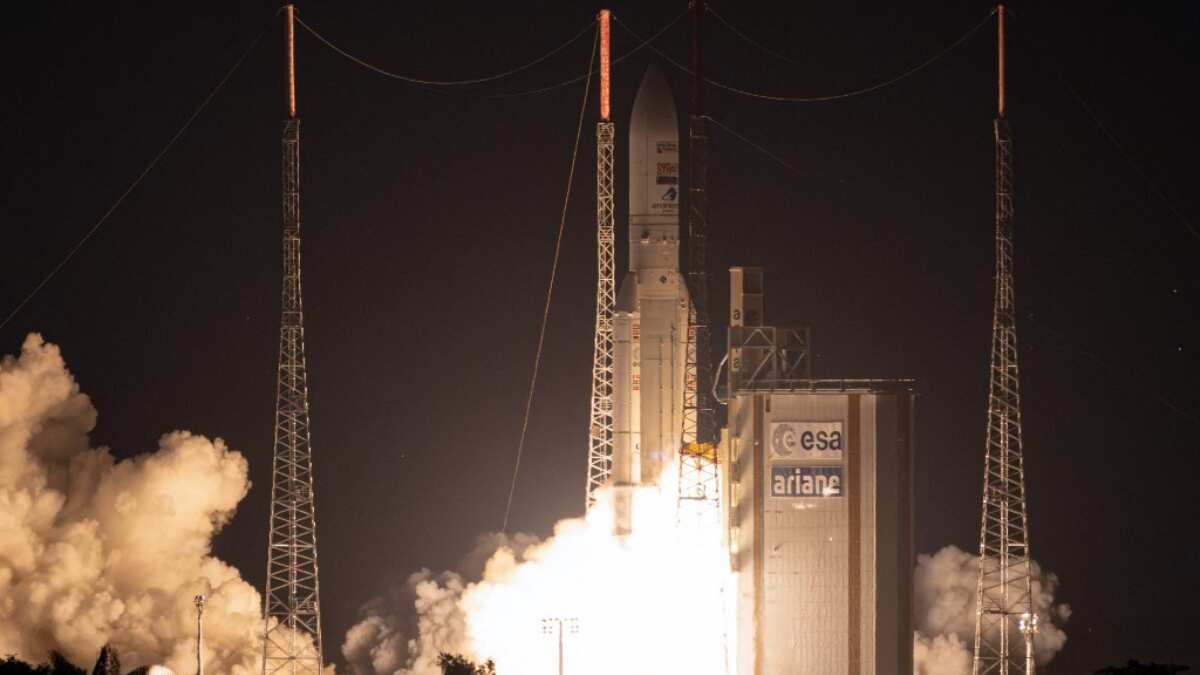
European Ariane-5 heavy rocket lifts off from Guyanese Space Center in Kourou.
Europe's heavy-lift rocket,Ariane-5, took off on its final mission on Wednesday. The rocket, which had made it possible for the continent to access space for nearly three decades, brought its career to an end after liftingtwo telecoms satellites into space.
Ariane-5 was regardedas a highly successful launcher after it faced only two outright failures in 117 outings.
However, the retirement of Ariane 5 has left Europe in a difficult position, as it has no replacement prepared to take over.
The Ariane-6, which is the next-generation rocket, is still in its development and testing phase and is less likely to debut till next year.
ALSO READ |More lifting-power for Indian rockets: ISRO test-fires India's most powerful rocket engine
To make matters more difficult, Russian Soyuz rockets can no longer be used by Europe and its smaller vehicle the Vega-C has been benched after it faced an in-flight failure last December.
Instead, the satellites of Europe have been forced to use the services of the United States. Euclid space telescope, which is worth €1.4 billion ($1.52 billion), was lofted last Saturday on a SpaceX Falcon-9 in Florida.
Europe's launcher crisis
The home-grown rockets' unavailability prompted European Space Agency director general Josef Aschbacher to recently announce that "Europe finds itself... in an acute launcher crisis".
The final mission of Wednesday was conducted, as usual, from the Kourou spaceport located in French Guiana.
The two "passengers" onboard the rocket were a German demonstration spacecraft, called Heinrich Hertz and a French defence satellite, named Syracuse 4B.
Right after the start of the rocket's launch window, the Ariane blasted at 19:00 local time (22:00 GMT; 23:00 BST).
Dr Aschbacher stated that scientists will remember the Ariane-5 as a remarkable vehicle.
"The performance and the accuracy of the Ariane-5 have been quite unique, but I'm convinced that Ariane-6 will have the same performance and the same accuracy once it's on the launch pad," he said while speaking to BBC News.
WATCH |South Korea salvages North Korea spy satellite rocket debris; to examine parts
On December 25, 2021, the famed accuracy was best demonstrated when the rocket launched the $10 billion James Webb Space Telescope.
The telescope's injection into orbit was done so precisely that the observatory did not require it to use its own fuel for correcting its trajectory, which doubled a projected operational lifetime from 10 to 20 years.
A new heavy-lift rocket from Europe was commissioned as the cost of production of the Ariane-5 appeared unsustainable in the wake of US competition.
The launch was upended by Elon Musk's SpaceX company with his reusable Falcons, undercutting the price point of Ariane.
You cannow write for wionews.comand be a part of the community. Share your stories and opinions with ushere.
WATCH WION LIVE HERE