Euclid telescope sends stunning test pictures back home from space. Have a look

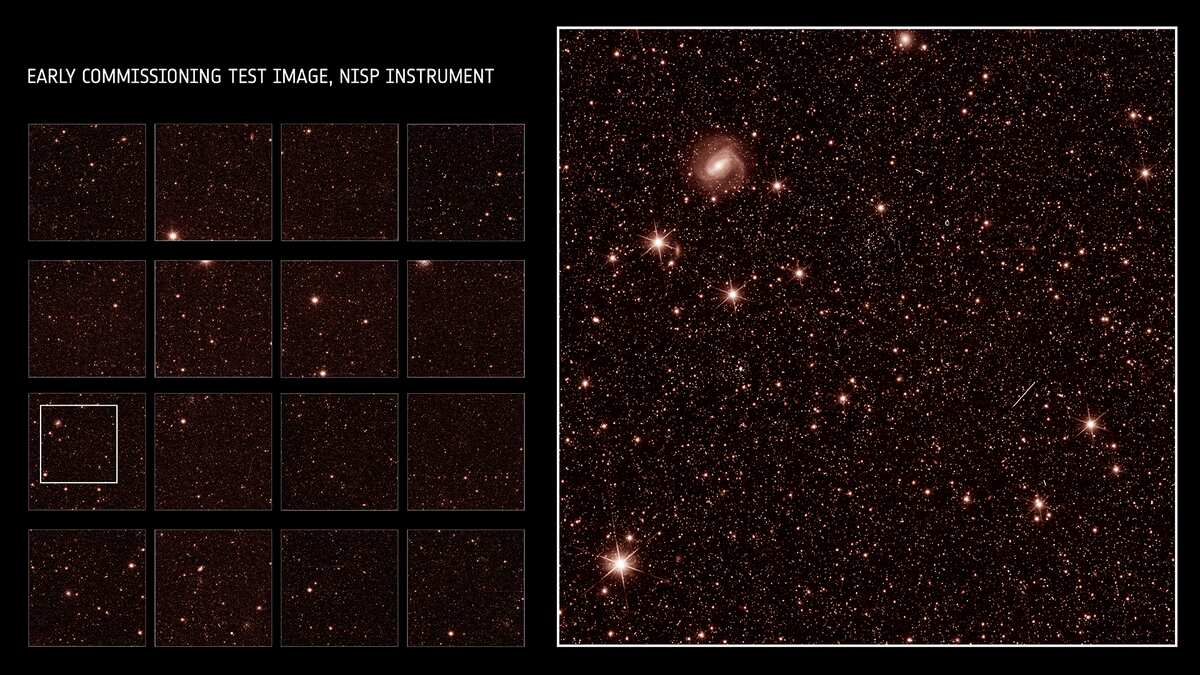
Images released by Euclid telescope
The European Space Agency's Euclid spacecraft has successfully taken its first test images, revealing a dazzling field of stars. These images indicate the space telescope is functioning well after travelling a million kilometres from Earth.
Have a look at the amazing pictures (Courtesy: ESA)


Launched on July 1 from Cape Canaveral, Florida, Euclid has reached its destination at the Second Lagrange Point (L2), around 1.5 million kilometres away from Earth.
Euclid's primary objective
The spacecraft's primary goal is to investigate profound mysteries of the universe, such as the nature of dark matter and the reasons behind the universe's accelerating expansion, which is attributed to "dark energy."
The initial images captured by Euclid's onboard instruments have boosted the confidence of the mission's scientists and engineers. They are excited about the upcoming scientific results.
"We are thrilled to see that the NASA-supplied detectors and other hardware are working as expected and are incredibly excited about the scientific results that will come in the months and years ahead," said Mike Seiffert, project scientist for the NASA contribution to Euclid at the agency's Jet Propulsion Laboratory in Southern California.
In the following months, the team will continue performance-verification tests before beginning science observations. This achievement is a significant step towards accomplishing the mission's ambitious scientific objectives.
A long way to go
Euclid Project Manager Giuseppe Racca of ESA expressed his exhilaration and emotions after seeing the first images, knowing that they represent only a glimpse of what the fully calibrated Euclid will achieve.
Watch:Europe's Euclid space telescope launched on mission
"It’s even more incredible when we think that we see just a few galaxies here, produced with minimum system tuning. The fully calibrated Euclid will ultimately observe billions of galaxies to create the biggest-ever 3D map of the sky," Racca said.
Euclid's mission promises to provide a remarkable advancement in our understanding of the universe. As it continues its exploration, experts eagerly hope to unveil the wealth of knowledge it will uncover.
The telescope shares its location at L2 with the James Webb Space Telescope, about 1.5 million kilometres from Earth in the opposite direction of the Sun. This strategic position offers an unparalleled vantage point for studying the universe, attracting other space missions like the James Webb Space Telescope and the Gaia mission.
WATCH WION LIVE HERE