Einstein ring reveals mysteries of an intensely luminous galaxy 10 billion light years away

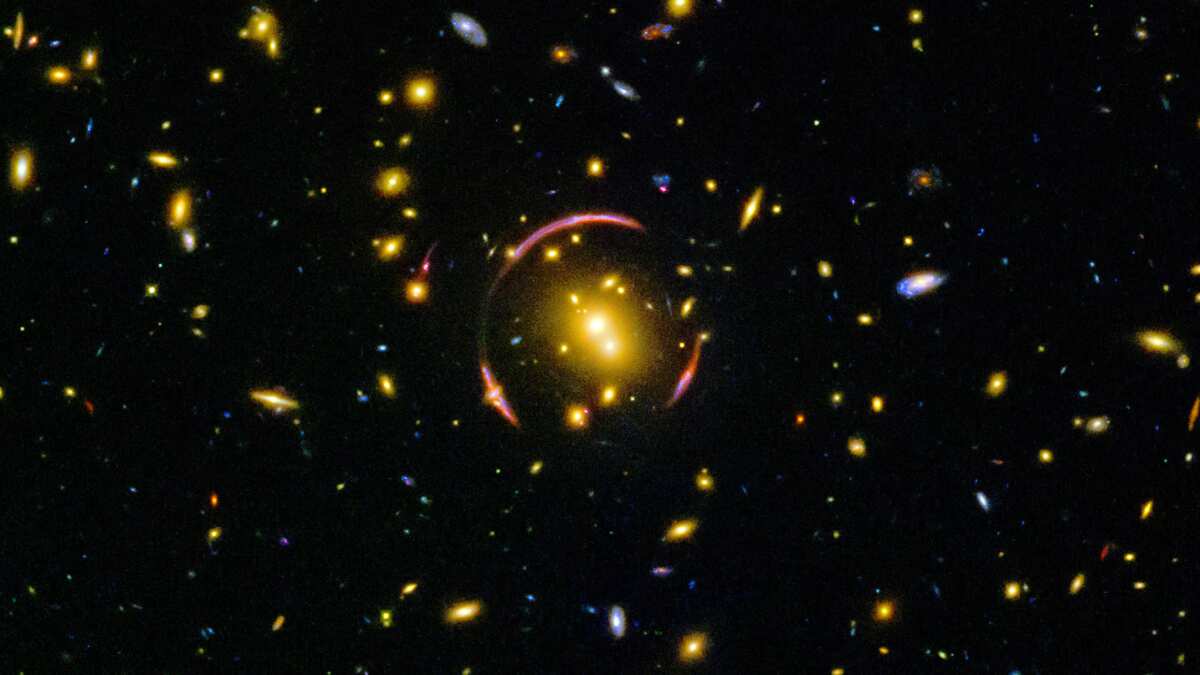
Einstein ring
A hyper-luminous infrared galaxy (HyLIRG) has captured the attention of astronomers. It was recorded following new observations of a rare feature known as an “Einstein ring”. The galaxy and the observations on it have been published in a paper in Nature Astronomy. The galaxy PJ0116-24 is located 10 billion light-years away from Earth. The intense luminosity in the galaxy contradicts the common notion that only galaxy mergers produce such intense luminosity.
A nearby galaxy acted as a gravitational lens, helping astronomers observe PJ0116-24 after light from it travelled close to 10 billion years. Because of the other galaxy's gravity, light from PJ0116-24 is bent and magnified, producing the striking circular feature known as an Einstein ring. This helped scientists observe PJ0116-24 in great detail.
The galaxy seems to be forming stars rapidly, hinting at the possibility that it can occur through internal processes. The latest discovery is forcing astronomers to rethink how such formations occur. Till now, only mergers between galaxies seemed to have resulted inintense luminosity produced by HyLIRGs. When two galaxies merge, dense regions of gas are formed, which provide a conducive environment for rapid star formation.
What is happening withPJ0116-24 galaxy
As per the European Southern Observatory (ESO), PJ0116-24 is shining 10,000 times brighter than the Milky Way in infrared light. Scientists observed that given the right conditions, it is possible for single galaxies to become HyLIRGs. Stars can form quickly when gases responsible for star formation quickly move towards the centre of the galaxy due to certain internal processes.
Data from the Atacama Large Millimetre/Submillimetre Array (ALMA) and ESO's Very Large Telescope (VLT) was combined which showed the presence of cold gas in the region, Cornell astronomer Amit Vishwas, PhD, one of the co-authors of the new study, said. The VLT noticed that warm gas in the galaxy was moving in an organised manner, something that doesn't happen when galaxies merge.
The latest findings about this distant galaxy complement earlier findings about a smaller galaxy made by Vishwas and his colleagues last year using the James Webb Space Telescope.

