Earth has two giant blobs deep beneath its surface which are likely shape shifters

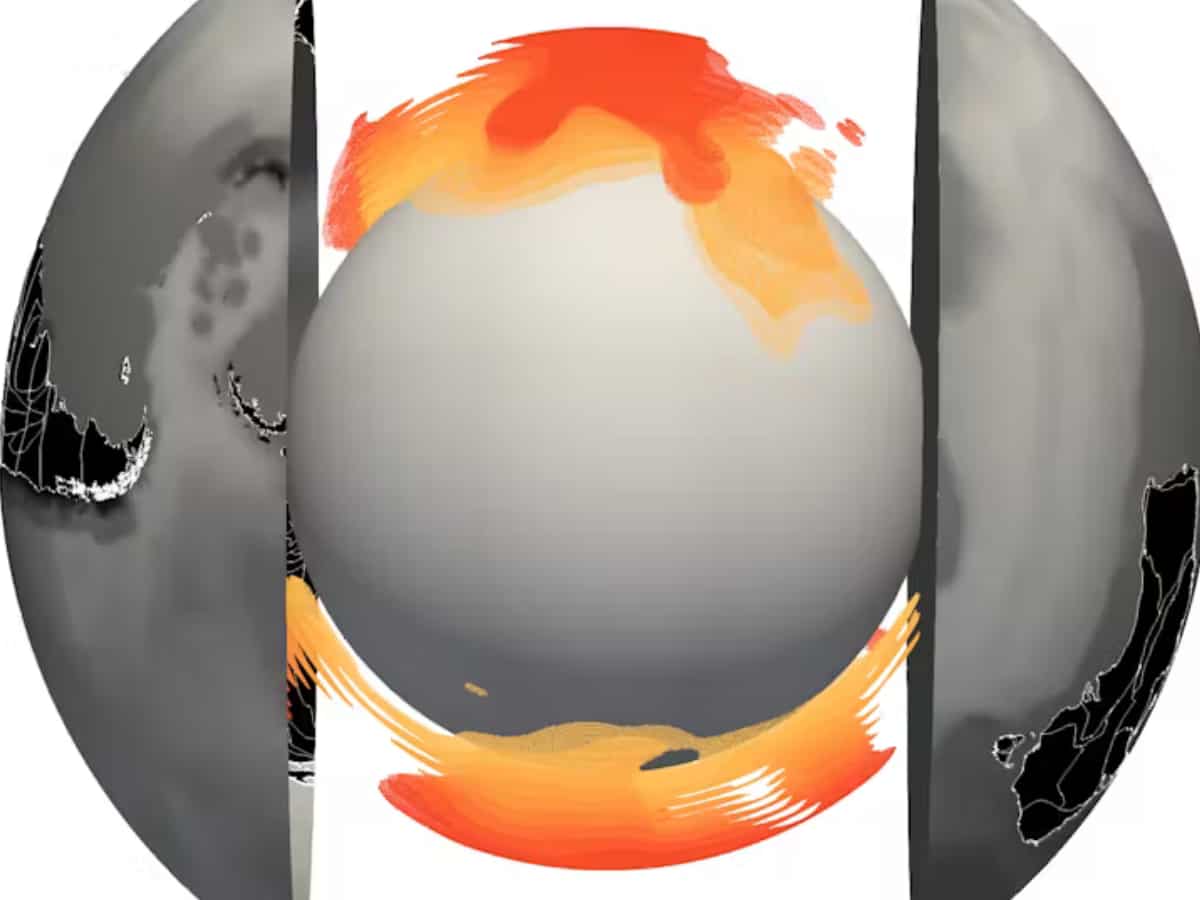
Inside image of Earth's core with two blobs
Scientists have always known that deep down in the core of the Earth, there existtwo blobs the size of continents. One is under the African continent and the other one is under the Pacific Ocean.
How these two blobs have spanned through centuries of Earth’s history always remained a mystery, until now. In the new research, scientists gathered that the blobs muster together and then break apart, much like continents and supercontinents.
Also Read |Historic image! Japanese space company unveils world’s first close-up image of space debris
The blobs have their roots 2,900 km (1,800 miles) below the surface, which is almost halfway to the centre of the Earth. These are thought to be the birthplace of rising columns of hot rock called “deep mantle plumes” that reach Earth’s surface and cause volcanic eruptions. Hence, these blobs have always remained an area of interest amongst the scientific fraternity.
Model demonstrating evolution of Earth blobs
The blobs are present in the mantle as they slow down waves caused by earthquakes, which suggest they are hotter than their surroundings. Scientists generally say that these blobs are linked with the movement of tectonic plates at Earth’s surface. However, how the blobs have changed over the course has puzzled the scientists.
One lot of scientists is of the opinion that the present blobs have acted as anchors, locked in place for hundreds of millions of years while other rocks move around them. But as we know tectonic plates and mantle changed over time, it means blobs were also changing and taking new shapes.
The new research shows Earth's blobs have changed shape and location far more than previously thought. In fact, over time they have assembled and broken up in the same way that continents and supercontinents have at Earth's surface.
The team of scientists used Australia's National Computational Infrastructure to run advanced computer simulations of how Earth's mantle has flowed over a billion years.
“We found that just like continents, the blobs can assemble – forming "superblobs" as in the current configuration – and break up over time,” wrote the team of scientists from various universities, in their research paper.
“A key aspect of our models is that although the blobs change position and shape over time, they still fit the pattern of volcanic and kimberlite eruptions recorded at Earth's surface. This pattern was previously a key argument for the blobs as unmoving 'anchors'.”
“Strikingly, our models reveal the African blob assembled as recently as 60 million years ago – in stark contrast to previous suggestions the blob could have existed in roughly its present form for nearly ten times as long,” read the research paper.
The team is yet to know the origin of blobs and how they were made in the first place. The authors of the original research are - Nicolas Flament, Senior Lecturer, University of Wollongong; Andrew Merdith, Research fellow, University of Leeds; Ömer F. Bodur, Postdoctoral research fellow, University of Wollongong and Simon Williams, Research Fellow, Northwest University, Xi'an.
(With inputs from agencies)