Draconid meteor shower to light up skies in October. Here's how skygazers can watch it

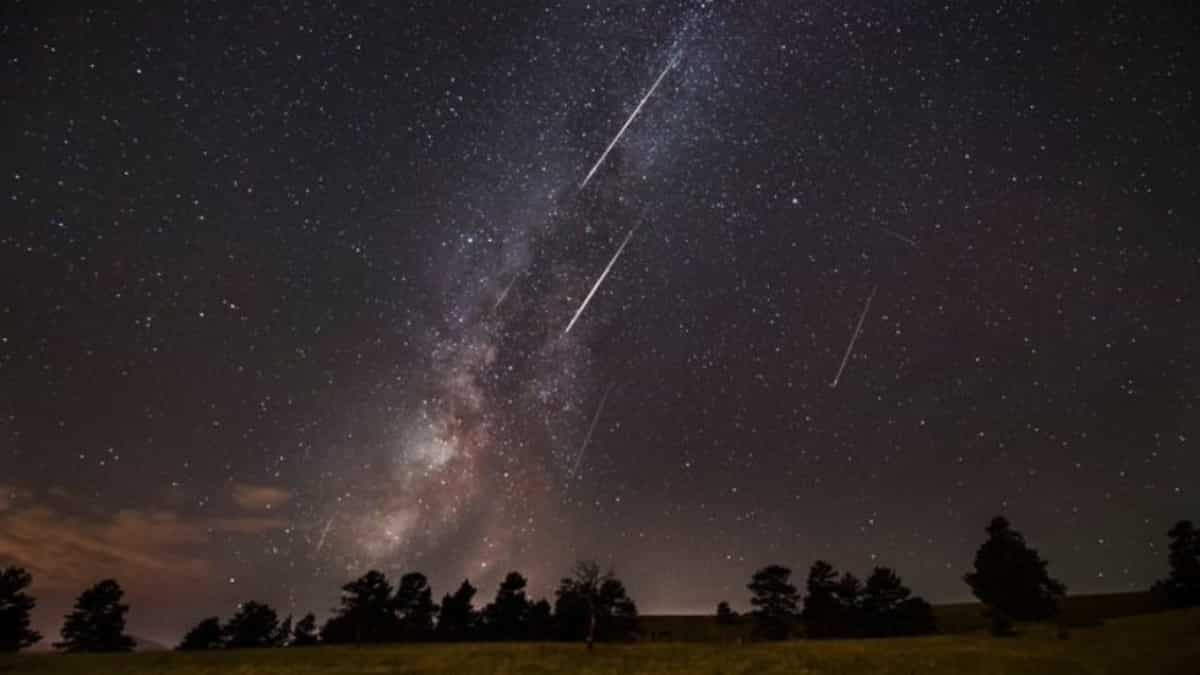
Representational image of Draconid meteor shower.
The annual Draconid meteor shower has started to light up the night skies from October 6 and will remain visible till October 10.
However, this year the meteor showeris expected to be fainter in comparison to the past years, as experts suggestthat the 2025 meteor shower will be the strongest one to have ever occurred in history.
The people in the United States will be able to see the Draconid meteor shower in areas with less or limited air pollution.
They will be able to catch the Draconids, which come from the dragon constellation Draco and is a well-known shower.
During the showers, the meteors are expected to be few and far from each other and they will reach their peak on October 7 and 8, when nearly 10 meteors will be visible every hour.
All about the Draconids
The Draconids are among the weaker showers, which fall at a speed of 21 kilometres per second.
Sometimes, it picks up the speed and moves at a speed of more than 1,000 meteors per hour.
It is expected that the dragon can turn very strong in 2025. But this will depend on ideal conditions like required aptitude for late nights, low light pollution and clear skies.
“The Draconids are what I call an all-or-nothing shower,” said Bill Cooke, who is the head of NASA’sMeteoroid Environment Office, while speaking to Smithsonian magazine.
“If there’s an outburst, it may be worth going out to see. But normal Draconid activity, they’re very faint, because they move so slowly. So, a normal Draconid year, you might see two to three meteors per hour, and that’s pretty much nothing,” he added.
The intensity will depend on the gravitational pull of the other planets, especially Jupiter, said Cooke.
The pull can affect the trajectory of the comet and bring it either more closer or farther away from Earth.
The constellation Draco, from which meteors fall, is easy to spot because of its proximity to the constellations Big Dipper and Little Dipper.
French astronomer Michel Giacobini first discovered the Draconids at the Nice University in France in 1900. It wasthen observed againby Ernst Zinner in 1913.
(With inputs from agencies)