Discovery of fossils shows humongous sea creature decapitated by dinosaur predator

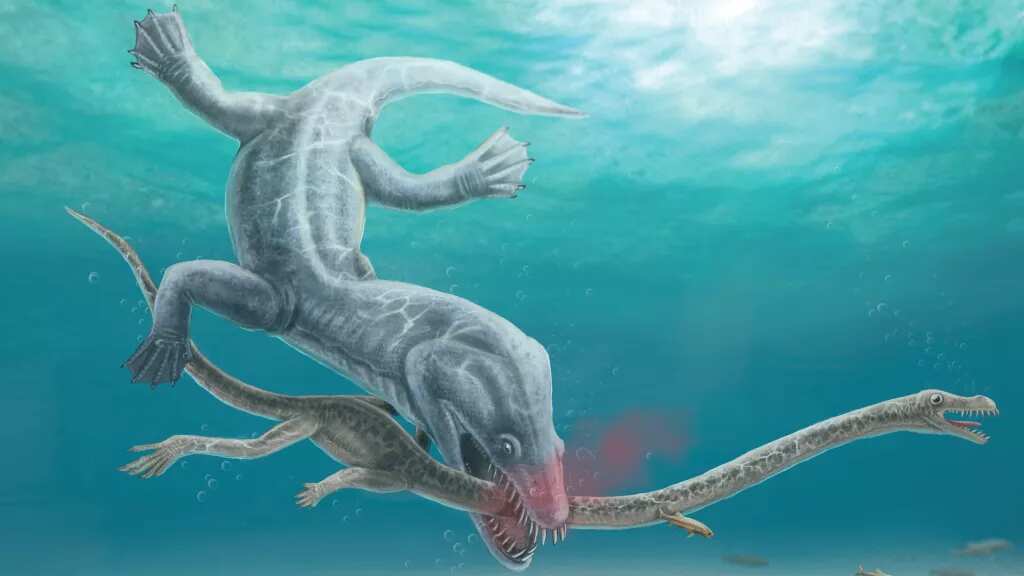
Tanystropheus
Unlike myriad modern-day marine reptiles, Earth once was home to a 20 feet (6 metres) long reptile. About 240 million years ago, such long-necked creatures used to roam around the blue planet, but their population was short-lived as they would often fall prey to their predators.
Tanystropheus’s first appearance was recorded during the Triassic Period when the Earth was witnessing its worst mass extinction. It used to thrive across the northern hemisphere for 10 million years.
It is said that Tanystropheus was a distant relative of the dinosaurs and feasted on fish and squid in what was a tropical lagoon during the Middle Triassic (247 to 237 million years ago).
For two centuries, scientists had suspected that such prehistoric marine reptiles possessing long necks were highly vulnerable to ambush attacks.
Recently, they unearthed fossils of Tanystropheus in a Switzerland mountain called Monte San Giorgio and found that their life was suddenly and violently ended after being decapitated by a powerful predator.
In a new study published on Monday (June 19) in Current Biology, the researchers said that the discovery of fossils provides the first concrete evidence that their necks had been severed, with clear bite marks on some of the vertebrates.
"We found two tooth punctures exactly where the neck is broken, and the neck is broken in a single, diagonal plain," the author of the study, Stephan Spiekman, told Live Science.
Bitten off in a single bite
Stephan Spiekman, a vertebrate palaeontologist at the State Museum of Natural History Stuttgart, in Germany, was studying two Tanystropheus specimens as part of his doctoral work at Switzerland's Paleontological Museum of the University of Zurich.
"This suggests that the neck was bitten off in a single bite," he said.
He added there may have been a few preliminary bites that did not hit the bone, but "it is very plausible that a large predator bit [off] the neck in one go, especially considering the large predators that were around in that environment."
Though Tanystropheus' long necks were a weak point, the researchers said that these reptiles persisted with stiff, long necks for around 175 million years, suggesting it played an important role during the Triassic period.
But what creature could have killed a 20-foot-long ambush predator? Spiekman said the huge diversity at Monte San Giorgio means the list of potential killers is substantial.
These includeCymbospondylus buchseri— a large, early ichthyosaur that could grow up to around 18 feet (5.5 m) — andNothosaurus giganteus— an enormous reptile that grew up to 23 feet (7 m). The third possibility isHelveticosaurus zollingeri, a "very enigmatic" 12-foot-long (3.6 m) predator with powerful forelimbs, a flexible tail and a strong, toothy snout, he said.
(With inputs from agencies)
WATCH WION LIVE HERE