Cosmic glitch in Einstein's relativity theory could redefine our understanding of Universe

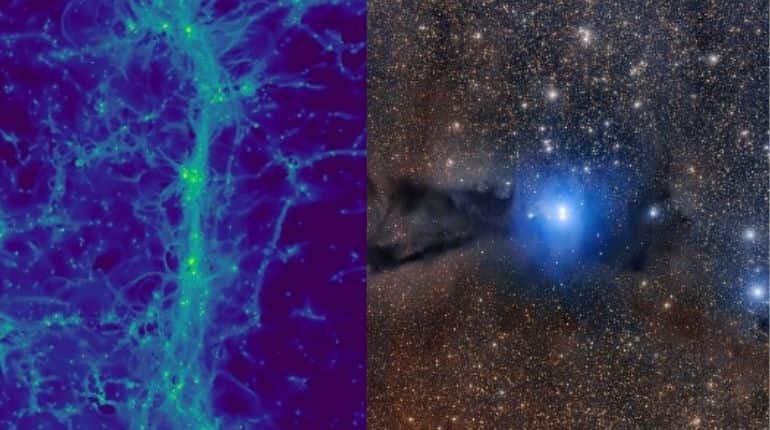
A 'Cosmic glitch', an irregularity in the rules of the universe, has been observed inEinstein's theory of general relativity, as per new research. This anomaly includes some inconsistencies in gravity at cosmic levels, where it gets weaker.
Notably, in everyday situations on Earth's surface or in our solar system, the effects of gravity are approximately constant. In extreme conditions, such as near black holes or during cosmic events like the collision of neutron stars, the effects of gravity can be significantly different and would require Einstein's theory of general relativity for accurate predictions.
However, a new cosmic glitch suggestdiscrepancy in the Einstein's theory.
Co-author Niayesh Afshordi reportedly said, "[It's] like making a puzzle on the surface of a sphere, then laying the pieces on a flat table and trying to fit them together," adding, "at some point, the pieces on the table will not quite fit each other, because you are using the wrong framework."
"The glitch is the smoking gun for a fundamental violation of Einstein's equivalence principle (or Lorentz symmetry), which could point to radically different pictures for quantum gravity, the Big Bang, or black holes," he added.
What does the study reveal?
In a study published on March 20 in the Journal of Cosmology and Astroparticle Physics, researchers found out two major issues. The current cosmological model relies on dark matter and dark energy - mysterious entities that haven't been directly detected and don't fully explain the universe's expansion rates.
To tackle these issues, the researchers suggested a simple modification - adjusting the universal constant of gravitation on different distance scales.
Watch |French artist Saype unveils latest artwork | Artwork entitled 'bright dreams'
"The modification is very simple: We assume the universal constant of gravitation is different on cosmological scales, compared to smaller (like solar system or galactic) scales," Afshordi said. "We call this a cosmic glitch."
"We find evidence for the glitch: cosmic gravity is about 1% weaker than galactic/solar-system gravity," Afshordi noted.
Scott Dodelson, a physics professor at Carnegie Mellon University, reportedly said,"If so, it means we understand even less than we thought we did."
(With inputs from agencies)