‘Comet of the century' is set to blaze past Earth. Here's how you can watch it with naked eyes

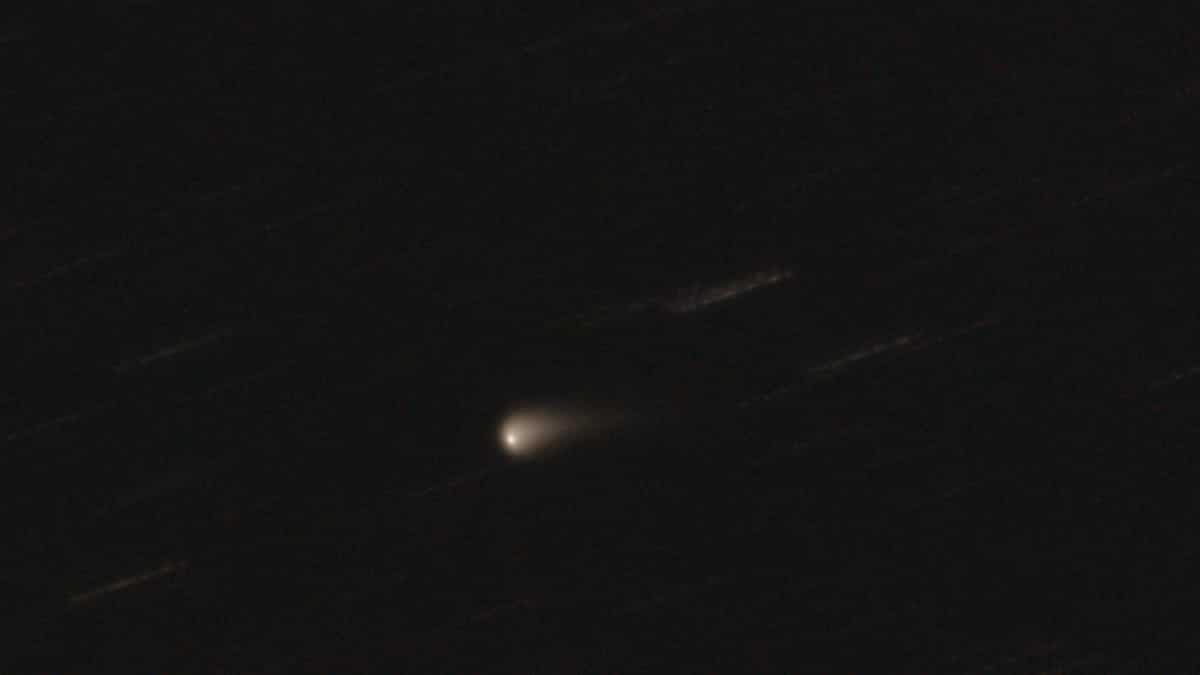
Image of Comet C/2023 A3.
Comet C/2023 A3 or Tsuchinshan-ATLAS, which has been given the title of ‘comet of the century' is set to come very close to Earth in autumn 2024.
When it approaches the Earth, it is likely to have a bright, beautiful and long tail as it passes by the Sun at a distance which is similar to the orbit of Mercury. During this time, the ice over the comet will evaporate, a large amount of dust will cover it and it will have the brightest tail.
When and where the comet will be visible?
The space observatories first spotted the comet in early 2023 inChinaand South Africa. This time it will be approaching Earth on October 12, which is the InternationalAstronomyDay.
When it comes closer, the comet will appearas bright as the stars. If it deteriorates, its lustre will be lost and it will becomedifficult to be viewed by the human eye.
Also Read:Delta Aquariids meteor shower to peak this week. How, when and where to watch celestial event
Comet C/2023 A3 will be clearly visible in the Northern Hemisphere. In 1997, Comet Hale-Bopp was also spotted in this hemisphere.
The comet is expected to be visible in November evenings at 4.5-8 magnitude and will rise higher in the Northern Hemisphere after sunset.
The comet should be visible at 8-10 magnitude in December. Gradually it will move closer to the Sun and move above the horizon.
How can you watch the comet?
It is not required to travel to distant places to watch this comet. People can log in to the 'Sky Tonight' app to watch Comet C/2023 A3 or Tsuchinshan-ATLAS.
In the application, the current position of the comet can be seen for the location. The device needs to be pointed to the sky and the white arrow has to be followed to the spot of the comet.
Watch:China proposes information superhighway between Earth and Moon
Astronomers are worried the comet might be breaking up and will crumble before it hits the perihelion which should happen sometime before September 27 when it makes its closest approach to the Sun.
Because of gravitational forces and solar radiations, the cometsdisintegrate.
(With inputs from agencies)