It's a Chinese rocket, not one from SpaceX that will crash on Moon, says astronomer

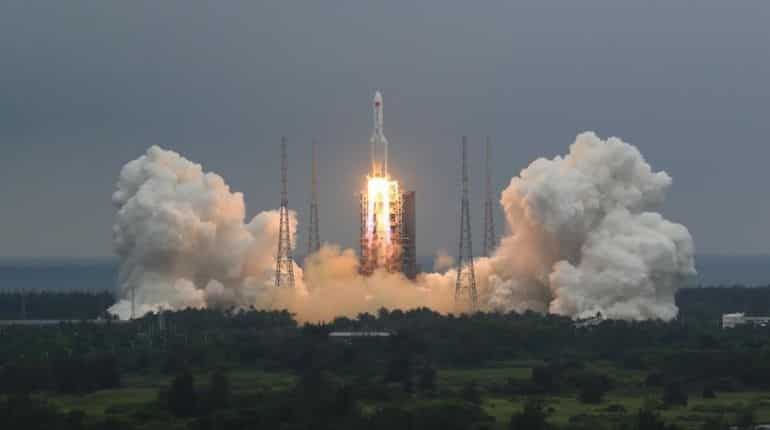
Long March 5B rocket
An astronomer has revealed thatthe Chinese Long March 3C rocket is on course to collide with the Moon and notSpaceX's Falcon 9.
Known as Bill Gray, the astronomer wrote the Project Pluto software used to track near-Earth objects.
Uncertainty over the rocket's orbital decay and China's failure to issue stronger reassurances has fuelled anxiety.
"It would be a little strange if the second stage went right past the Moon, while DSCOVR was in another part of the sky. There's always some separation, but this was suspiciously large," Gray explained.
An object called WE0913A can collide with the far side of the Moon on 4 March 2022, at around 12:25 pm UTC as per his observations.
However, if its leftover fuel leaks out and pushes it around that can cause changes in the orbit.
Remnants of China's biggest rocket, Long March 5B had landed in the Indian Ocean with most of its components destroyed upon re-entry into the atmosphere. It hadlaunched the 22.5-ton core of China's newest space station.
The 18-tonne rocket that fell last May was the heaviest debris to fall uncontrolled since the former Soviet space station Salyut 7 in 1991.
The Long March was the second deployment of the 5B variant since its maiden flight in May 2020. The pieces from the first Long March 5B fell on Ivory Coast, damaging several buildings.
China’s first space station, Tiangong-1, crashed into the Pacific Ocean in 2016 after Beijing confirmed it had lost control. In 2019, the space agency controlled the demolition of its second station, Tiangong-2, in the atmosphere.
The Global Times, a Chinese tabloid, dismissed as "Western hype" concerns the rocket was "out of control" and could cause damage.
"It is common practice across the world for upper stages of rockets to burn up while reentering the atmosphere," Wang Wenbin, a spokesman at China's foreign ministry, said at a regular media briefing.
"To my knowledge, the upper stage of this rocket has been deactivated, which means most of its parts will burn up upon re-entry, making the likelihood of damage to aviation or ground facilities and activities extremely low," he added.
The rocket, which put into orbit an unmanned Tianhe module containing what were supposed to be living quarters for three crew on a permanent Chinese space station, will be followed by 10 more missions to complete the station by 2022.
(With inputs from agencies)