China's 'artificial sun' cracked a major code, setting a new record in physics

&imwidth=600&imheight=450&format=webp&quality=medium "China's 'artificial sun' cracked a major code, setting a new record in physics")
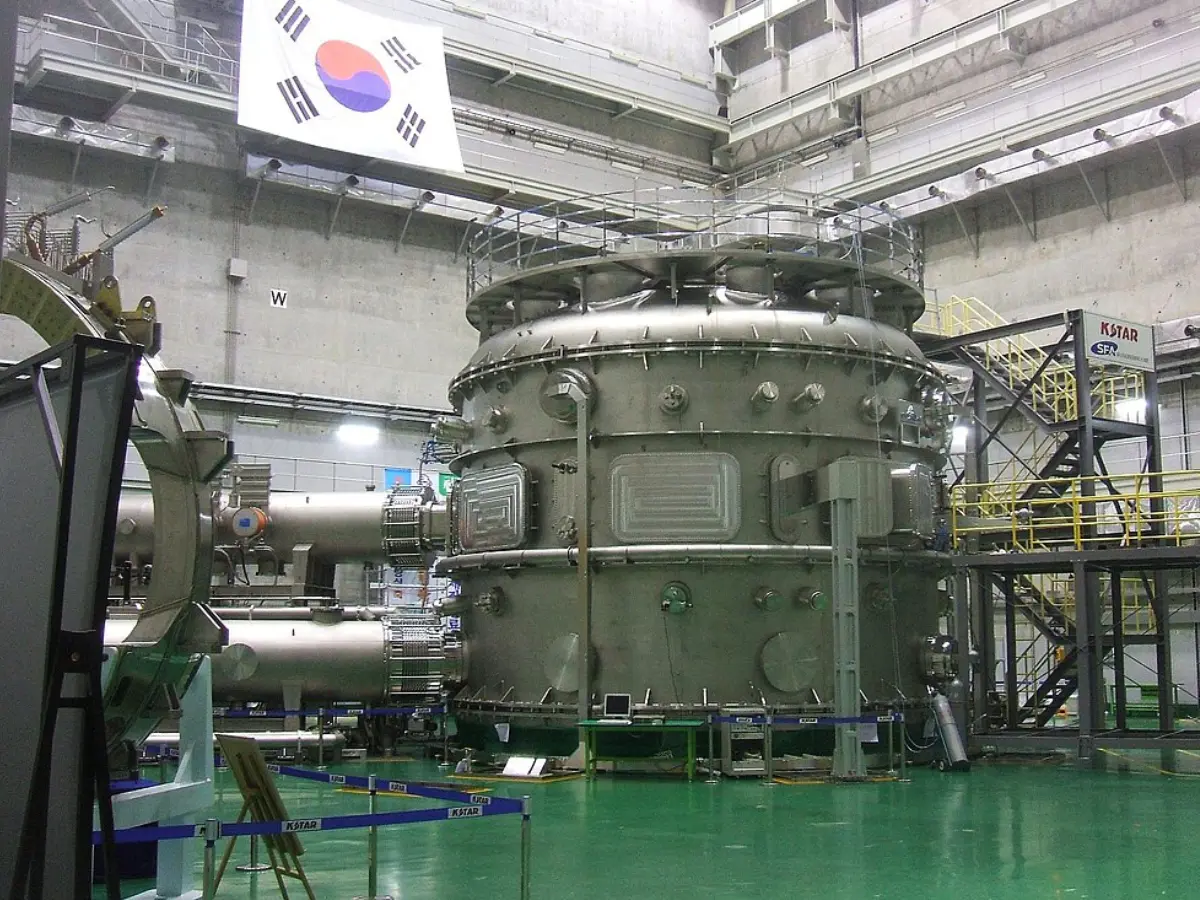
n the Experimental Advanced Superconducting Tokamak in China. Photograph: (Wikimedia Commons)
Scientists in China have broken the Greenwald limit, achieving a major breakthrough in fusion reaction. They solved a crucial problem while working on the "artificial sun", or the Experimental Advanced Superconducting Tokamak (EAST).
Scientists in China working on the "artificial sun" have managed to break a long-standing "speed limit" in physics known as the Greenwald limit. The breakthrough on the Experimental Advanced Superconducting Tokamak (EAST) came on January 1, and it also changes the rules for building stars on Earth. This limit occurs in a scenario in which there is a fusion reactor shaped like a doughnut where scientists pack in super-hot gas (plasma) to create energy, just like the sun. But there is a rule for how much of it you can add, and this ceiling is what is known as the Greenwald limit. If too much plasma is added to the bottle, the gas would become unstable, and the reaction would crash. However, Chinese scientists have worked a way around it. They can now add 1.3 to 1.6 times more fuel than what was believed could be squeezed in, the team wrote in a new paper published in Science Advances.
They achieved this state using precise microwave heating and a "self-cleaning" method, both of which keep the reactor walls cool and clean. This creates an environment in which impurities do not accumulate, and this prevents them from ruining the reaction. The scientists were able to create a "density-free regime" where the plasma stabilises itself and does not tear apart. This breakthrough has several benefits when it comes to energy production. "The findings suggest a practical and scalable pathway for extending density limits in tokamaks and next-generation burning plasma fusion devices,” says Zhu Ping, co-lead of the study, who is a professor at Huazhong University of Science and Technology.
How does breaking the Greenwald Limit help energy production?
One of the benefits is that the energy produced increases, not just by double, but four times. In fusion, doubling the fuel translates to quadrupling the energy. Breaking this limit means reactors can produce way more power. Secondly, packing in more energy into a smaller space means that future fusion power plants don't necessarily need to be humongous, billion-dollar megastructures. They could be smaller, simpler, and cheaper to build. Besides, breaking the Greenwald Limit shows that it was merely a hurdle and not something defined by nature. The achievement opens doors for limitless, clean energy and can make international fusion projects more efficient.

