Chang’e-6: China launches historic mission to collect samples from far side of the Moon

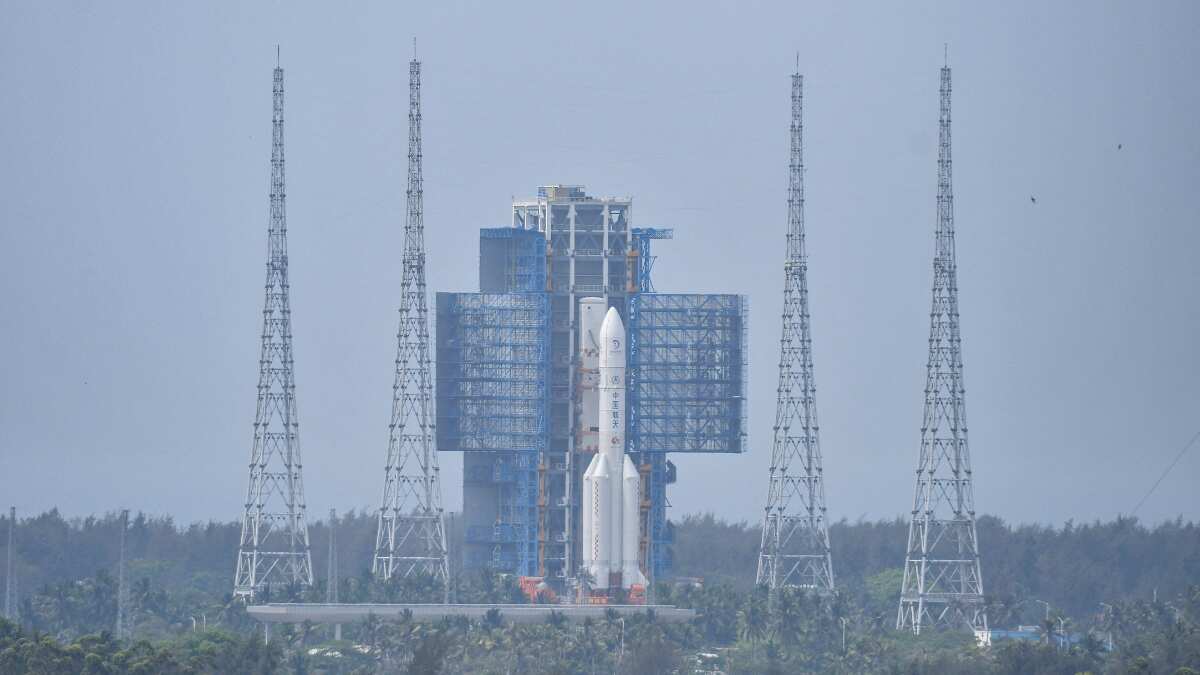
China's Chang'e rocket
China on Friday (May 3) successfully launched its historic mission to collect rocks and soil from the far side of the Moon, becoming the first country to make such an ambitious attempt.
About the launch ofChang’e-6 probe
The Long March-5, China’s largest rocket, successfully launched carrying the Chang’e-6 probe, which weighs more than eight metric tonnes, from the Wenchang Space Launch Centre, on the southern island of Hainan, at around 5:27 pm (local time), announced the China National Space Administration (CNSA).
The launch was attended by scientists, diplomats and space agency officials from France, Italy, Pakistan, and the European Space Agency (ESA), all of which have Moon-studying payloads aboard the rocket.
“It is a bit of a mystery to us how China has been able to develop such an ambitious and successful programme in such a short time,” said Pierre-Yves Meslin, a French researcher working on one of the scientific objectives of the Chang’e-6 mission, as quoted by Reuters.
Notably, no United States-based organisations applied to get a payload spot, said Ge Ping, deputy director of the CNSA’s Lunar Exploration and Space Programme.
This is because Beijing is banned by American law from any collaboration with the US space agency NASA.
What is the Chang’e-6mission about?
Chang’e-6 is tasked with landing in the South Pole-Aitken Basin on the far side of the Moon, which faces away from Earth, to retrieve samples.
The mission’s goal is to collect two kilogrammes of soil and rocks from the landing site and bring them back to Earth for detailed analysis.
“The far side of the moon has a mystique perhaps because we literally can’t see it, we have never seen it apart from with robotic probes or the very few number of humans that have been around the other side,” said Neil Melville-Kenney, a technical officer at ESA working with Chinese researchers on one of the Chang’e-6 payloads, as quoted by Reuters.
Also Read |Crater-filled Moon and faint Earth in the background: Chinese satellites beam eerie image from space
The Chinese spacecraft will rely on the relay satellite that has been recently deployed and in its 53-day mission is orbiting the Moon.
Once the probe separates from the rocket it will take around four to five days to reach the Moon and is expected to land on the far side of the lunar surface in June.
The probe – named after the Chinese Moon goddess – will then spend around two days digging up the samples before it makes its journey back to Earth, where it is expected to land in Inner Mongolia.
(With inputs from agencies)