'Carrying the Tricolour on my shoulder’: Indian astronaut Shubhanshu Shukla makes historic address from space

&imwidth=600&imheight=450&format=webp&quality=medium "'Carrying the Tricolour on my shoulder’: Indian astronaut Shubhanshu Shukla makes historic address from space")
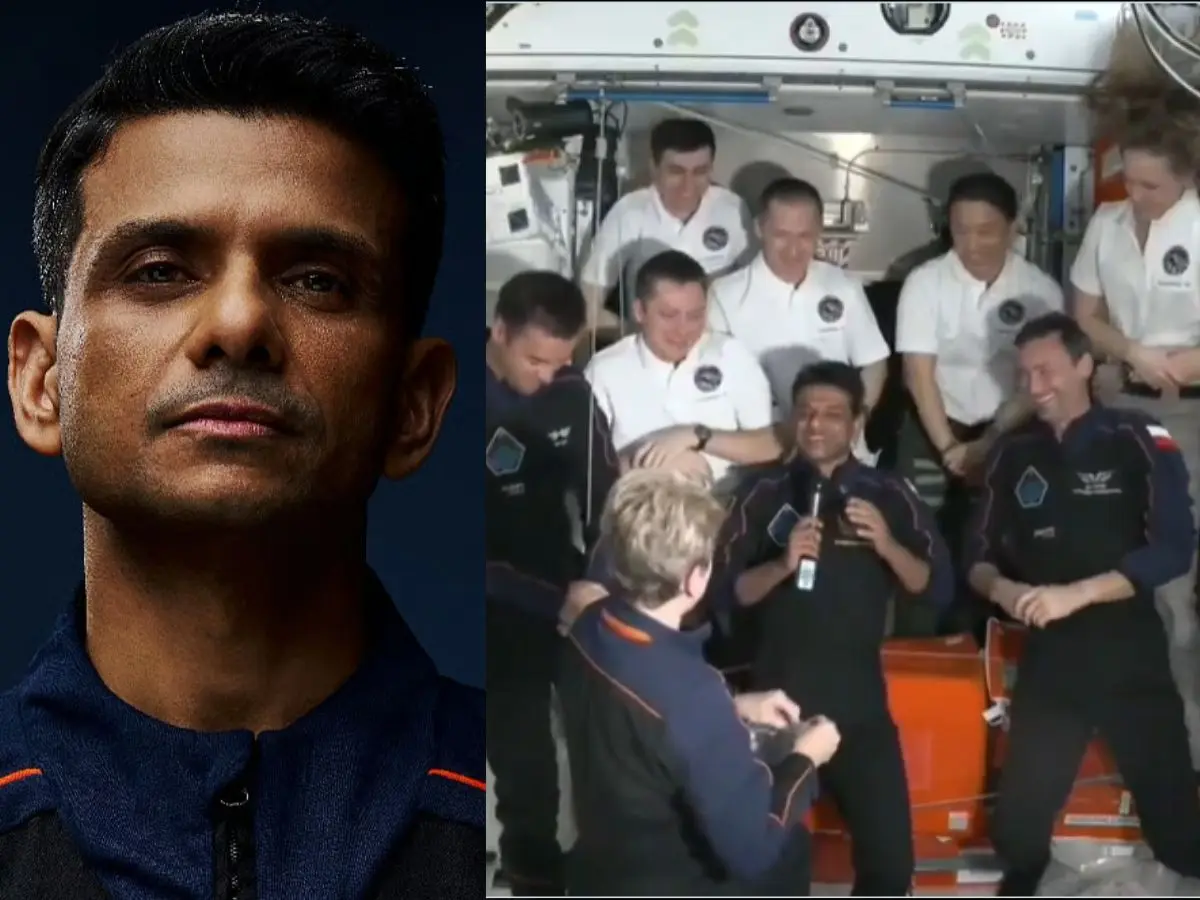
Shubhanshu Shukla makes historic address from space Photograph: (Axiom Space)
“This is just the first step of a long journey. We will be conducting many experiments and also speaking to you from time to time,” Shukla said.
Shubhanshu Shukla, Group Captain in the Indian Air Force, became the first Indian to reach the International Space Station (ISS), marking a historic milestone for India’s space ambitions. Part of the Axiom Mission 4 (Ax-4), Shukla addressed the nation from the ISS on Thursday, saying, “It is a privilege to be among the few who have had the chance to see Earth from such a vantage point.”
His message followed a successful 28-hour journey aboard SpaceX’s Dragon spacecraft, which docked with the ISS’s Harmony module. He was pinned with the official Astronaut No. 634 badge by mission commander Peggy Whitson before delivering his remarks. “Thanks to your love and blessings, I have safely reached the International Space Station,” he said. “It may look easy to stand here and speak, but it’s actually a little difficult. There’s a bit of pressure on the head, a bit of discomfort, but these are small things. In just a few days, we’ll get used to it.”
14-day science mission, ISRO collaboration underway
Shukla is joined by Whitson, Tibor Kapu (Hungary), and Sławosz Uznański (Poland) on the Ax-4 mission, operated by Axiom Space in collaboration with NASA, ESA, ISRO, and SpaceX. The crew will work alongside the seven Expedition 73 crewmates, conducting over 60 scientific experiments — including seven developed by ISRO. “This is just the first step of a long journey. We will be conducting many experiments and also speaking to you from time to time,” Shukla said.
Expressing national pride, he added, “I’m carrying the tricolour on my shoulder, and I believe you are all with me. So I believe that all of you are as excited as I am. The next 14 days are going to be very exciting. Jai Hind. Jai Bharat.” ISRO has reportedly paid $59 million for Shukla’s seat and training, aiming to use insights from this mission to advance India’s human spaceflight programme, including Gaganyaan in 2027, a space station by 2035, and a lunar mission by 2040.
“I'm looking forward to the next 14 days, advancing science and research, and working together,” Shukla said as he passed the mic to his fellow crewmate from Poland.

