Brain study on F-16 pilots reveals crucial insights for future space travels

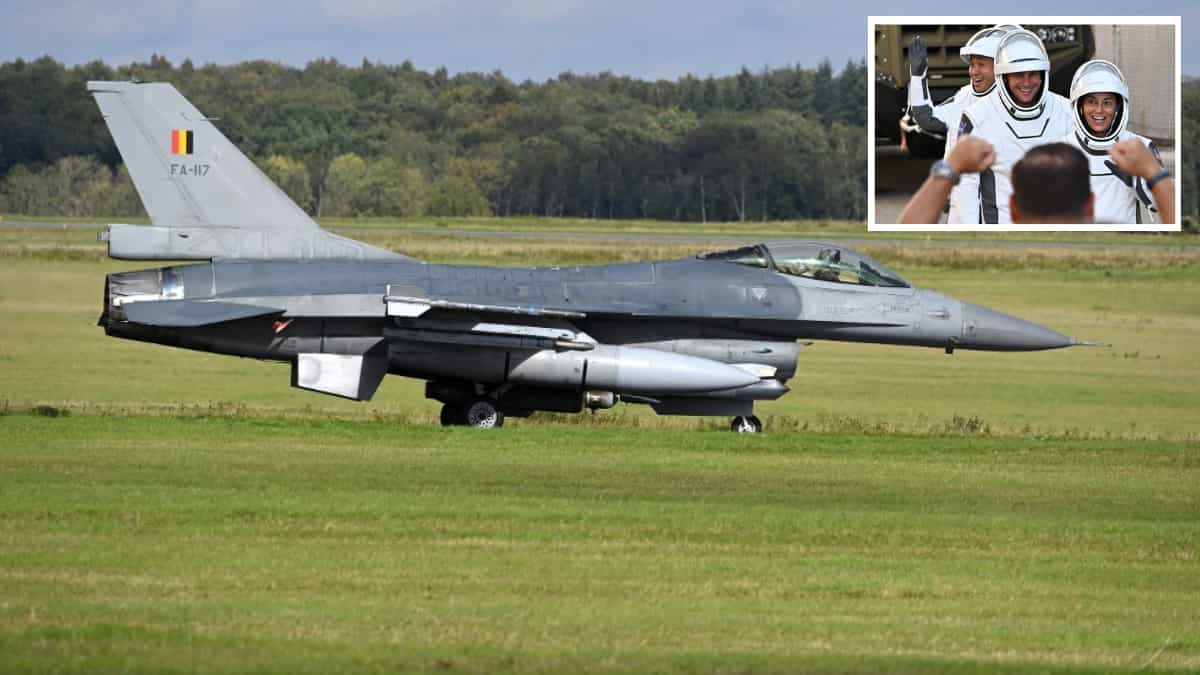
An F-16 fighter jet owned by Belgian Air Force and astronauts who flew off a SpaceX rocket last year
Experienced fighter jet pilots have better brain connectivity to process visual information as well as the sense of balance, researchers in Belgium found in a significant study for defence aviation as well as space travel. The study, aimed to investigate functional brain connectivity in fighter jet pilots, examined the cognitive abilities of a total of 10 male fighter jet pilots of the Belgian Air Force. The pilots selected for the study had flight experience with the F16 fighter jets.
The researchers then compared the results with the cognition abilities of 10 adults 'with no flight experience'.
The MRI scans revealed that pilots with more flight experience showed specific brain connectivity patterns in areas related to processing sensorimotor information, indicating enhancedpostural control and gait as well as better-timed reflexes.
F-16 pilots and astronauts experience similar gravity changes
The study further examined whether brain connectivity changes in F16 fighter pilots could be expected in astronauts. This is because the F16 fighter pilots have a lot in common with astronauts in terms of adapting to variable gravity levels and rapidly processing diverse sensorimotor information.
"Fighter pilots have some interesting similarities with astronauts, such as exposure to altered g-levels, and the need to interpret visual information and information coming from head movements and acceleration (vestibular information)," said Professor Floris Wuyts of the University of Antwerp, senior author on the study. "By establishing the specific brain connectivity characteristics of fighter pilots, we can gain more insight into the condition of astronauts after spaceflight."
ALSO WATCH |Gravitas: Is AI going to replace your brain?
Since the F-16 pilots experience similar gravity level changes as astronauts, the study finds relevance for future long-duration missions, such as to the Moon and Mars,where a future space crew will be exposed to varying levels of gravitational force across the span of the mission.
What did the study find?
The study found that changes in functional brain connectivity are linked to the number of hours flown by a fighter jet pilot. For the pilots who have 'flown more often', the study found better connectivity between parts of the brain that responds to process visual information and the sense of balance.
WATCH WION LIVE HERE
You can now write for wionews.com and be a part of the community. Share your stories and opinions with us here.