Black holes don’t gobble up everything, consume just 3% of what they suck: Study

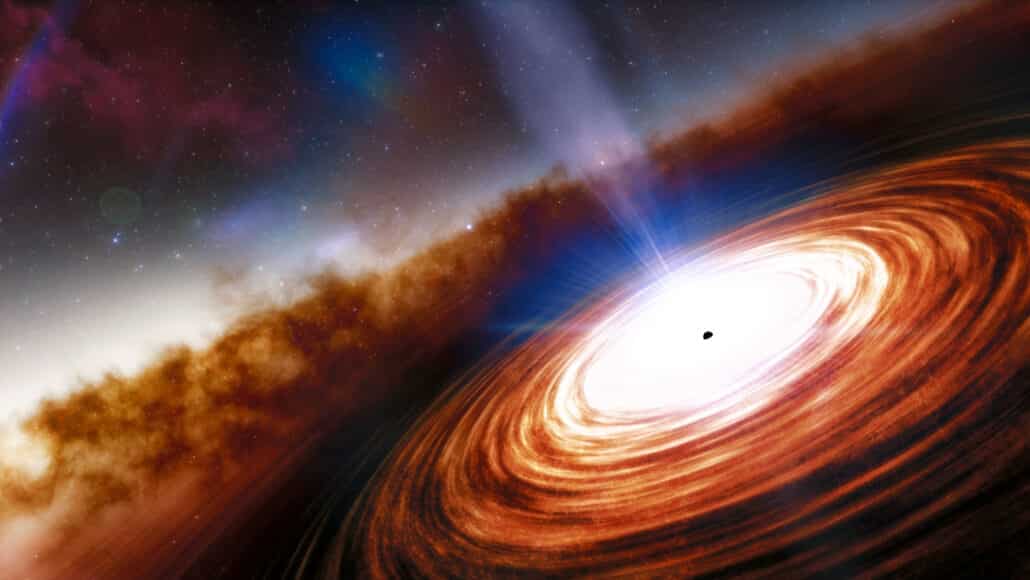
Image representing a supermassive black hole
Have you ever wondered what the supermassive black holes feed on? It is generally thought that they gobble up everything whatever comes in their way. But now a team of Japanese scientists have concluded that the black holes might be much pickier and actually consume just 3 per of what is sucked into them.
The team reached the results using the ALMA radio telescope array in Chile's Atacama Desert. While conducting the experiment, the team focused on a relatively tiny sliver of the black hole at the centre of the Circinus galaxy, which lies some 13 million light-years from Earth.
What did the scientists observe?
The team noted that the gravitational pull of the black hole theorised gas and dust from space ionised it and sucked it into an inner accretion disk around it.
The scientists observed that even as the hole attracted a lot of gas, and clouds of dust around it, it ate just 3 per cent of the total elements pulled into it.
"The supply of material to the SMBH is known to trigger this feedback, although it has not been possible to quantitatively connect the gas supply to the subsequent feedback," the scientists write in the paper, but they also point out that more research will need to be done to validate the findings and build on their theory of how black holes' leftovers might feed new star formation.
About supermassive black holes
Supermassive black holes are believed to be situated at the heart of vast galaxies, including our own. Much like a spider in the centre of its web, these enigmatic entities expand by consuming interstellar gas and dust that venture too near.
Watch:Gravitas: Scientists reveal the sound of a super massive black hole
Yet, due to the extreme density and opacity of black holes, understanding their nature proves to be an immensely challenging task.
It is to be noted that despite having garnered the special attention of scientists for decades, black holes still remain a topic of mystery among the scientific community. Experts possess limited knowledge regarding the fate of matter drawn close to black holes, except for the observation that once it enters.
(With inputs from agencies)