As moon probe Chandrayaan-3 falls asleep, Sun probe Aditya-L1 is awake and kicking

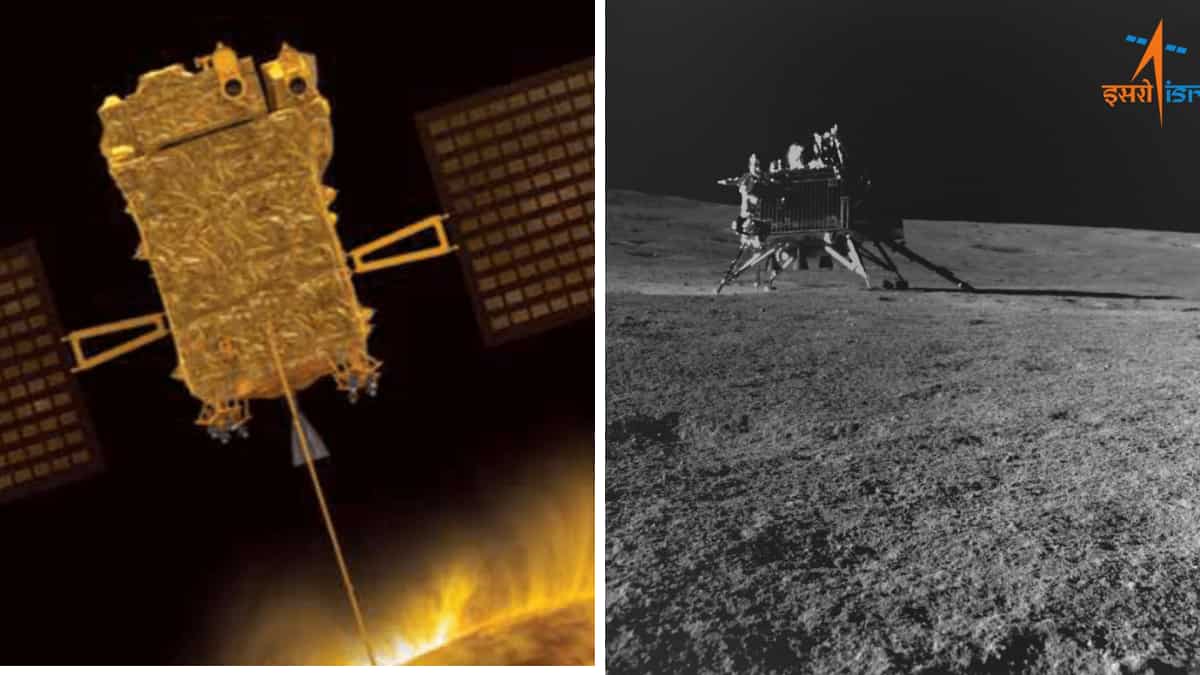
Aditya and Vikram
India's Aditya-L1 craft, the country's maiden mission to study the Sun has performed its maiden Orbit Raising Manoeuvre (fired its on-board engines to kick itself further away from earth). The craft was placed in an elliptical (egg-shaped) orbit around the earth by a PSLV-XL rocketaround 1 PM, Indian Standard Time on September 2nd.
Meanwhile, the Indian moon probe Chandrayaan-3 is being 'put to sleep' near the Lunar South Pole, as the Lunar night (fortnight-long on earth) fast approaches.
"Aditya-L1 Mission: The satellite is healthy and operating nominally. The first Earth-bound maneuvre (EBN#1) is performed successfully from ISTRAC, Bengaluru. The new orbit attained is 245km x 22459 km. The next maneuvre (EBN#2) is scheduled forSeptember 5, 2023, around 03:00Hrs. IST" ISRO said on X, formerly known as Twitter on September 3rd.
"Chandrayaan-3 Mission: The Rover completed its assignments. It is now safely parked and set into Sleep mode. APXS and LIBS payloads are turned off. Data from these payloads is transmitted to the Earth via the Lander. Currently, the battery is fully charged. The solar panel is oriented to receive the light at the next sunrise expectedon September 22, 2023. The receiver is kept on. Hoping for a successful awakening for another set of assignments! Else, it will forever stay there as India's lunar ambassador," ISRO posted on X on September 2nd.
While Aditya-L1 is a mission to study the sun, it would be travelling only 1 per centof the Earth-Sun distance, unlike NASA's Parker Solar Probethat has flown a few million miles in the vicinity of the Sun.
The Earth-Sun distance is approximately 150 million kilometres.
The launch of Aditya-L1 comes barely 10 days after India soft-landed its Chandrayaan-3 craft (comprising a lander and rover) on the moon.
"Studies related to the Sun can be carried out from ground-based observatories, but they are limited by the day-night cycle. So, an agency would require multiple stations across the earth to study the sun continuously, but each of these observatories would offer their own data(based on the unique characteristics of the equipment). Also, the earth's atmosphere and dust particles scatter the radiation coming in from the sun and affect the quality of the data" Prof Ramesh from the Indian Institute of Astrophysics told WION.
Chandrayaan-3 soft-landed near the Lunar South Pole on August 23rd.
Over the last 11 days, the Chandrayaan-3 lander and rover have been performing in-situ experiments with their respective payloads and sharing the data.
However, the end of the Lunar day time is closing in fast on the Vikram Lander and Pragyan Rover. As the duo are solar-powered, they would not be able to function during the fortnight-long Lunar night.
"The Chandrayaan-3 Lander and Rover are functional and our payload teams are doing all th work... The Rover has traversed a distance of 100meters from the lander..." Dr.S.Somanath, Chairman, ISRO, said following the successful launch of the Aditya-L1 solar observatory satellite.
On average, the temperature during the Lunar day could be around 120degrees Centigrade(For earthlings - that's much more than the boiling point of water or more than twice the hottest recorded temperatures on earth), whereas the Lunar nights could get as cold as -130degrees Centigrade (that's almost twice the coldest temperature recorded on the Earth).
At the Lunar poles, these temperatures could be even more extreme and hostile.
ISRO mentioning that the Chandrayaan-3 rover is out to sleep and lander is to be put to sleep, shows that
ISRO has the possible technological means and hope to make Vikram and Pragyan survive the Lunar night.
Also watch |Chandrayaan-3's Vikram Lander detects unknown seismic activity on the moon
Else, if the mission were to come to an end after the Lunar day, ISRO could have mentioned about bidding permanent goodbye to the lander and rover. By switching off all the on-board equipment and going into a hibernation mode and protecting itself from the cold (comparable to covering oneself using a blanket), ISRO could possibly ensure that Chandrayaan-3 survives the Lunar night.
When the Lunar dawn breaks next (around the third week of September),if and when the lander and rover survive, they could again harness the power of the Sun and charge their batteries and continue to carry out their operations.
Though a possibility, this could prove a serious bonus to ISRO's exploratory activities near the Lunar south pole region, which India temporarily has for itself to explore.
However, both the lander and rover have to survive the night for the duo to function normally.
This is because, the Lander craft is the primary and direct communication link with the earth.
If the lander cannot communicate directly, it could also use the services of the Chandrayaan-2 orbiter to relay its communications to earth and receive new commands.
However, the 26-kg rover is entirely dependent on the lander to receive commands and carry out communications, data transfer.
"We are hoping that after the Lunar night it will come back, but it is not assured. This is because, all systems will go to minus 150degrees Centigrade temperature, which is far beyond the survival limit of may materials used on the lander craft. By design it is meant to live for 14days, but if we are lucky, we may get longer" M. Sankaran, Director, ISRO's UR Rao Satellite Centre had told WION.
WATCH WION LIVE HERE
You can now write for wionews.com and be a part of the community. Share your stories and opinions with us here.
