As Chandrayaan-3 approaches Moon, Chandrayaan-2 lends helping hand

Chandrayaan-3
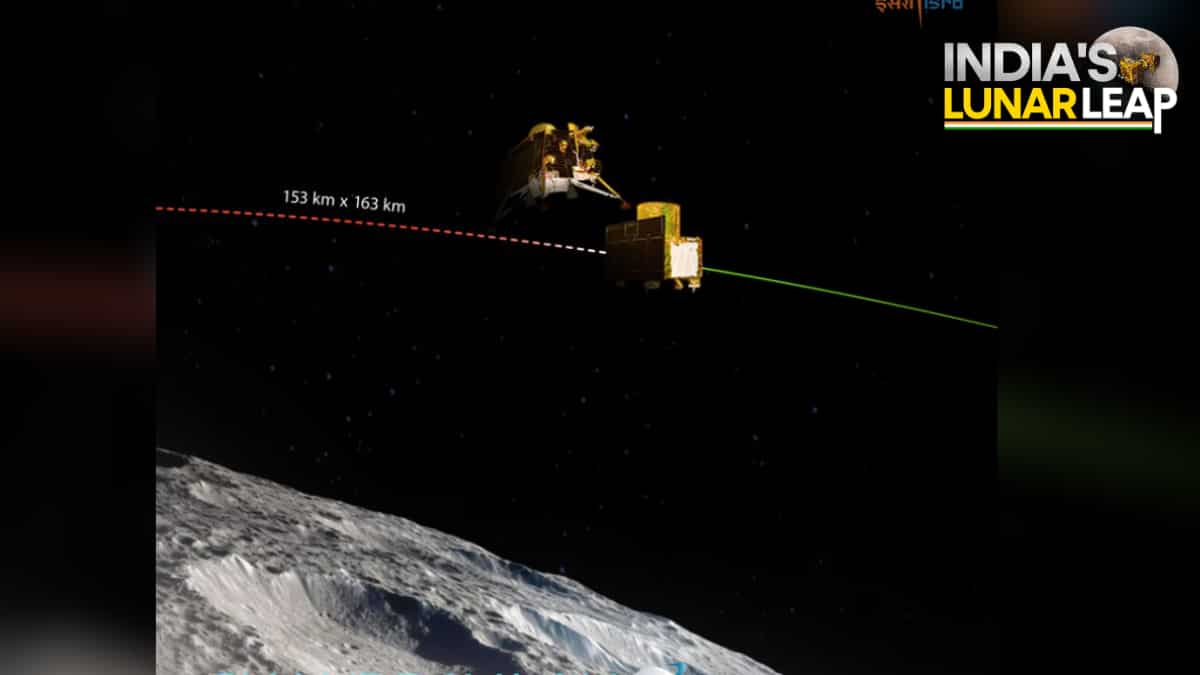
Indian Space Research Organisation's (ISRO) Chandrayaan-3 is racing towards the Moon as India seeks another milestone in its spacefaring endeavours. On Friday (August 18), the lander module of Chandrayaan-3 carried out an orbit reduction manoeuvre to draw itself closer to the Moon. It is first of two such manoeuvres. A soft landing is scheduled to take place on August 23.
"The Lander Module (LM) health is normal. LM successfully underwent a deboosting operation that reduced its orbit to 113 km x 157 km. The second deboosting operation is scheduled for August 20, 2023, around 0200 Hrs. IST," said ISRO on social media platform X (formerly Twitter).

In its Chadrayaan-2 mission, India was not able to land on the Moon successfully but the mission helping its successor to succeed nonetheless. The orbiter from Chandrayaan-2 mission has been orbiting Earth's only sattelite for past four years. And it is set to do its bit to ensure that Chandrayaan-3 mission succeeds.
Watch | Chandrayaan-3 shares new video as it readies for touchdown
The orbiter is contributing to the mission already as it has identified a relatively safe place on Moon for the lander to land. Additionally, it will also facilitate communication between the lander module and Earth. This means that Chandrayaan-3 lander, when it lands, will first send message to Chandrayaan-2 orbiter which will then relay it to Earth. Chandrayaan-3 lander has an independent capacity to communicate with Earth as well but when it will land, ISRO would have benefit of having 'boots on grounds' as well as in the orbit of the Moon.
“Ultimately, the radio signals will come to earth from the orbiter and this is not from Chandrayaan-3 but from the orbiter of Chandrayaan-2. The Chandrayaan-2 orbiter is functioning very well and it will communicate with the Chandrayaan-3 lander. This signal will reach the ground station,” ISRO chairman S Somnath said in a public interaction on August 9.
Also Read | Chandrayaan-3: Vikram Lander 'healthy', completes its maiden solo manoeuvre
“Suppose, for any reason, the Chandrayaan-2 orbiter is not working properly then the Chandrayaan-3 lander will communicate directly with Earth. For the rover (which will be released after a safe and soft landing) the communication is only with the lander and the lander will communicate with the orbiter or earth stations,” Somnath said.
When Chandrayaan-2 was approaching the Moon, its landing site was finalised based on pictures of the Moon obtained from other space agencies. But this time India is finalising things on its own.
“The landing site area is increased to four km by 2.4 km against the (earlier) 0.5 x 0.5 for C2. The lander will land in the middle of the landing site. The landing site has been imaged properly. We found that the landing site is reasonably flat but it still contains craters and boulders but compared to other locations it is flatter. The camera (onboard the lander) will still have to look before landing to see there are no craters or boulders,” the ISRO chairman said.
You can now write for wionews.com and be a part of the community. Share your stories and opinions with us here.
WATCH WION LIVE HERE