An unknown civilisation? Giant sloth pendants indicate humans came to Americas earlier than believed

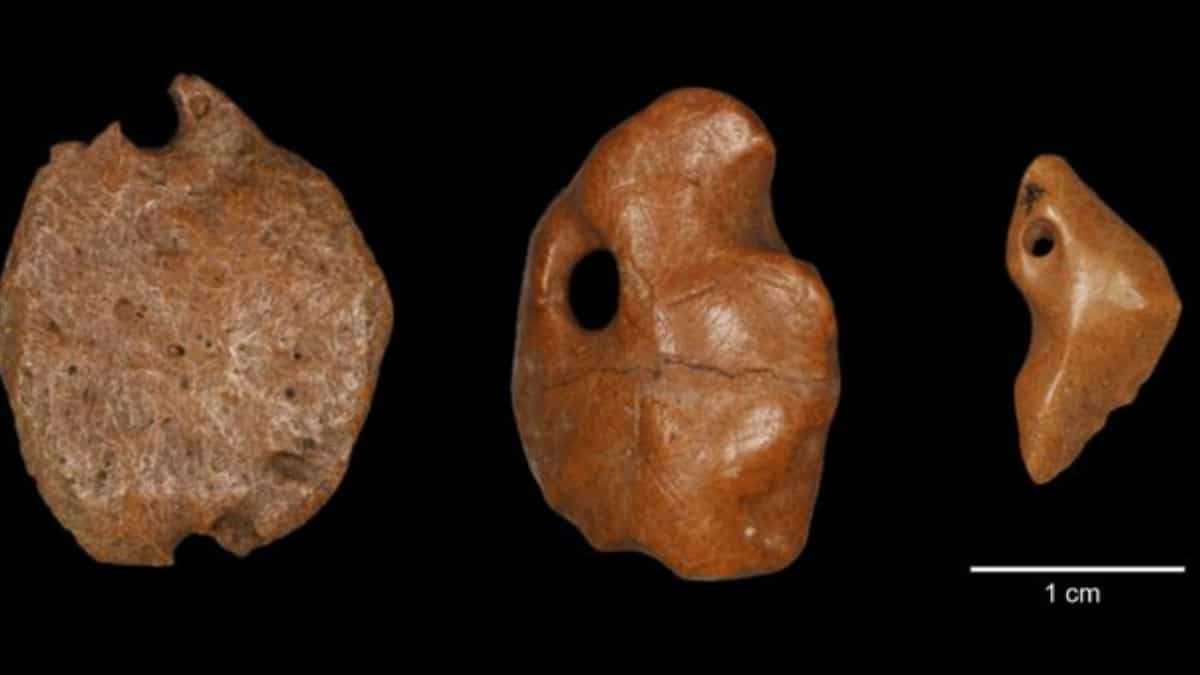
Giant sloth pendants discovered in Brazil.
New research has hinted at the possibility of humans living in South America in the same time period when now-extinct giant sloths existed, hence giving evidence of people living in the Americas earlier than believed.
Teardrop-shaped and triangular pendants, made of bony material taken from the sloths, were analysed by the scientists. They reached the conclusion that drilled holes and carved and polished shapes appeared to be the craftsmanship of humans.
The pendants, which are believed to be between 25,000 and 27,000 years old, are the oldest known personal ornaments which have been unearthed in the Americas and the only ones found which are believed to have been made from giant sloth bone in archaeological history, as per palaeontologist Thais Pansani, lead author of a new study on the artefacts.

ALSO READ |Astronomers discover most reflective planet that's 'like a mirror'
The suggested period ranges several thousand years earlier than some theories that stated that the first people arrived in the Americas after they migrated out from Africa and then Eurasia.
“We now have good evidence – together with other sites from South and North America – that we have to rethink our ideas about the migration of humans to the Americas,” stated Mirian Liza Alves Forancelli Pacheco, study co-author and archaeologist at the Federal University of Sao Carlos in Brazil.
Ornaments discovered in a rock shelter
In the last decade, other research has questioned the conventional wisdom that humans did not reach the Americas till a few thousand years before the Bering land bridge was covered by rising sea levels between Russia and Alaska, around 15,000 years ago.
The researchers discovered the ornaments around 30 years ago at a rock shelter which has been named 'Santa Elina' in central Brazil. The new study is the first which has extensively analysed them and rule out the possibility of humans carving them thousands of years after the extinction of the animals.
WATCH |Did an interstellar meteor hit earth in 2014?
The team of researchers from the US, France and Brazil in their analysis said that this handiwork was done in some days to a few years after the animals were killed, and before the materials had fossilised. Meanwhile, natural abrasion and other reasons which might explain the shapes and holes were also ruled out by the researchers. Their findings were reported by them on Wednesday in Britain’s Proceedings of the Royal Society B journal.
“We think they were personal objects, possibly for personal adornment,” stated Thais Rabito Pansani, study co-author and palaeontologist at the Federal University of Sao Carlos in Brazil.
Anthropological geneticist at the University of Kansa Jennifer Raff stated that the new paper was “an important addition” to the conversation, however, like similar findings on the topic, it may also attract pushback.
You cannow write forwionews.comand be a part of the community. Share your stories and opinions with ushere.
WATCH WION LIVE HERE