A tiny meteorite probably struck Soyuz causing a coolant leak, Russian official says

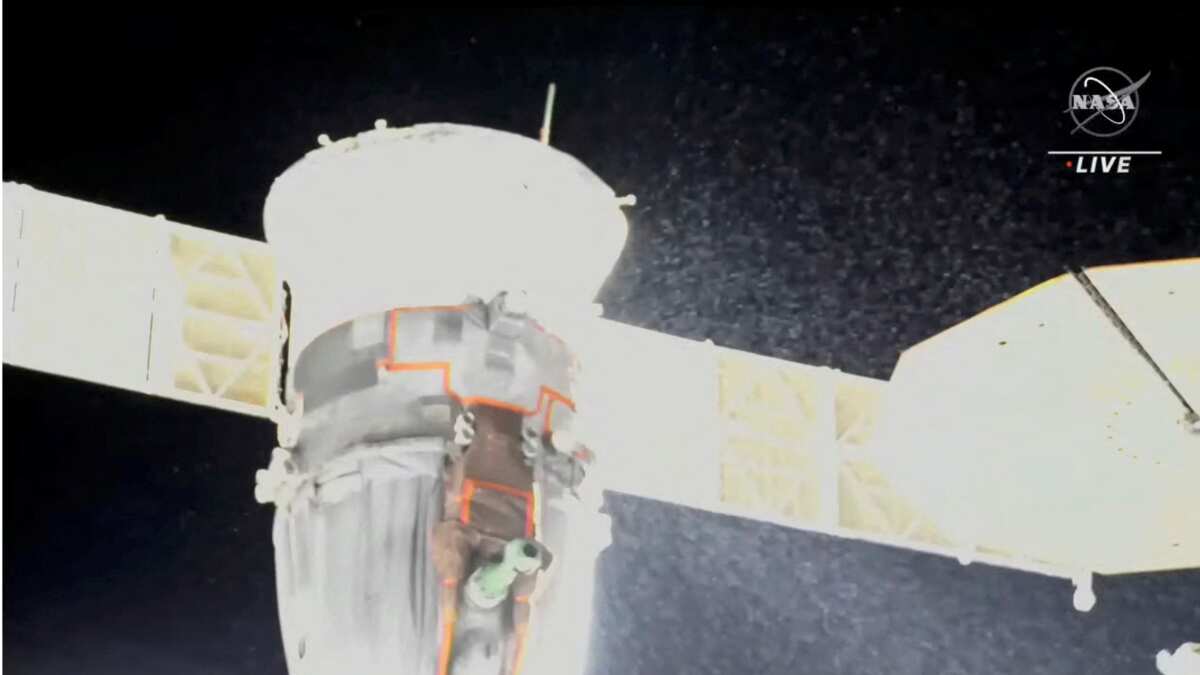
Soyuz leak
A coolant leak aboard the Soyuz MS-22 spacecraft that lasted at least three hours might have been caused by a tiny meteorite strike. The capsule is docked with the International Space Station and started spewing a stream of liquid right before the Russian cosmonauts were about to start a spacewalk on Wednesday. A liquid seems to be escaping from the spacecraft, possibly coolant, a NASA commentator had said.
Dramatic NASA TV images had earlier showed white particles that looked like snowflakes streaming out of the rear of the vessel for hours.
The TASS news agency quoted Sergei Krikalev, a former cosmonaut and head of the crewed space flight program for Russia's space corporation Roscosmos, as saying that the leak may have been caused by a tiny meteorite striking the capsule.
"The cause of the leak may be a micrometeorite entering the radiator," TASS quoted Krikalev as saying. "Possible consequences are changes in the temperature regime."
"No other changes in the telemetric parameters of either the Soyuz spacecraft or the (ISS) station on the Russian or American segments have been detected," Krikalev said.
Roscosmos and NASA said the leak did not pose any danger to the astronauts and cosmonauts aboard the ISS.
"The crew members aboard the space station are safe, and were not in any danger during the leak," NASA said.
"Potential impacts to the integrity of the Soyuz spacecraft" are also being evaluated, NASA said.
Tiny micrometeoroids are nothing but space rocks, mostly as small as a grain of sand. They are a common part of the space environment and are not known to cause heavy damage to the ISS and other spacecraft that are protected by advanced shielding.
The Soyuz spacecraft in question had carried cosmonauts Sergey Prokopyev and Dimitri Petelin and NASA astronaut Frank Rubio to the space station in September as part of the first joint US-Russian flight under a renewed agreement between NASA and Roscosmos. The coolant leak is likely to have an impact on the return flight to Earth by the three crew members in March next year. In case problems persist, NASA and Roscosmos will need to look at other contingency plans.
(With inputs from agencies)
WATCH WION LIVE HERE
You can now write for wionews.com and be a part of the community. Share your stories and opinions with us here.

