2022 was fifth hottest year on record, and 2023 is likely to be worse: Report

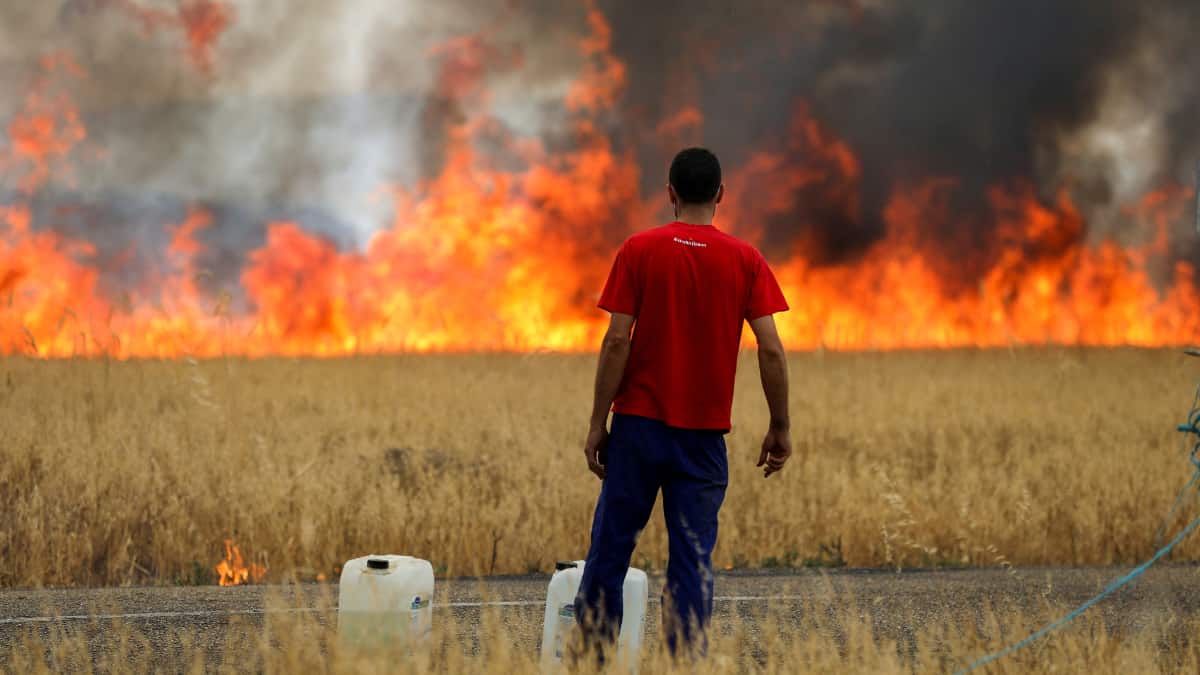
Spain wildfire
A report published on Thursday said that 2022 was the fifth warmest year on record globally. The report by EU Copernicus scientists has also predicted the return of the El Nino weather phenomenon that could drive temperatures higher in 2023. Glaciers melted last year during Europe's hottest recorded summer and the phenomenon could repeat as the continent warms at nearly twice the global rate, the EU's climate observatory said.
"El Nino is normally associated with record breaking temperatures at the global level. Whether this will happen in 2023 or 2024 is yet known, but it is, I think, more likely than not," said Carlo Buontempo, director of the EU's Copernicus Climate Change Service.
"We are really moving into uncharted territory."
Climate models suggest a return to El Nino conditions in the late boreal summer, Buontempo said. He added that there is possibility of a strong El Nino developing towards the end of the year.
Climate change fuelled extreme weather events in the world last year and later, with heavy rain causing disastrous flooding in Pakistan. Later in February, Antarctic sea ice levels hit a record low.
In several European countries, 2022 saw the highest carbon emissions from wildfires that engulfed several areas for a much longer period than average. The wildfires ignited earlier and finished later in the year, Copernicus's Samantha Burgess said.
"Climate change isn't a future problem, it is a current problem or a current challenge that we all need to adapt to and live with," she said.
Human-caused emissions are heating the planet and Europe is warming around twice as quickly as the world average, which is 2.2 degree Celsius over the past five years compared to the pre-industrial era.
Burgess says that the forecast for 2023 remains unclear, but "with higher concentrations of greenhouse gases in the atmosphere, the probability of more warm years continues to increase".
Due to the extreme droughts, southern Europe is still "incredibly dry". Burgess says that its impacts will be felt this year "unless we have significant spring rainfall".
"Unfortunately the impacts are probably already in place for the growing season. So we're likely to see reduced crop production this year because of the dry winter and spring period."
The world's average global temperature is now 1.2 degree Celsius higher than in pre-industrial times, Copernicus said.
However, Burgess still seems hopeful, despite projections that the world could hit the 1.5-degreethreshold set out in the Paris climate agreement by the early 2030s.
"Every single fraction of a degree matters, so the choices that people make are incredibly important," she said.
Climate change thaws world's northernmost research station
Meanwhile, at the planet's northernmost year-round research station, scientists are racing against time to understand how an area high above the Arctic Circle is becoming the fastest-warming place on Earth. Arond the small town of Ny-Aalesund, in Norway's Svalbard archipelago, glaciers are inundating with water.
Scientists say that studying the polar regions is extremely important as what happens in the Arctic can impact global sea levels, and storms in North America and Europe. The Arctic is warming about four times faster than the rest of the world. The situation in Svalbard is worse, with temperatures climbing even faster, up to seven times the global average.
August temperatures in Ny-Aalesund were on average 5.1 degree Celsius, about 0.5C warmer than normal for the month.
Polar bears are going hungry, partly due to the loss of sea ice, and their hunting grounds.
(With inputs from agencies)
WATCH WION LIVE HERE
You can now write for wionews.com and be a part of the community. Share your stories and opinions with us here.

