
&imwidth=800&imheight=600&format=webp&quality=medium "India at 80: From Nehru’s ‘Tryst with Destiny’ to Viksit Bharat 2047—A view from Sri Lanka")
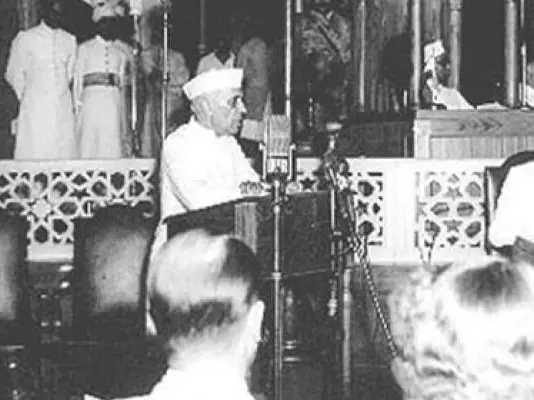
As India marks the eightieth anniversary of its independence this month, it is worth returning to the opening words of Jawaharlal Nehru’s historic “Tryst with Destiny” speech. Few passages in modern political history speak as directly to India’s present aspirations as they do today.
“Long years ago we made a tryst with destiny, and now the time comes when we shall redeem our pledge, not wholly or in full measure, but very substantially.”
Those words were not simply a celebration of freedom. They were a reminder that independence was only the beginning of a much larger national enterprise. The pledge had been redeemed only “very substantially.” The greater task still lay ahead.

Nearly eight decades later, India’s aspiration of Viksit Bharat 2047, articulated by Prime Minister Narendra Modi, can be viewed as the latest chapter in fulfilling that original promise. While India’s political landscape has changed dramatically since 1947, the country’s larger national mission has displayed remarkable continuity. Different leaders have pursued different priorities, but each has added to the long project of transforming India into a prosperous, confident and globally influential nation.
Seen from neighbouring Sri Lanka, this continuity is perhaps one of the defining characteristics of modern India.
Outside observers often focus on elections, ideological debates and changes of government. Yet beneath the robust contestation that characterises the world’s largest democracy lies a deeper national consensus: that India must steadily strengthen its economy, institutions, technological capabilities and global standing.
Trending Stories
Nehru’s generation secured political freedom, established democratic institutions and laid the foundations of a modern state. Later governments accelerated economic liberalisation, expanded infrastructure and integrated India with the global economy. Today, the emphasis has shifted towards advanced manufacturing, digital public infrastructure, innovation, defence capabilities and the ambition of becoming a fully developed nation by the centenary of independence in 2047.
Each phase has reflected the needs of its time. Together, they tell a single story.
For Sri Lanka, India’s evolution has never been a matter of distant observation. Geography ensures that India’s successes and setbacks inevitably shape our own prospects.
A larger Indian economy means greater opportunities for Sri Lankan exports, tourism, investment and educational exchanges. India’s advances in digital public infrastructure, financial technology, renewable energy and manufacturing are already influencing the wider region. As India grows, neighbouring countries increasingly become participants in an expanding regional economic ecosystem rather than simply trading partners.
This makes the success of Viksit Bharat relevant not only to India but to South Asia as a whole.
Sri Lanka has experienced this first-hand. India’s support during our recent economic crisis, its humanitarian assistance following natural disasters, and its contributions to regional resilience during the COVID-19 pandemic demonstrated how a stronger India can serve as a source of stability for its neighbours. As India’s capabilities continue to grow, so too does its capacity to contribute to the prosperity and security of the wider region.
Nehru’s speech, however, contained another message that deserves equal attention today.
Its tone was one of responsibility rather than triumph.
Freedom, he reminded his audience, brought “opportunities to the greater triumphs and achievements that await us.” Nation-building was presented as a continuous obligation requiring discipline, innovation and public purpose.
That spirit remains equally relevant today.
The aspiration of becoming a developed nation extends beyond economic growth. It also encompasses strong institutions, educational excellence, scientific innovation, efficient cities, environmental stewardship and ensuring that the benefits of prosperity are widely shared.
The destination matters. So too does the character of the journey.
These reflections resonate particularly strongly in Sri Lanka.
In 2028, Sri Lanka will celebrate the eightieth anniversary of its own independence. Our national experience has been different from India’s, yet we too face the enduring challenge of translating political freedom into sustained economic and social transformation.
Recent years have reminded us that independence is never a finished achievement. Every generation must renew the institutions, policies and national purpose that sustain it.
In that sense, India’s present journey offers valuable lessons for the entire region.
One lesson is the importance of thinking beyond electoral cycles. The aspiration of Viksit Bharat 2047 asks citizens to look across generations rather than governments. Such long-term national vision is difficult to sustain in any democracy, yet it is often the foundation of lasting transformation.
Another lesson is the importance of confidence.
When Nehru spoke on that midnight in August 1947, India faced poverty, illiteracy and immense uncertainty. Few would have imagined that within eight decades it would become one of the world’s largest economies, a leader in digital public infrastructure, a major space power and an increasingly influential voice in global affairs.
The journey itself demonstrates what sustained national purpose can achieve.
As India approaches the centenary of its independence, its greatest strength has been the continuity of its national mission. Successful nations build through continuity as much as through change. The institutions established by one generation, the reforms undertaken by another and the ambitions articulated by today’s leadership together shape the future.
For Sri Lanka, this perspective is both reassuring and instructive.
Our prosperity will increasingly depend on engaging with an India that is larger, wealthier, more innovative and more globally connected than ever before. Rather than viewing this transformation with anxiety, we should approach it with strategic confidence and imagination.
If India fulfils its ambition of becoming a developed nation by 2047, the consequences will extend far beyond its borders. They will reshape South Asia’s economic landscape and create new opportunities for regional cooperation.
Perhaps that is why Nehru’s opening words continue to resonate after eighty years. The “tryst with destiny” did not end at the stroke of midnight in 1947. It invited each generation to redeem the nation’s pledge more fully than the last. Seen from Sri Lanka, Viksit Bharat 2047 can be understood as a continuation of the aspirations that have guided India’s national journey since independence.
