US Elections: Trump turns criminal convictions into campaign gold

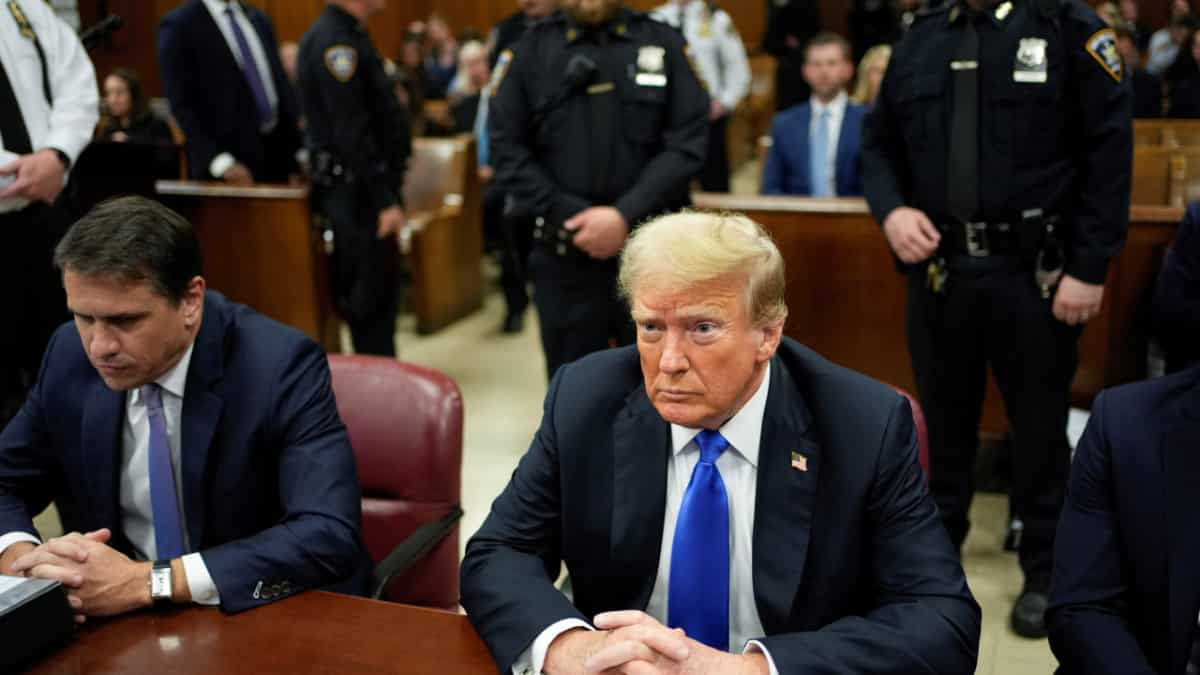
Former US President Donald Trump appears in Manhattan Criminal Court.
Seven months into his campaign to win the 2016 USelections, Republican candidate Donald Trump made headlines with a bold assertion: “I could stand in the middle of Fifth Avenue and shoot someone and I wouldn’t lose any voters. OK?”
That test of the blind allegiance of his followers did not happen. But it awakened memories eight years later, shortly after a jury in New York turned him into the first convicted criminal running for the presidency in the history of the United States. His supporters did not mind.
Hours after he was found guilty in what became known as the hush money trial, the Trump campaign reported such a flood of donations that its website crashed.
In the first 24 hours after the May 30 verdict in what became known as the hush money trial,donations topped $53 million, mostly in small contributions from individual Trump followers. Big donations were expected to follow from billionaires who posted messages of support for Trump.
How this reaction to a unique event in America’s 248-year history will affect the presidential elections in November is keeping analysts and pollsters busy. Predictions on the outcome of the contest between Trump and the incumbent Democratic president, Joe Biden, vary but there is consensus that Trump is unlikely to lose large numbers of voters.
National polls show the two geriatric candidates – Biden is 81, Trump will turn 78 this month – running neck andneck in popular votes. But in America’s antiquated electoral college system, victory does not go to the candidate with the most overall votes. Instead, victory goes to the candidate who wins most states.
In 2016, Trump won 304 electoral votes, 77 more than his Democratic opponent, Hillary Clinton. The most importantfor Trump’smargin of victory were three states, Michigan, Pennsylvania and Wisconsin where he won by 0.2, 0.7 and 0.8 percentage points, respectively.
In 2020, Biden won 306 electoral votes, Trump 232. Trump never accepted that result, claiming it was rigged, and launched a “Stop the Steal” campaign which led to more than 2,000 of his supporters storming the Capitol in Washington on January 6, 2021, to stop the ceremonial counting of the electoral votes.
It was the first attempt in American history to stop the peaceful transfer of power after an election.
After exhaustive investigations, a federal grand jury in Washington charged him with having orchestrated a broad conspiracy to keep him in power after his election defeat. It is the most serious, and most extensively documented of three criminal cases still pending against him.
For a slew of complicated reasons, none of these cases islikely to come to trial before the elections on November 5. Trump has dismissed them all as political witch hunts and has made clear he would squash the federal cases against him if he won re-elections.
But he would not have the power to annul the New York hush money conviction because it was decided in a state court. The label “convicted felon” will stick to him for the rest of his life.
Sentencing in the New York trial is scheduled for July 11 – the maximum punishment would be four years in jail – and scholarly legal arguments over the potential outcome have brought to light a little known aspect of American law.
Here goes: there is no legal or constitutional barrier for a convicted criminal to run for presidential elections, even from jail, or run the country from the highest office in the land. The hush money sentence is scheduled for four days before the Republican National Convention at which Trump is almost certain to be named the party’s presidential nominee.
A Reuters/Ipsospoll conducted shortly after the hush money verdict found that 56 per cent of registered Republicans said the case would have no effect on their vote. And 35 per cent said they were more likely to support Trump.
Judging from panel discussions, political analysts and the enthusiastic reception Trump gets when he holds rallies, Republican support for him is more solid than Democratic support for Joe Biden.
He has angered young voters and the progressive wing of his party with his unflinching support for Israel in its war on Gaza, where USmade bombs and shells have killed more than 30,000 Palestinians, most of them women and children.
This is part of the electorate – roughly, 244 million are eligible to vote – which may well stay away from the polls and what they see as the choice between evil and lesser evil.
For those who have not followed Trump’s legal troubles, a brief reminder what the New York case was about. A jury of 12 Manhattan residents – seven men and five women – deliberated on the prosecution’s allegations that Trump had falsified paper work to hide a $130,000 payment to buy the silence of porn actress Stormy Daniels.
Her tale of sex with Trump might have driven away voters and thus changed the outcome of the elections. Trump consistently denied the sex but the explicit details Daniels gave in testimony dispelled any doubts the jurors might have had.
(Disclaimer: The views of the writer do not represent the views of WION or ZMCL. Nor does WION or ZMCL endorse the views of the writer.)
