Israel-Hamas war: In Gaza, collective punishment is becoming routine

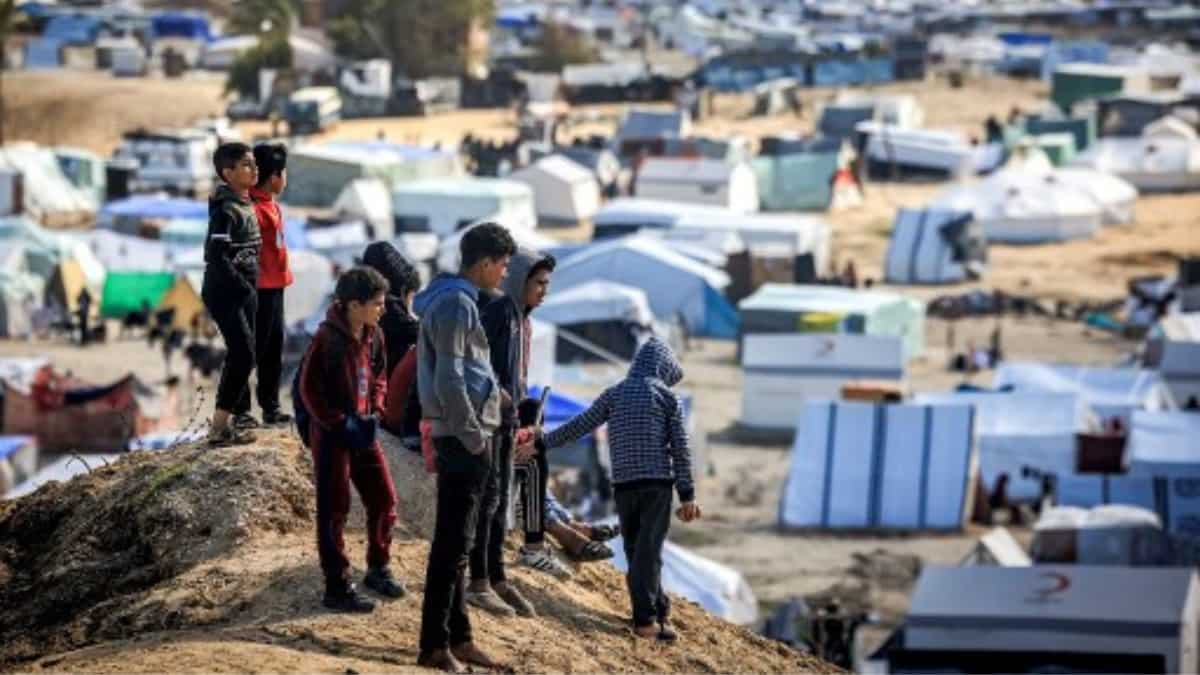
Children stand atop a small hill near tents at a makeshift shelter in Rafah in the southern Gaza Strip
Just hours after militants of Hamas stormed across the border between Israel and Gaza and massacred around 1,200 Israelis, Israeli warplanes began a bombing campaign that laid waste to entire cities and prompted charges of collective punishment.
That was on October 7, 2023. Sixteen weeks later, the Israeli government released an intelligence dossier that said 13 employees of the United Nations Relief and Works Agency (UNRWA), the largest humanitarian relief body in Gaza, had been involved in the attack. Two helped in kidnapping some of the 250 people abducted that day.
UNRWA chief Phillippe Lazzarini said that those accused of complicity had been fired while the UN’s Office of Internal Oversight launched an investigation. UN Secretary-General Antonio Guterres said anyone complicit in the October 7 massacre would be held accountable, including through criminal prosecution.
But even before the investigation was launched, a string of countries announced they were suspending millions of dollars in funding for the agency, which is the main provider of food and shelter for more than two million people in Gaza. Israel’s war against Hamas has driven Gaza into a humanitarian catastrophe. The cuts will make conditions even worse.
Among the first countries to announce the suspension of aid was the United States, UNRWA's biggest donor, followed by Britain, Germany, Switzerland, and Australia. In 2022, the USdonated $344 million, followed by Germany with $202 million.
Also watch |UNRWA crisis: After US, Germany & other European nations suspend funding | World News | WION
The crisis triggered by the Israeli allegations comes at a desperate time for Gaza, where more than 26,000 people have been killed, mostly women and children, and many of the 1,9 million who have been displaced are on the edge of starvation, according to the World Food Program.
According to Lazzarino, more than two million Gazans are almost entirely dependent on aid provided by UNRWA and more than a million are sheltering in UNfacilities.
The suspension of aid has dismayed aid agencies and – in an echo of the post-October 7 Israeli bombing campaign, prompted accusations of collective punishment. That was the phrase used by Egyptian Foreign Minister Sameh Shoukri and Russian Foreign Minister Sergei Lavrov.
Sharp criticism also came from Norway, which did not join the cavalcade of aid suspenders.
Norwegian Foreign Minister Espen Barth Eide said: “We should not collectively punish millions of people. We must distinguish between what individuals have done and what UNWRA stands for.” He urged donors to consider the consequences of funding cuts.
Jan Engeland, secretary of the general of the Norwegian Refugee Council condemned “an arbitrary and reckless defunding of a large lifeline on mere allegations from a party in the conflict.”
Israeli Prime Minister Benjamin Netanyahu, who has made no secret of his disdain for the UN in general and UNRWA in particular, said in a British television interview that UNRWA was infiltrated by Hamas.
Neither Netanyahu nor anyone in his cabinet has explained who would do the work of UNRWA if lack of funds forced it to cease operations.
But it is becoming increasingly obvious that there is no end in sight to the humanitarian crisis in Gaza. When Hamas started the war with its October 7 massacre, Netanyahu said Israel’s aim was to finish Hamas “once and for all.”
But both in Israel and the United States, military experts now estimate that Israel had managed to eliminate only between 20 and 30 per cent of Hamas’s fighters and still had no complete picture of the vast tunnel system the militant group built since Israel withdrew Jewish settlements there in 2005
American and Israeli officials estimate that Hamas had about 30,000 fighters when the war began, plus thousands of police and armed sympathisers. That means Israel’s “once and for all” will take time while the people of Gaza will remain victims of collective punishment.
(Disclaimer: The views of the writer do not represent the views of WION or ZMCL. Nor does WION or ZMCL endorse the views of the writer.)
