With Chandrayaan-3 entering Lunar orbit, all Indian Lunar crafts have circled the moon

Chandrayaan-3
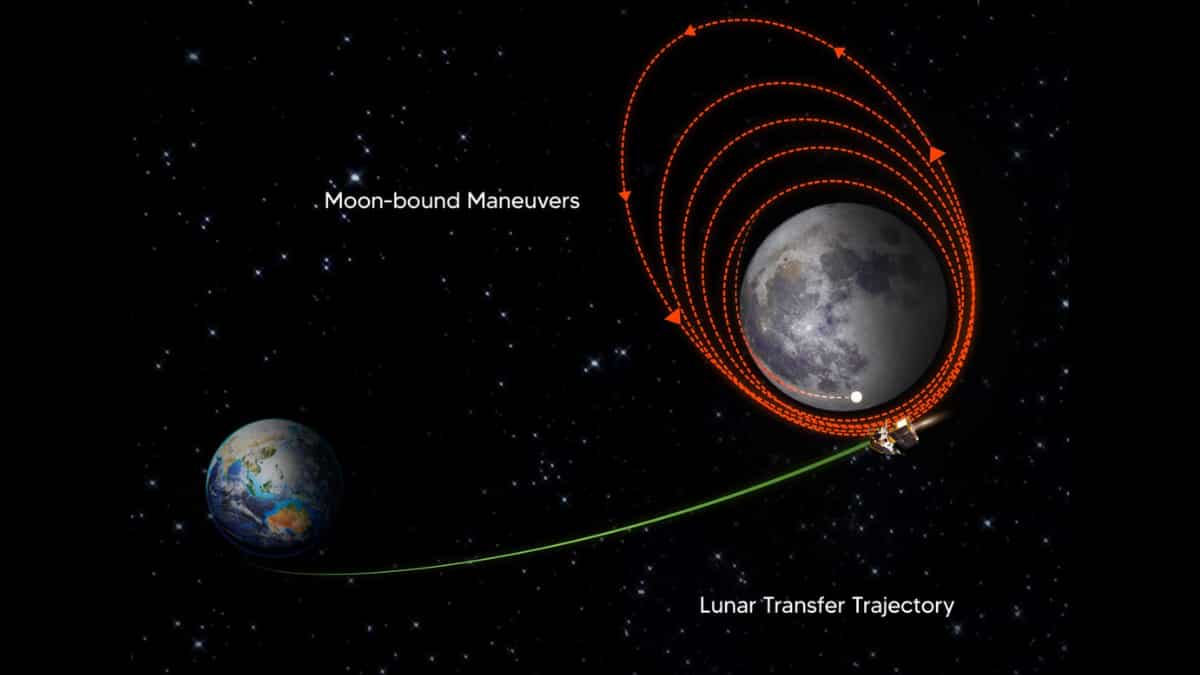
Having travelled a distance of nearly 3.84 lakh kilometres over a period of 20 days in space, India's third Lunar spacecraft Chandrayaan-3 has been captured by the Lunar gravity. At present, the craft is circling the moon in a highly-elliptical orbit. In a circular orbit, a spacecraft constantly remains at a certain distance from the body that it is orbiting. However, in a highly elliptical orbit, the craft circles the celestial body (moon, in this case) where its distance from the body varies drastically.
It is a significant milestone for the Indian space programme, that all Indian Lunar crafts Chandrayaan-1 (2008), Chandrayaan-2 (2019) and the ongoing Chandrayaan-3, have flawlessly entered into an orbit around the moon.
“MOX, ISTRAC, this is Chandrayaan-3. I am feeling lunar gravity,” ISRO said on X, formerly known as Twitter, indicating that Chandrayaan-3 is under the moon's gravitational influence. Chandrayaan-3 has been successfully inserted into the lunar orbit, the Indian space agency added. The craft has been captured by Lunar gravity after it performed what is known as a Lunar Orbit Insertion manoeuvre.
"During the Lunar orbit insertion, the craft will reach the vicinity of the moon and within the Lunar gravitational influence. Thereafter, it would fire its on-board engines to slow itself down and get captured into Lunar orbit. Then, it would begin to circle the moon in a highly-elliptical orbit," Dr. Mylswamy Annadurai explained to WION. Having contributed majorly towards India's maiden Lunar mission Chandrayaan-1 as its Project Director, Dr. Annadurai earned the moniker 'Moon Man of India'. He had retired from ISRO as the Director of UR Rao Satellite Centre.
The journey so far...
Chandrayaan-3 was launched on 14July from India's spaceport, Satish Dhawan Space Centre, Sriharikota. Sixteen minutes from the lift-off, the craft was placed in a highly elliptical orbit around the earth. Thereafter, by performing five engine burns, the craft raised its orbit on five occasions and slingshot itself further away from Earth, while continuing to remain in Earth's orbit.
In the intervening night of 31st July and 1st August, Chandrayaan-3 performed its Trans-Lunar injection burn. This was a long-duration firing of its engines and it pushed the craft out of Earth's gravitational pull and towards Lunar gravitational influence. "By firing its engines for the TLI, the craft gained departure velocity and set course from the earth orbit towards a location in the vicinity of the moon," Dr. Mylswamy Annadurai had told WION.
The journey ahead...
ISRO has said that the craft's next operation would be the maiden reduction of orbit around the moon. It is scheduled for August 6th 2023, around 23:00hrs IST, ISRO said. Just like ISRO slingshot the craft away from earth by performing multiple engine firings, the same process would be carried out for the reverse effect. Engine firings would be done to bring the craft closer to the lunar surface and eventually into a circular orbit around the moon.
"When the lander separates from the propulsion module, the craft will be in a 100x100kms circular orbit around the moon. The craft would be in that orbit for 4-5 days and we would use that period to test the crucial systems, sensors that would be used for the lunar landing (because, this is the first time we would be testing them in space)." M.Sankaran, Director of ISRO's UR Rao satellite Centre, had told WION.
Thereafter, the craft would be brought to 100x30kms orbit and then a process of Rough braking, Attitude hold, Fine braking, velocity reduction would be carried out, in the run-up to the lunar landing. ISRO has planned the Lunar landing at 5:47 pm Indian Standard Time, on 23rd August.
Objectives of Chandrayaan-3...
India's 3rd Lunar spacecraft comprises a propulsion module, lander and rover. The combined mass of them is 3.9 tonnes. The key goal of the craft is to perform a lunar soft-landing and perform in-situ analysis near 70 degrees latitude of the Lunar surface. The mission is expected to last 14 earth days or one lunar day, during which the six-wheeled rover and the lander will perform their respective experiments.
WATCH WION LIVE HERE
You can now write for wionews.com and be a part of the community. Share your stories and opinions with us here.
