Will keep Indian flag high, says Commanding Officer of Indian contingent of UN peacekeepers

UN Peacekeeping
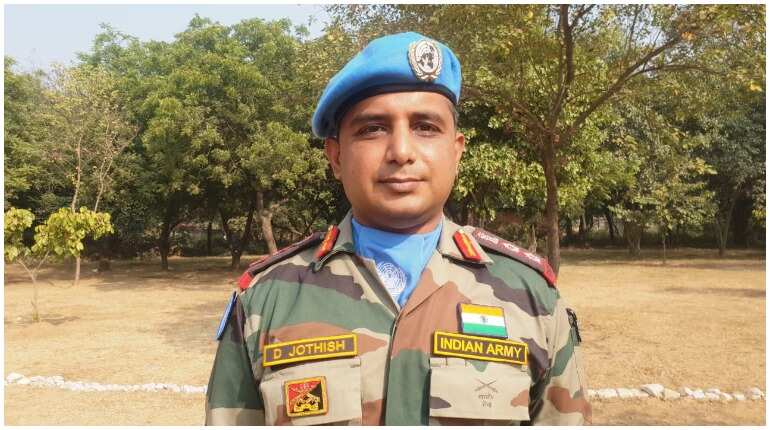
The commanding officer of the next Indian contingent to UN peacekeeping mission in South Sudan said that as peace ambassadors the contingent will keep Indian flag high. Speaking exclusively to WION's Diplomatic Correspondent Sidhant Sibal, Colonel D Jothish said, "We are the face of the nation and we understand that. We are under the UN flag but we never forget, we are peace ambassadors from our country.".
He highlighted the training that goes into serving under the UN mandate that focuses on the "humanitarian angle". He said that he had the task to ensure that UN ceasefire was in place. He also talked about how Covid-19 impacted the peacekeeping and about the new protocols in place.
WION: Why are Indian Army personnel most sought after for UN peacekeeping?
Col. D Jothish: When the Indian army gets deployed during a United Nations peacekeeping operation, we act as the face of the nation. That being said, the best of the battalions, for that matter nominated, for this mission, even for me, as commanding officer, I am proud that my battalion will be part of the contingent in UN mission in South Sudan. We start doing mission-specific, tactical training for them. We also make them understand, political, cultural, social issues of the nationals where they are going to be deployed. For this whole process commences with a core team of trainers getting trainers at a place called the center for UN peacekeeping. Once they get trained, they train the whole battalion. We carry personnel from all services, and they have integration training in Delhi. Keeping all these phases of training, the depth in which we go, the preparation which we do, for the UN Missions, keeping that in mind we have been doing a fabulous job. Our colleagues and friends have done extremely well in UN.
WION: What kind of training Indian army personnel go through before a UN peacekeeping mission?
Col. D Jothish: The humanitarian angle in it, and since its Indian Army, we always look at that angle wherever we are deployed. Indian army is always deployed in line of control, counter-terror grid, and places where national requirement is there. UN works under the UN Security Council mandate. So those mandates will have specific tasks. In the upcoming mandates, I have the task to ensure that UN ceasefire is in place. Once we go over there, we are neutral in nature, peace ambassadors. Unlike the operations that we do, which is defensive and offensive in nature in our own country, over there, we are peace ambassadors and peacekeeping. They are completely different, different tactics, and groundwork differs. We have concepts called the graduated ground matrix. The way we are going to respond to any situation varies as per the united nations. These things carry importance and that is why we carry on training.
WION: Indian army personnel representing India under UN flag. How does it feel?
Col. D Jothish: We are the face of the nation and we understand that. Our conduct dictates in any foreign country. We are under the UN flag but we never forget, we are peace ambassadors from our country. We always like to keep our Indian flag high. The dedication for our job, The way the Indian army is contributing to national buildup. Now we will get the opportunity to put the Indian flag high in an international environment. Moreover, the Indian army is the most professional army in the world. We would always like to conduct, and project in a foreign nation similarly. Wherever Indian army personnel has been deployed as on date, they all have been professionally very sound, and which has shown results, that people have known and people have accepted the fact that these guys mean business and they are very clear about whatever they going to do. Neutral way of approach of our troops, the main factor of achievement in the United Nations.
WION: How has COVID-19 has impacted UN Peacekeeping?
Col. D Jothish: Firstly when the COVID-19 lockdowns started internationally, there was a delay in the deployment of UN Peacekeepers. The world started learning, we also learned about various precautions to be taken as a COVID protocol. We started maintaining social distancing. However, the main effort goes into the fact that we don't want COVID to spread from our nation to any foreign nations. For that multiple COVID tests are carried out on our troops, and once they come negative, only then troops are sent to any foreign nation. In addition, we follow quarantine. All the troops, who are likely to get deployed under the UN, undergo very strict quarantine measures at a separate location, and they are deployed.