The imprisoned Lord: First-person account from Ayodhya

Ram-temple-Ayodhya
WION travelled to Ayodhya on December 6, 2017 - the 25th anniversary of the Babri mosque demolition - and visited the makeshift Ram Temple that now exists on the disputed site. With cameras barred, WION brings to you this first person account from Ground Zero.
WION travelled to Ayodhya on December 6, 2017 - the 25th anniversary of the Babri mosque demolition - and visited the makeshift Ram Temple that now exists on the disputed site. With cameras barred, WION brings to you this first person account from Ground Zero.
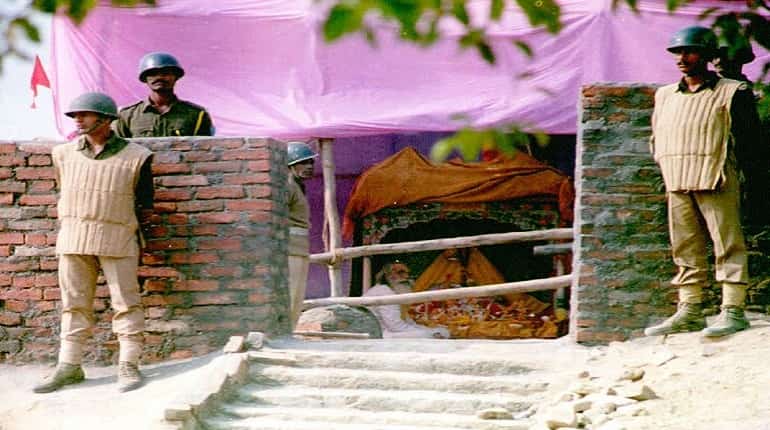
There he was, wrapped in bright and shiny clothes, adorned with jewellery, sitting pretty inside the fireproof tarpaulin tent which has been his home for the past 25 years now. There he was, the prince of Ayodhya, the darling of devotess, the man known as the “maryada purushottama”. There he was, a God who now, almost helplessly, lies imprisoned in a makeshift temple in his own birthplace.
Imprisoned. That's the word that stayed with me from the moment I passed through the first frisking point, walked through a narrow, serpentine passageway protected by walls and a roof made of wire mesh (made so narrow on purpose so that it can only accommodate a single queue of visitors), encountering two more frisking points on the way, to the point when I finally could get a glimpse of Ram Lalla, or Baby Ram.
The sight of gun-wielding personnel from India's Central Reserve Police Force (CRPF) just outside the tent housing Baby Ram's idol inside that tent was surreal, to put it mildly. As if the God himself was under threat and required protection.
Reaching him is not easy. The first security barricade is almost a kilometer away from the 2.7 acre site where Ram Lalla or Baby Ram now resides. Policemen from Uttar Pradesh's Provincial Armed Constabulary manning this barricade are not too finicky. All they are interested is in ensuring that no four-wheeler passes through this barricade. The second barricade comes after 500 meters and is located just next to the palace of Dashrath - Lord Ram's father. Located at what is called Bada Sthan (Big Place) this barricade is just 500 hundred meters away from the first frisking point.
 The palace of Lord Ram's father, King Dashrath in Ayodhya (WION)
Devotees and visitors to the makeshift temple are not allowed to wear belts, carry any electronic gadgets or even a pen beyond the first frisking point. A wallet, some cash and “prasad” is all that is allowed in, that too, after three stages of frisking. The moment the policemen find out that you are from the media, the checking becomes even more stringent with security personnel even insisting on shoes being removed for checking. The ban on photography and videography is painted on walls at regular intervals.
“Please beware of the monkeys inside. They may snatch your prasad,” warn many policemen standing guard inside the disputed compound. The sight of policemen carrying colorful slingshots appears amusing to begin with but it takes only a few moments to realize that those slingshots are probably their only protection against the constant assaults from an army of monkeys which roams in and around Ground Zero.
After clearing the second frisking, the walk through the narrow wire mesh passageway, with monkeys dangling on the outside of the enclosed passageway, feels like one long walk inside a never-ending cage. Probably nowhere in the world would one have to negotiate such a fortress-like security and heavy presence of armed forces to go visit a deity.
On any given day, the security personnel don't allow people in the cramped queue inside that narrow wire-meshed passageway to halt for more than 7-8 seconds at the spot from where the Ram idol is seen. The fact that I visited the makeshift Ram Temple in Ayodhya on December 6, 2017 - which marked the 25th anniversary of the events of 1992 - probably was a stroke of luck. With just a couple of hours to go for the temple to close for the day, I not just escaped those long queues which are a daily feature here but also managed to stand before the Ram Lalla idol for a good five minutes before finally making my way out.
The priest sitting on the other side of the wire-mesh was a good-humoured man. He told me that if I could just take a step to my left and look diagonally inside the tent, I'll be able to see an idol of Lord Hanuman as well. He was right and seemed pleased when I told him that I could actually see the Hanuman idol. I asked him if he was the only priest on duty there to which he replied that there are four priests who serve the temple in shifts.
Watching me stand before the temple for almost five minutes, a CRPF personnel finally asked me move, his discomfort at my long halt there almost palpable. A sizeable number of the CRPF personnel guarding the innermost security ring around the makeshift temple comprises of women. Having witnessed an attempt by six heavily armed terrorists to storm the makeshift temple in 2005, the security forces clearly are taking no chances and want adequate women personnel to keep a watch on female visitors to the shrine.
As I made my way out, trying to soak in what I had just experienced, a plethora of thoughts and questions started flooding my mind.
Would a God need protection? Would a God approve of what happened in 1992? Would any God want people to fight people believing in a different God? Would a God want his devotees to be frisked at multiple locations before they can reach his temple? Would a God want to be a party to a land dispute? Would a God even care about a temple or a mosque for that matter?
Watch WION's special segment
This segment brings to you news on 25th anniversary of Babri Mosque demolition. Watch this clip to know more. (WION)