Opinion: Mud and bamboo houses are not signs of poverty

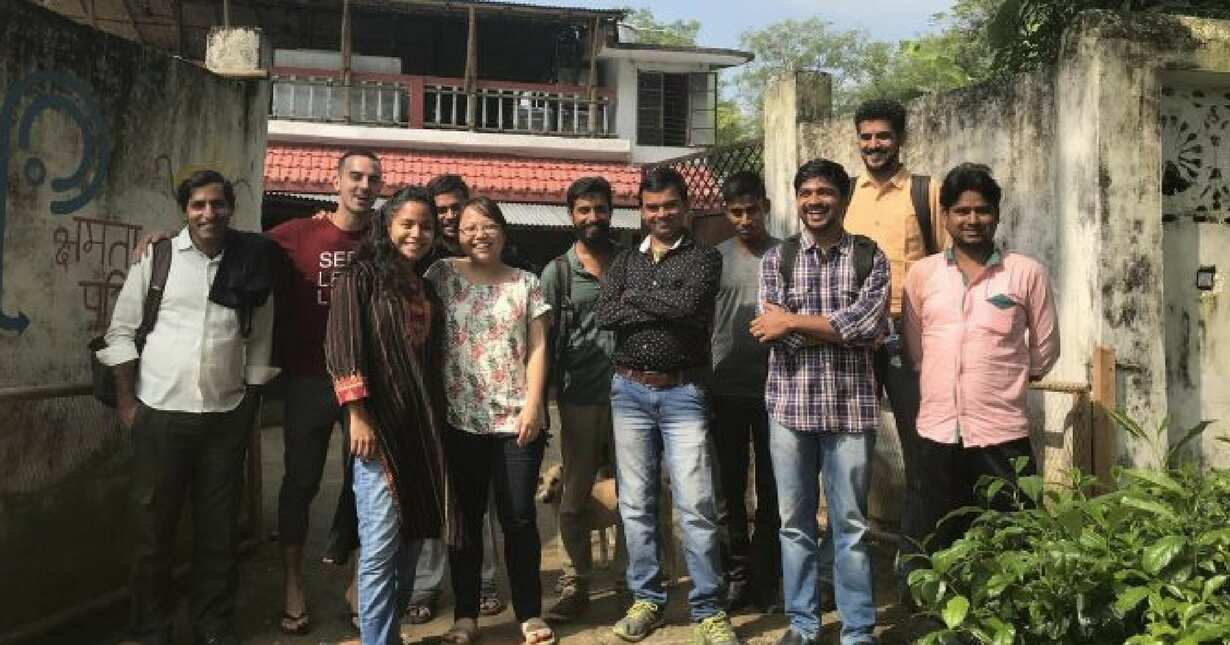
Project Potential Staff Members and Architects
It is indeed possible to build a structure ? a home ? with sustainable materials designed to meet not only contemporary needs but more specifically withstand earthquakes, flooding and other disasters.
I like sleeping outside, right underneath the bamboo rooftop on the balcony, falling asleep to Bihar’s heavy rain and the wind rustling the coconut trees nearby. My eyes get heavy to the unpredictable rhythmic of the rain hitting our gravel dirt road. Without any walls, the sunrise busts in at 5:03 in the morning, making a scene, warming my cold nose, blinding me awake, telling me it’s time to wake up. It is the most relaxing and beautiful sight I’ve ever woken up to. I still wiggle out of my sleeping bag, step off my cot and lean over the balcony to soak in its red-orange warmth before sneaking back for a couple more hours of sleep.
When I first arrived at eArthshala, Project Potential’s campus, and I climbed the stairs to what is now my favourite spot, the bamboo rooftop balcony, I was hesitant because I imagined rain soaking through. I even tried to look for signs of water on the ground to prove my point but couldn’t find any. I brushed it off, perhaps it hadn’t rained for a few days? Eventually, I asked someone, wouldn’t the rain slip through and soak whoever is up here? The answer was no, but I’m not sure I actually believed them. I’ve come to realise that bamboo is versatile. You can eat it, you can wear it and you can build a home with it, not to mention countless other things. And yet, I believed it to be both fragile and archaic.
I had to wonder – did the problem exist with natural materials such as bamboo and even mud, or was it merely a problem of the modern mind? The common misconception of bamboo or mud – natural materials used for construction – is that they are not as strong as cement and steel. However, these traditional structures are what we should rely on, as we face issues that human beings have yet to experience to this magnitude: A rapidly deteriorating planet, overpopulation, countless environmental issues, natural disasters and globally destructive wars.
As I marvel at the beauty of Project Potential’s bamboo roof, I have to wonder: How can we begin to build on today’s issues without damaging our environment further? How will we mass produce construction materials for places such as Aleppo, Syria, that desperately need them? How can we build sturdy homes with locally-sourced materials that can also withstand cyclones and earthquakes? How we decide to build for those that can not afford ‘modern materials,’ or what materials we decide to use will nonetheless have an impact on our Earth.
In some ‘developing’ countries like India and some ‘developed’ countries like the United States, children and adults are conditioned to believe that mud houses are temporary, while brick and cement are permanent in nature; this is a fundamentally flawed argument, as natural materials like mud and lime plaster, when used appropriately, only strengthen over time (as demonstrated by mud structures built centuries ago and still standing). Withstanding time seems reasonable but structures made from earthen materials can also be used to rebuild for the next earthquake. In the face of natural disasters, these organic materials can still hold up. I myself was doubtful, thinking about the natural disasters that plagued our world in 2017, from heavy flooding in Bangladesh and Nepal to earthquakes in Mexico. It is indeed possible to build a structure – a home – with sustainable materials designed to meet not only contemporary needs but more specifically withstand earthquakes, flooding and other disasters.
 Example of a bamboo house in a nearby village. (Others)
However, it is important to point out that these organic homes aren’t the only ones to withstand natural disasters. Thanks to modern technology, we have created shock absorbers and techniques that can save thousands of lives in a city, and allow skyscrapers to shake but still survive. Although this technology exists, it is quite costly and largely inaccessible and arguably an unnecessary development in some areas, not to mention irrelevant in certain parts of the world. Why not get back to the basics?
I am not advocating that we all tear down our buildings and move into earthen houses; mud and bamboo will not be the answer for everything and everywhere. However, I ask that we open our minds and view these materials as an intentional choice, instead of as poverty. That perhaps ideas of development and the right to development be open to debate so that locations that were robbed of resources, can view all their options with untainted societal pressures. Let’s instead tear down stereotypes and build a humanity of intentionality. Let’s stop teaching our children that mud houses are ‘kachcha’ (wrong) and cement houses are ‘pakka’ (right)because it will only harm us in the name of progress.
 Architects visiting Project Potential’s site and local houses to view how locals use bamboo, and how to assist us in thinking about our construction goals. (Others)
Building our homes with intentionality, be it from organic material, or traditional processes, to the values we hope to encourage visitors to think about, is what Project Potential is doing right here in rural Bihar, close to the borders of Nepal and West Bengal. In March 2016, Project Potential sought to create an alternative learning environment for local youth so that they can explore new notions of self, community, and environment that would ultimately lead to meaningful employment.
It was with this goal in mind that we purchased a 15-acre campus through which we hoped youth will be exposed to skills required to make a sustainable living. We aim to frame eco-toilets, bamboo, mud construction and solar panels in a new way. We hope that these will create an 18- degree transformation through which youth will define their own values and interests (not by societal standards), and accordingly learn skills that they can use to sustain themselves, their communities, and the environment.
We see our campus — e???????? (eArthshala) from English earth and Hindi arth, which means both ‘economy’ and ‘meaning’ — as a gathering space for such learning. e???????? is meant to serve as a kind of ‘ashram’ for our programs. In other words, through its design, practices and culture, the campus will be a space which inspires us toward better versions of ourselves and a better future, even if the core focus for the gathering is educational.
We strive to have positive effects on the local economy and be a catalyst for local development through everything we do, including construction. Together, our youth and campus would contribute to the image building of Bihar, and in turn, they could leverage the positive change in perception. Thus, our honest intent to bring in this transformation must be reflected in our spaces and design language.
Project Potential isn’t just trying to tackle the youth unemployment crisis in Bihar; it also wants to understand how our organisation’s presence makes a difference. From analysing the way in which we decide to engage youth, to the language we use to engage the community, to how we place ourselves within the community.
Ultimately, we desire to utilise the community’s economy and natural materials that will protect the community and empower the people to create sustainable living. Bamboo can offer us shelter, food, clothing, a good fire, clean air; let us view it in the light, instead of poverty. Everything we need is right here.
This article was originally published on29/ 11/ 2017 on American India Foundation
(Disclaimer: The author writes here in a personal capacity).