Opinion: Mandal vs Kamandal version 2.0 likely in 2019 polls

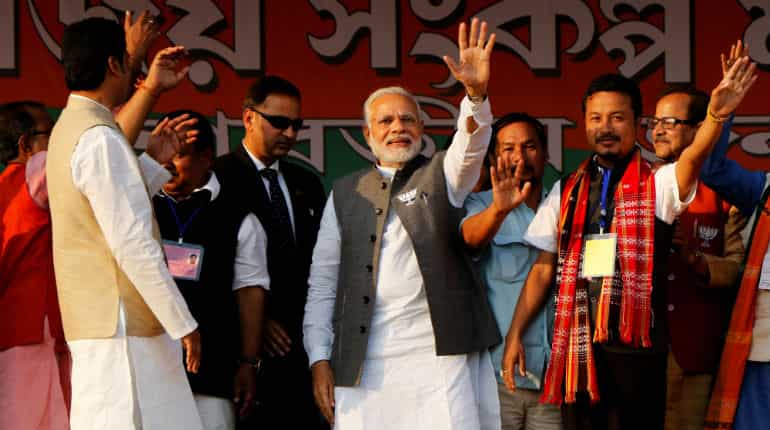
Narendra-Modi-Tripura-Reuters
2019 Lok Sabha elections is less likely to be fought on economic promise or earned laurels but on the issue of social justice on caste lines.
2019 Lok Sabha elections is less likely to be fought on economic promise or earned laurels but on the issue of social justice on caste lines. This pattern was broken during 2014 Lok Sabha elections. The prominent theme was Sabka Saath Sabka Vikas (collective efforts, inclusive growth) and PM Modi's viral slogan Na Khaunga Na Khane Dunga (will not engage in corruption myself, nor allow others). It also witnessed split in Dalit vote in North India leading to BJP sweeping all the reserved seats in Uttar Pradesh.
This trend continued well into the Uttar Pradesh assembly elections leading to a tsunami in BJP's favour. Despite such good showing, the backward caste realignment has found a firm footing in the opposition's politics. There is one main factor for its re-emergence.
First and foremost reason is the internal contradiction within Hinduism. At the level of practice, the limit of tolerance fails both socially and culturally at the door of a Dalit family. This contradiction was surmounted only because of Narendra Modi's massive appeal in 2014 but subsequent cultural positions of upper caste and sanskritised OBC reopened the schism.
Upper caste and OBC led political Hindutva met its match with backward caste mobilisation in Bihar. Though the point in case is that in absence of gathbandhan (tie-up) between OBC and backward castes, BJP swept UP and did exceptionally well in reserved constituencies as well.
It is this realisation that Congress in past two years has altered it politics from Congress Ka Haath Aam Aadmi Ki Saath (Congress' hand is with the common man) to strong backward caste, Dalit oriented politics. It peppers its Dalit campaign with strong Hindu symbols to counter the 'foreign' character of Rahul Gandhi's leadership. The regional parties too have come together out of an existential crisis.
Apart from minorities, Dalits too were at the receiving end of the cow protection campaign. It created schism within the concept of the larger Hindu family. Multiple cases across North India were reported where Dalits became target of the lynch mobs because there work involved cattle skinning and trading which stood opposed to the upper caste and OBC led moral eco-system of the new Hindutva brigade.
Lastly, it is the only issue the BJP government has been politically defensive about. Whether it was Rohit Vemula controversy, or violence against Dalit community in Gujarat or anti-reservation agitation - it reinforces old identity politics which BJP has been trying to subsume under the rubric of cultural nationalism. The attempt of BJP has been to consume caste identities under one monolithic identity of a Hindu but inadvertently, old identities persist as caste remains integral to practiced Hinduism which manifests itself in forms of marriage, death, rituals and feasting. It for this reason that BJP has paid special focus on contribution of BR Ambedkar and common dining with Dalit communities. But original ideology has its limitation. It is for this reason that post-Tripura victory saw desecration of statues of Ambedkar.
The same consolidation seem to be working in Karnataka which has not allowed BJP campaign to take off.
Uttar Pradesh was an example in case where undivided Hindu vote created a BJP tsunami. Phoolpur and Gorakhpur results on the other hand show that backward caste alignment amongst OBCs and Dalits have the potential to create a counter narrative. What is debatable is as to which identity politics is better - India divided on backward-forward politics, or between one majority and various minorities? The whole idea is debatable but what it does is that it takes Indian politics back to Mandal vs Kamandal polarisation.
The only difference is that it took couple of years for BSP and SP to sink differences to defeat BJP. The political compulsion and strength of BJP was the reason behind it. The result is there for everyone to see. Only thing is whether history will repeat itself. Such political configuration have defeated Congress and BJP in past but none could complete a term which includes alliance between then Mulayam Singh Yadav and Mayawati. So, whoever wins Lok Sabha elections on 2019, old identity politics is back in the game.
(Disclaimer: The opinions expressed above are the personal views of the authors and do not reflect the views of ZMCL)