Opinion: Khalistan is history, Amarinder Singh should state to Trudeau

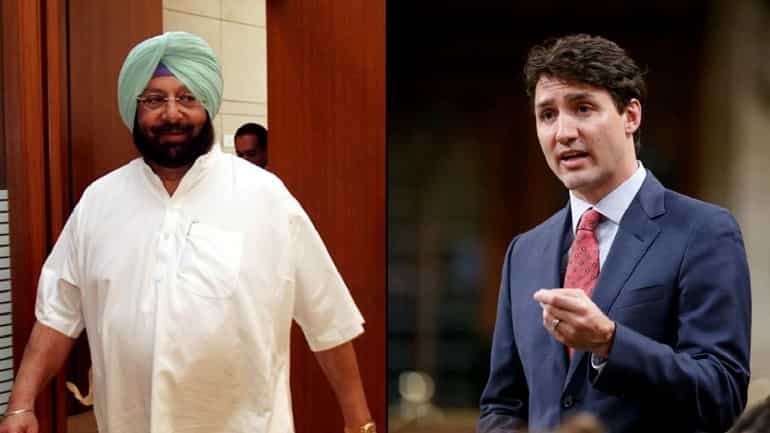
Amid fears, Khalistan issue, Punjab CM, Canadian PM Trudeau
It is evident Khalistanis have taken advantage of Canadian official multiculturalism to cultivate an identity, but in Indian eyes, it is nothing but collective attempts at reviving separatism.
By Saumyajit Ray*
The recent visit of Canadian Prime Minister Justin Trudeau to India comes right on the heels of the decision by major Canadian gurudwaras (the Sikh place of worship) banning the entry of Indian diplomats in their official capacity. In April last year, during the India visit of Canada’s Defense Minister, Harjit Sajjan, Punjab Chief Minister Capt. Amarinder Singh accused Canadian Sikhs (including Sajjan) of being Khalistan sympathizers. This is over and above the hobnobbing that politicians of all hues in Canada indulge in with Sikh separatists in that country and the periodic yet regular glorification of dead Sikh extremist leaders during public functions in Canadian gurudwaras.
Though Prime Minister Trudeau is slated to meet the Punjab Chief Minister Amarinder Singh today. The no-nonsense Capt. Amarinder Singh, a scion of the Patiala royal family with impeccable nationalist credentials, has sent a strong message - Sikh leaders in India are unwilling to take their community back to a tragic and violent past that transformed the once-prosperous state into a vast killing field, snuffing out thousands of lives, and driving a wedge between Hindus and Sikhs for more than a decade.
If Canadian leaders do not wish to accept this truth and are bent upon flogging a dead horse, then relations between the two countries are bound to sour despite decades of strong business and cultural ties. The India of 2018 is not the India of 1985.
But is the Khalistan movement in Canada really a dead horse? Going by the glorification of dead Khalistan activists, it is not. Going by the plethora of Canada-based websites espousing Khalistan, it is not. And, going by the funds raised by Khalistan sympathizers for the election efforts of Canadian politicians cutting across party lines, it is not. But then under no stretch of imagination can such concerted Sikh activity in Canada be termed a “movement”.
The Khalistan cause does not have a widespread following in Canada, not even in areas with high Sikh populations like that of British Columbia, where Sikhs are nearly 5% as against the national percentage 1.4%. Nor do all gurudwaras in Canada give credence to pro-Khalistan sentiments. Many of them do not subscribe to the ban on the entry of Indian diplomatic officials in their official capacity in their precincts).
At the height of the Khalistan movement in the mid-1980s, led by Sant Jarnail Singh Bhindranwale from India and Jagjit Singh Chauhan in Britain (both long dead), Canada was indeed a hotbed of Sikh separatism and consequent anti-Indian activity. There is no doubt that the federal government of Canada and the various provincial governments had allowed Canadian soil to be used for activities directed at weakening and undermining the sovereignty, unity, and integrity of India. This may have been an unintended consequence of Canada’s official policy of multiculturalism, but it created mayhem in India, another multicultural and officially faith-neutral country.
Canadian Sikhs had pumped millions of dollars into the murderously violent Khalistan insurgency in Punjab and the rest of north India, before and after the tragic and ill-conceived Operation Bluestar. That had razed the Akal Takht, the highest seat of Sikh temporal and spiritual authority, and damaged the Harmandir Sahib (Golden Temple), the holiest of Sikh shrines. Though the government of India, under the then Prime Minister Indira Gandhi, succeeded in liberating the Golden Temple premises from the clutches of Sikh militants. It had scarred the Sikh collective psyche forever, expanding and deepening the alienation that the Sikh community everywhere (including expatriate Sikhs in Canada) suffered from. Less than six months after that notorious military action in Amritsar, Indira Gandhi herself paid with her life when she was gunned won by her own Sikh bodyguards at her official residence in New Delhi. It took more than a decade after that to get things back to normal in the beleaguered state of Punjab.
But for many Sikhs in Canada, the Khalistan cause was not a lost one. Even though the stories of woe and injustice in Punjab had stopped trickling into Canadian Sikh congregations, the dream of an independent Sikh state—expressed best in the slogan Raj karega Khalsa (the Khalsa shall rule)—lived on among Sikhs in Canada and the United States. Sikhs were and continue to be major sources of voter support and election funds for both liberals and conservatives in the two countries. And party leaders there, especially in Canada, have not been averse to support Khalistan from official platforms. Quite a large number of Sikhs have entered Canadian politics and hold official positions, and it is at them that Capt. Amarinder Singh had raised his finger, accusing them of keeping alive the Khalistan issue.
It is too early to predict whether discontent with India and the unfulfilled dream of a Sikh state among Canadian Sikhs have the potential of reviving the Khalistan “movement”. But there is no doubt that they have carved out for themselves a distinct identity—quite separate from the greater Indian immigrant identity—in that country.
It is evident that they have taken the advantage of Canadian official multiculturalism to cultivate such an identity, but in Indian eyes, it is nothing but collective attempts at reviving separatism. In India, though Sikhism remains as strong and vibrant as ever, Khalistan is history. Punjab and the rest of India look forward to the likes of Captain Amarinder Singh to cremate it for all times to come.
*Saumyajit Ray teaches atCentre for Canadian, US and Latin American Studies, School of International Studies, JNU.
(Disclaimer: The opinions expressed above are the personal views of the author and do not reflect the views of ZMCL)